

Tennis necklace: A Buyer's Guide
A CZ tennis necklace gives you the unbroken, light-catching line of a classic diamond tennis necklace at a fraction of the cost — buy on stone quality, setting security, and an honest base metal, not on a "looks like diamonds" promise. This guide is for the shopper who wants that elegant ribbon of sparkle for everyday wear without four-figure spend or fragile upkeep. The one trade-off that actually decides it: a real-diamond piece is a heirloom investment, while a cubic-zirconia version is jewelry you can wear daily and not worry about. Below we cover what makes a tennis necklace a tennis necklace, how to judge CZ quality, the lengths that work, the honest base-metal question, and the care a plated piece needs.
Key takeaways
- A tennis necklace is defined by its continuous, unbroken line of individually set stones — no pendant, no gaps. CZ delivers that look honestly; it is not a diamond and we never pretend it is.
- The criterion that matters most is setting security plus stone cut. Well-cut AAA cubic zirconia (Mohs ~8.5) throws bright rainbow fire; a loose stone in a flimsy setting is the real failure point.
- The honest caveat: most CZ tennis pieces — including ours — are 18k gold-plated brass, not solid gold and not 316L stainless. The plating is a surface layer that resists tarnish for years with care, not forever.
- Quick pick for the most common case: a 16–18 inch, 2mm, gold-tone CZ tennis necklace sits at the collarbone, layers easily, and reads "everyday luxe."
What makes it a tennis necklace — and how to choose a good one
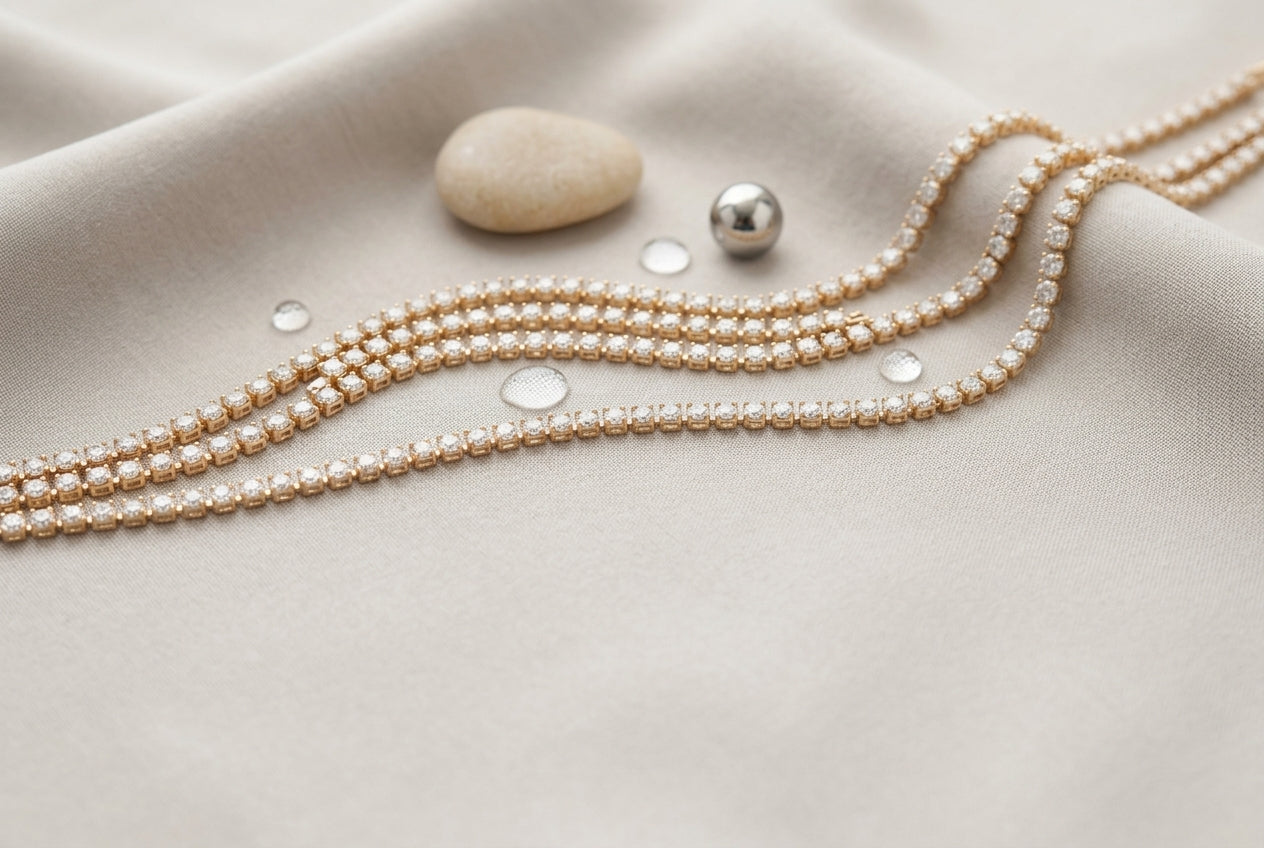
A tennis necklace (also called a riviera or line necklace) is built from small, closely set stones, each in its own setting, connected link by link in one continuous line around the neck — no pendant, no focal point, no gaps. That unbroken ribbon is what catches light from every angle and lies flat against the skin. When you shop a cubic-zirconia version, judge it on these:
- Stone cut and grade. Cubic zirconia is graded loosely (often "AAA" for the brightest, well-faceted material). A clean, precise cut is what produces the sparkle — look for crisp facets and consistent stone size down the line, not cloudiness.
- Setting security. Each stone should sit snug. The most common complaint with any line necklace is a stone working loose, so secure prong or channel settings matter more than carat-look bravado.
- Width. Stone size is usually given in millimeters. A 2mm line is delicate and everyday-friendly; wider lines read as more of a statement and cost more.
- Base metal — read it honestly. The chain and settings can be solid gold, gold-plated brass, gold-plated 316L stainless, or sterling silver. This drives both price and care, so it's the single spec to confirm before you buy (more below).
- Length. Tennis necklaces are usually worn at 16–18 inches (collarbone / princess length); 14 and 20 inches exist for closer or longer drapes.
CZ vs. diamond vs. moissanite — what you're actually buying
The point of a tennis necklace is the line of light, and different stones get there at very different prices. Here's how cubic zirconia stacks up against the alternatives on verified, plain-fact terms.
| Stone | Best for | Key facts (verified) | Typical line-necklace price |
|---|---|---|---|
| Cubic zirconia (CZ) | Everyday luxe look, layering, gifting on a budget | Mohs ~8.5; very high dispersion (0.058–0.066) gives bright rainbow "fire"; a lab-made diamond simulant — not a diamond | ~$40–$120 (plated) |
| Moissanite | A more diamond-like sparkle that's still lab-grown | Mohs ~9.25; even more dispersion than diamond; a separate gemstone, not a diamond | Hundreds and up |
| Natural / lab diamond | An heirloom investment piece | Mohs 10 (hardest); dispersion 0.044; refractive index 2.42 — the classic white brilliance | Four figures and up |
The takeaway: if you want a continuous line of sparkle you can wear daily without insuring it, CZ wins. If you want a permanent, investment-grade piece, that's a diamond conversation — and a very different budget. We sell the honest-sparkle version and label it as such.
Best for X — matching the necklace to the buyer
Different shoppers want different things from a line necklace. Quick guidance:
- Best for everyday wear: a 16–18 inch, 2mm gold-tone CZ line. It layers under and over other chains and sits right at the collarbone.
- Best for a gift: CZ delivers the maximum visual impact per dollar, so it's the smart gift if you want a "wow" look without a heirloom price tag — just be honest with the recipient that it's a plated piece.
- Best for sensitive skin: choose a piece on a 316L stainless steel base rather than plated brass. 316L is prized for very low nickel release, which is what actually matters for reactions. (Our Anne necklace below is plated brass — a beautiful look, but not the pick if you specifically need a hypoallergenic base.)
- Best for layering: a thinner 2mm line pairs cleanly with a longer choker or chain; mix lengths rather than widths.

Anne Tennis Necklace
A 2mm tennis necklace that goes great on its own or layered with a longer choker and necklaces.
Shop this necklace →For honesty: the Anne is set with AAA white cubic zirconia on an 18k gold-plated brass base — a gold-tone everyday piece, not solid gold and not stainless.
Honest caveats — the questions a smart buyer asks
- Is CZ a diamond? No. Cubic zirconia is a lab-created diamond simulant. It is genuinely hard (Mohs ~8.5) and actually throws more rainbow fire than a diamond because its dispersion is higher — but it is softer than diamond (Mohs 10) and is its own stone. We call it CZ, never "diamond."
- Is the metal real gold? Most CZ tennis necklaces, including ours, are 18k gold-plated brass, not solid gold. Under FTC rules a piece can be called "gold plated" only if the plating is at least 10k fineness and at least 0.175 microns thick. Plating is a surface layer: it resists tarnish for years with care, but it's not permanent the way solid gold is. If you want a hypoallergenic base, look for 316L stainless instead — brass can react with some skin.
- Will it turn my skin green? That green is copper reacting with skin and moisture. A well-plated piece kept dry and clean shouldn't, but a plated-brass core means you should treat it more gently than solid metal — see care below.
- Will it arrive looking like the photo? Check the stated width and length. A 2mm line is delicate and dainty by design — it's not a chunky statement chain, and we'd rather you know that than feel catfished on scale.
- Any hidden costs? No. Our prices are one-time — no subscription, no auto-enrollment, no membership to keep the price.
Caring for a plated CZ tennis necklace
To keep a plated piece looking its best: put it on last (after lotion, perfume, and hairspray), take it off before swimming pools, showers, and the gym, and store it dry — away from humidity. Wipe it gently with a soft cloth after wear. The plating is what's protecting the brass, so the gentler you are with it, the longer the gold tone lasts.
Want options across the line? Browse the full stainless steel necklace collection to compare widths, lengths, and finishes.
Frequently asked questions
What is a CZ tennis necklace?
It's a necklace built from a continuous, unbroken line of small, individually set cubic-zirconia stones — no pendant and no gaps — that lies flat and catches light from every angle. Cubic zirconia is a lab-made diamond simulant, so it delivers the classic tennis-necklace sparkle at a fraction of a diamond's cost.
Is cubic zirconia the same as a diamond?
No. Cubic zirconia is a separate, lab-created stone used as a diamond simulant. It's hard (about 8.5 on the Mohs scale) and actually has more rainbow dispersion than a diamond, but a diamond is harder (Mohs 10) and is a natural or lab-grown gem. We always label our stones as CZ, never as diamonds.
What length should a tennis necklace be?
Most tennis necklaces are worn at 16 to 18 inches, which sits at or just below the collarbone (also called princess length) and flatters most necklines. Shorter 14-inch and longer 20-inch options exist if you want a closer or more dramatic drape.
Is a gold-plated CZ tennis necklace real gold?
It is real gold on the surface, not solid gold throughout. Pieces like our Anne necklace are 18k gold-plated over a brass base. Under FTC guidelines, "gold plated" means the plating is at least 10-karat fineness and at least 0.175 microns thick. The plating resists tarnish for years with care, but it is a surface layer, not permanent like solid gold.
Will a CZ tennis necklace tarnish or turn my skin green?
A well-plated piece kept dry and clean resists tarnish for a long time. Green marks come from copper in brass reacting with skin and moisture, so keep a plated-brass piece dry, put it on after lotion and perfume, and store it away from humidity. If you need a base that's gentler on sensitive skin, choose a 316L stainless steel piece, which has very low nickel release.
The buying rule stays simple: a CZ tennis necklace earns its place when the stones are well cut, the settings are secure, the length suits your neckline, and the brand is honest that the metal is plated. See also our guides on chunky chain necklaces and dainty gold necklaces.

Leave a comment
This site is protected by hCaptcha and the hCaptcha Privacy Policy and Terms of Service apply.