

Men's Stainless Steel Crucifix Necklace: Buyer's Guide
A men's stainless steel crucifix necklace is a cross necklace that carries the corpus — the figure of Christ on the cross — built on a 316L stainless steel base so it survives daily wear, sweat, and water without rusting or turning your skin green. The word that decides the whole purchase is "crucifix": unlike a plain cross, a crucifix has raised, detailed relief, which changes how you should think about size, finish, and plating. This guide explains the crucifix-versus-cross difference clearly, what to look for in the metal, and where a gold-plated stainless steel piece fits — with an honest word on what Meideya's own range does and doesn't include.
Key takeaways
- A crucifix is a cross with the corpus — the figure of Christ — while a plain cross is bare. The two are searched interchangeably, but the corpus is the detail that distinguishes them and the reason a crucifix usually reads bolder.
- 316L stainless steel is the durability winner for a piece worn every day. Its chromium-and-molybdenum alloy resists the sweat, chlorine, and saltwater corrosion that ruins plated brass — so it won't rust or tarnish.
- Detail and size matter more on a crucifix than on a plain cross. The corpus is fine relief, so a too-small crucifix loses its definition; a bolder pendant on a longer chain reads clearly as a men's piece.
- Quick pick: for a tarnish-free, water-safe cross with a warm gold tone, an 18k gold-plated 316L piece is the most forgiving everyday option — though for a traditional bold corpus crucifix you may need to size up beyond a demi-fine cross.
Crucifix vs. cross: what you're actually buying
Before you compare metals, get the symbol right, because "cross" and "crucifix" are not the same thing and the difference is visible at a glance.
- A cross is the bare T- or Latin-shaped symbol — no figure on it. In Christian symbolism it points to the resurrection and victory over death, which is why the plain cross is the more common choice among Protestants.
- A crucifix is a cross that bears the corpus — the sculpted body of Christ. It emphasizes the crucifixion and sacrifice itself, and is the form most associated with Catholic devotion. Catholics wear both; many Protestant traditions favor the plain cross.
- Why the distinction matters for buying. The corpus is fine sculptural relief. On a small pendant that detail can disappear, and on a plated piece the raised surfaces are exactly where a thin coating shows wear first. So a crucifix rewards both a slightly larger footprint and a more durable finish than a flat plain cross would.
How to choose a men's stainless steel crucifix necklace
Four things decide whether the piece works: the base metal, the finish, the size, and the chain. Get the metal and the chain right and the crucifix looks and lasts the way you expect.
- Base metal — insist on 316L stainless steel. Not all "stainless" is equal. The grade worth buying is 316L: roughly 16–18% chromium, 10–14% nickel, and 2–3% molybdenum, with low carbon (the "L"). That molybdenum is what separates 316L from the cheaper 304 grade — it sharply improves resistance to pitting and corrosion from the chlorides in sweat, pool water, and salt water. That is why 316L, often sold as "surgical stainless steel," is the practical choice for a necklace you don't take off.
- Finish — bare steel vs. gold-plated, and the plating method. Bare 316L reads silver-gray. If you want a gold tone without solid-gold prices, look for 18k gold-plated stainless steel. The plating method matters even more on a crucifix because of the corpus relief: PVD (physical vapor deposition) bonds the gold layer far more durably than the thin electroplating on bargain pieces, so the color holds on the raised detail instead of rubbing thin at the high points.
- Size — measure the pendant in millimeters. A crucifix lives or dies on detail, and detail needs room. Anything under about 25mm tall tends to read dainty and can blur the corpus; a clearly masculine crucifix usually runs 30mm or larger. Always check the listed mm before you buy — "looks big in the photo" is how most people end up with a pendant smaller than expected.
- Chain — match it to the pendant. Curb, cable, and box chains all suit a crucifix; a heavier curb or box chain balances a bolder corpus, while a finer cable chain suits a subtler one. Length is the single most common sizing mistake (covered in the FAQ).
Best crucifix or cross for each kind of buyer
Different men want different things from the piece. Here is the honest match.
- Best for everyday, no-fuss wear: 316L stainless steel — it handles showers, workouts, and rain without tarnishing, and it's the most affordable grade that genuinely holds up.
- Best for sensitive skin: surgical-grade stainless steel. The American Academy of Dermatology lists it — alongside platinum, 18k-and-higher gold, and pure sterling silver — among the metals nickel-sensitive people can generally wear.
- Best for a gold look on a budget: 18k gold-plated 316L — the warm tone on a water-safe base in the roughly $36–$55 band instead of hundreds for solid gold.
- Best for a traditional bold corpus crucifix: a larger, heavier piece — size up the pendant and chain so the corpus reads clearly.
- Best for a lifetime heirloom: solid gold — nothing to wear off, but expect to pay many times more and handle it more carefully.
Stainless steel vs. gold vs. silver: the honest comparison
Here's how the common materials actually stack up for a man who wears a cross or crucifix daily. Prices are typical market ranges, not exact quotes.
| Material | Best for | Durability & care (verified) | Typical price |
|---|---|---|---|
| 316L stainless steel | Daily wear, gym, water | Highly corrosion-resistant (chromium + molybdenum); won't rust or tarnish; very low nickel release. Bare steel reads silver-gray. | $30–$60 |
| 18k gold-plated 316L (e.g. Meideya) | Gold look, water-safe, budget | Stainless base + PVD gold layer; waterproof and tarnish-free; quality PVD wears slowly, but it is a coating, not solid gold — relief details show wear first if the plating is thin. | $36–$55 |
| Solid gold (14k/18k) | Heirloom, lifetime piece | No plating to wear off; softer than steel (scratches more easily); highest cost by far. | $300+ |
| Sterling silver (925) | Classic silver tone | Hypoallergenic and timeless, but tarnishes with air and moisture and needs periodic polishing. | $40–$120 |
The takeaway: for a cross or crucifix you'll wear and forget, 316L stainless steel — bare or gold-plated — wins on durability and value. Solid gold earns its premium only when "forever, no plating to wear off" is worth several times the price.

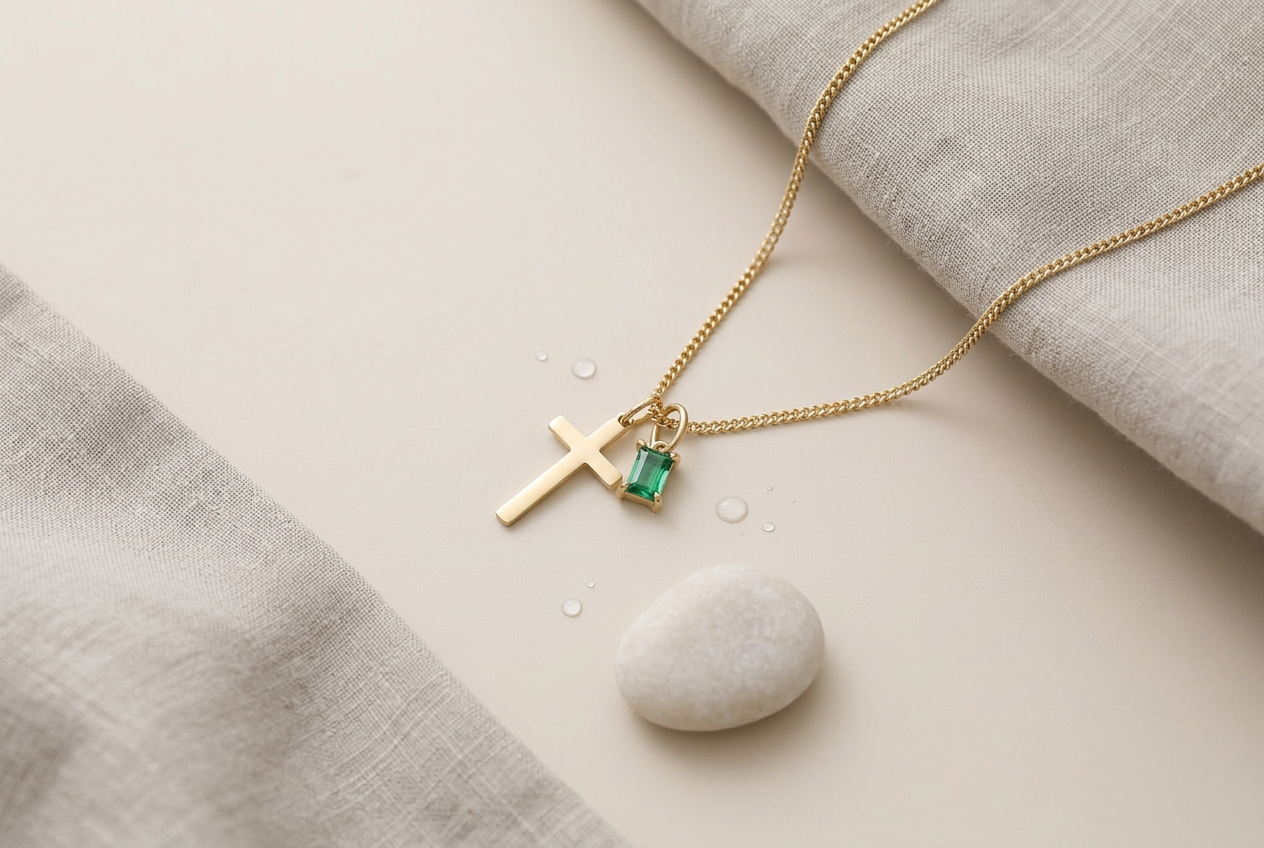
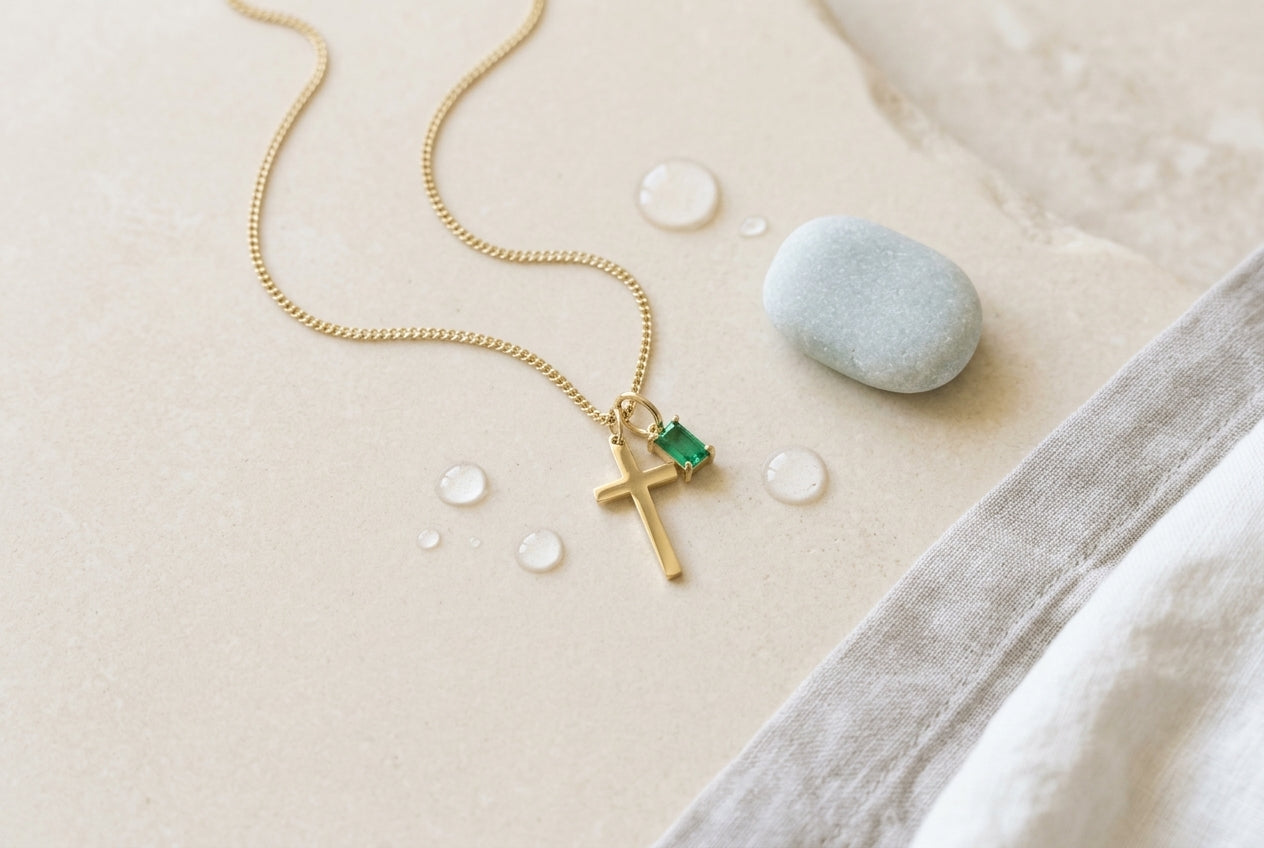
Cross and Birthstone Necklace
18k gold-plated stainless steel · waterproof and tarnish-free · cross measures 10mm × 20mm with a 4mm × 6mm birthstone, on a 16" chain plus a 2" extender.
Shop this necklace →One honest note: this is a cross, not a corpus crucifix — a refined, demi-fine cross face (10mm × 20mm) with a personalizable birthstone, designed to be layerable rather than a bold statement chain. If you specifically want a large, detailed crucifix with the figure of Christ, this isn't that piece; size up to a dedicated crucifix design and a longer chain.
Honest answers to the real questions
- Is it actually waterproof, or will it tarnish like my last "gold-plated" set? A 316L stainless steel base is corrosion-resistant by design — it won't rust or tarnish in the shower, the gym, or the rain. On gold-plated pieces the gold is a surface layer, so quality PVD plating is what keeps the color from fading, especially on the raised corpus where coatings wear first. The honest caveat: any plating is a coating — a thin gold layer over steel, not solid gold.
- Will it arrive looking like the photo, or will it be tiny? This is the most common letdown in online jewelry, and it bites hardest on detailed pieces — so check the millimeters, not the photo. Meideya states measurements plainly (the Cross and Birthstone Necklace cross is 10mm × 20mm). That's a refined, demi-fine scale, not a bold oversized crucifix — and we'd rather you know that up front than be surprised at the mailbox.
- Am I being signed up for a hidden subscription? No. Meideya is a one-time purchase at a one-time price — no membership, no recurring "luxe" fee slipped into checkout, no auto-enrollment. What you pay is what you pay.
If you're comparing styles, chain lengths, and finishes, browse the full pendant necklace collection.
Frequently asked questions
What is the difference between a crucifix and a cross necklace?
A crucifix is a cross that carries the corpus — the sculpted figure of Christ — while a plain cross is bare. The crucifix emphasizes the crucifixion and sacrifice and is most associated with Catholic devotion; the plain cross points to the resurrection and is the more common choice among Protestants. Visually, a crucifix has fine raised relief, which is why size and finish quality matter more on a crucifix than on a flat cross.
Are stainless steel crucifix necklaces good for everyday wear?
Yes — that's their main advantage. 316L stainless steel is highly corrosion-resistant thanks to its chromium and molybdenum content, so it won't rust or tarnish through showers, workouts, sweat, or rain. On a gold-plated piece, a durable PVD finish is what keeps the gold from rubbing thin on the raised detail, so it's the most forgiving option for a piece you don't want to take off.
Will a stainless steel cross or crucifix turn my skin green or cause a reaction?
Stainless steel won't turn skin green the way some plated-brass and copper pieces can. 316L does contain nickel, but when made to standard it releases very little, and the American Academy of Dermatology lists surgical-grade stainless steel among the metals most nickel-sensitive people can wear. If you have a confirmed severe nickel allergy, choose a piece explicitly verified as nickel-safe.
What chain length should a man choose for a crucifix pendant?
For a pendant like a crucifix, 22–24 inches is the sweet spot — it lets the piece hang on the chest where it reads as a men's necklace and gives the corpus room to show. A 20-inch chain sits higher at the collarbone for a more tucked-in look, while a bolder or taller crucifix usually looks best at 24 inches or longer.
Is gold-plated stainless steel the same as solid gold?
No. Gold-plated stainless steel is a stainless steel core with a thin layer of gold (ideally applied by durable PVD) bonded to the surface — it gives the gold look and stays water-safe at a fraction of the price. Solid gold is gold all the way through with no plating to wear off, but it costs many times more and scratches more easily than steel.
The buying rule is simple: decide whether you want the bare cross or the corpus crucifix, then choose 316L stainless steel — bare or gold-plated — for the best mix of durability, comfort, and value, and let the chain length make it look right. See also our guides on stainless steel cross necklaces for men and the dainty cross necklace collection.

Leave a comment
This site is protected by hCaptcha and the hCaptcha Privacy Policy and Terms of Service apply.