

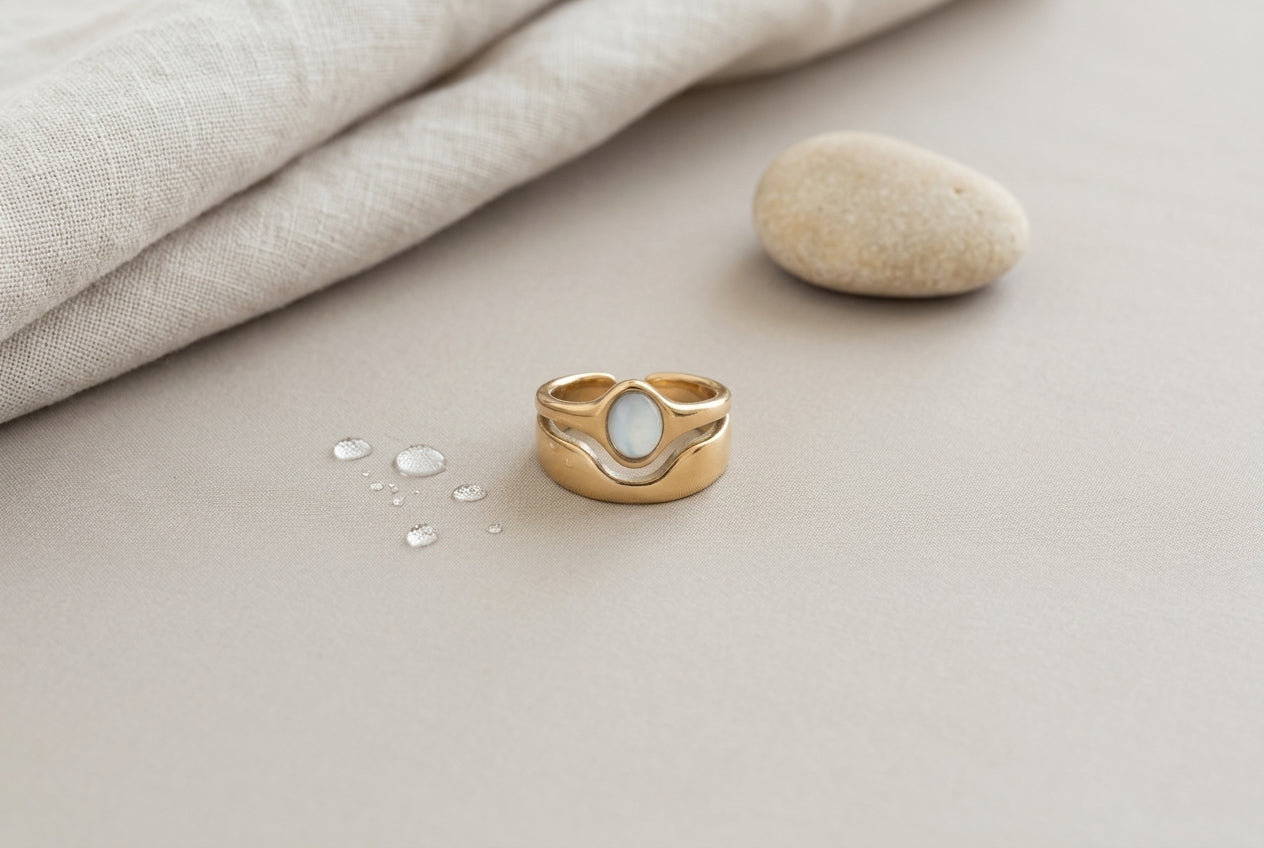
Mother of pearl jewelry: A Buyer's Guide
Buy mother of pearl jewelry for its soft, shifting iridescence — but choose the setting for everyday durability, because the shell itself is genuinely soft (about 3.5–4 on the Mohs hardness scale) and needs gentle care. Mother of pearl is the luminous inner lining of a real mollusk shell, so its glow is genuine — the catch is that the band or chain holding it is what determines whether the piece survives daily wear. This guide covers how to judge a piece, which one fits which buyer, an honest material comparison, and the real care a soft natural shell needs.
Key takeaways
- Mother of pearl is real nacre — the iridescent inner shell of a mollusk — not a printed or plastic imitation, and it shows bolder color-play than a pearl bead.
- The metal decides longevity, not the shell. An 18k gold-plated 316L stainless steel setting stays waterproof and tarnish-free; the shell, being soft, just needs gentle handling.
- Don't overpay for "gold." Plating is a surface layer — by FTC rules a "gold-plated" piece carries at least a 10k-gold electroplate of 0.175 microns or more — which gives you the look for a fraction of solid-gold prices.
- Quick pick: for an everyday piece you never have to think about, a 316L gold-plated ring set with a white mother-of-pearl cabochon is the easiest place to start.
What to look for: the buyer's decision criteria
Mother of pearl pieces vary more in their setting than in the shell itself. Here is what actually separates a piece worth keeping from one that disappoints.
- Genuine shell, not imitation. Real mother of pearl is nacre — the same substance that coats the inside of pearl-producing oyster, abalone, and freshwater-mussel shells. It has natural depth and an iridescence that shifts as the light moves; flat, perfectly uniform "shimmer" is usually a printed or resin imitation. The shell is genuine; what differs between sellers is the metal it sits in.
- The base metal of the setting. This is the part that lives in the shower and the gym, so it matters most. A 316L stainless steel base finished with 18k gold plating is waterproof and tarnish-resistant. Be sure you know which one you're buying — gold-plated brass can also look the part but is a different material under the plating.
- How the stone is held. A smooth cabochon (a domed, polished shell with no facets) seated cleanly in a bezel or a one-piece band takes daily wear better than a thin shell perched in exposed prongs, because the metal shields the soft edges.
- Honest sizing and finish. Mother of pearl ranges from milky white to grey, gold, and peacock tones. Look for a clear color description and a real size range so the piece arrives looking like the photo.
Best for X: matching the piece to the buyer
Different buyers want different things from a mother-of-pearl piece. Here is the honest match.
- Best for everyday wear: a gold-plated 316L stainless steel ring or stud with a white shell cabochon — the setting handles water and daily knocks while the shell brings the glow.
- Best for sensitive skin: look for a 316L stainless steel base. 316L contains nickel but releases very little, which is why it is widely considered hypoallergenic — though "hypoallergenic" means lower-risk, not nickel-free, so very nickel-sensitive wearers should still test cautiously.
- Best as a gift: mother of pearl reads as soft and timeless without the price of solid gold, so it suits someone who likes understated luxury. A clean cabochon ring is hard to get wrong.
- Best on a budget: a plated piece gives you the warm gold tone and the real shell at an entry price, instead of paying for solid-gold metal you mainly never see.
Mother of pearl vs. pearl vs. CZ: an honest comparison
Buyers often confuse mother of pearl with pearls, and wonder how it stacks up against a sparkle stone like cubic zirconia. Here is what each one actually is, with verified hardness values.
| Material | What it is | Hardness & durability | Best for |
|---|---|---|---|
| Mother of pearl | The iridescent nacre lining of a real mollusk shell — a genuine natural material | Soft, ~3.5–4 Mohs; slightly more abrasion-resistant than a loose pearl, but still needs gentle care | Soft, shifting color-play; understated everyday luxury |
| Freshwater pearl | A bead made entirely of nacre, grown inside the mollusk | Soft, ~2.5–3 Mohs; the softest of the three | Classic, even luster; dressier looks |
| Cubic zirconia (CZ) | A lab-made stone — honest sparkle, not a mined diamond | Hard, ~8 Mohs; very wear-resistant | Bright, diamond-like sparkle at an accessible price |
Mother of pearl and pearls are the same substance — nacre — in different forms: mother of pearl is the flat inner-shell layer, while a pearl is the rounded bead. If you want gentle iridescence and a sculptural look, mother of pearl wins; if you want hard, bright sparkle, CZ is the practical choice. Whichever stone you pick, a gold-plated 316L setting is what keeps the piece wearable day to day.

Hugo Ring - White Mother of Pearl
A one-piece design with an open-front aesthetic, centered with a shimmering white shell cabochon.
Shop this ring →Honest caveats: the real objections
- Will it actually hold up? The metal will: an 18k gold-plated 316L stainless steel setting is waterproof and tarnish-resistant, so the band can take the shower, pool, and ocean. Plating is a surface layer that resists wear for years, not literally forever, and the shell is soft — so treat the stone gently even though the metal is tough.
- Is the shell really genuine — and will it arrive looking like the photo? On a piece described as white mother of pearl, the stone is real nacre cut from a shell, so the iridescence is natural. Because nacre is soft (~3.5–4 Mohs) it can scratch, so cabochons are kept smooth and modestly scaled rather than oversized; check the size range so the proportions match your expectation rather than assuming a big statement stone.
- Is the metal solid gold? No — and that is the point. A gold-plated piece is honestly a surface layer of gold over a 316L stainless steel base, which is how you get the warm gold look without solid-gold pricing. We never imply solid gold or a mined diamond; the shell is genuine and the plating is genuine plating.
- Any hidden costs? No. Meideya is a one-time price with no hidden subscription or auto-enrollment — you buy the piece and you own it.
If you'd rather start from a curated set than a single piece, browse the full signet rings collection for clean, everyday-wearable styles.
Frequently asked questions
Is mother of pearl real or fake?
Genuine mother of pearl is real — it is nacre, the iridescent inner lining of a real mollusk shell, the same material that coats the inside of pearl-producing oyster, abalone, and freshwater-mussel shells. Imitations exist (printed or resin versions), so look for natural depth and shifting iridescence rather than a flat, perfectly uniform shimmer.
What is the difference between mother of pearl and a pearl?
They are the same substance — nacre — in different forms. Mother of pearl is the flat iridescent layer lining the inside of the shell, while a pearl is a rounded bead made entirely of nacre that grows inside the mollusk. Mother of pearl shows bolder color-play; a pearl shows softer, more even luster.
How hard is mother of pearl, and is it durable enough for daily wear?
Mother of pearl is soft — about 3.5–4 on the Mohs hardness scale — so it can scratch more easily than harder gemstones. It is wearable every day when set in protective metal and handled gently, but it should not be treated like a hard stone such as cubic zirconia.
How do I care for mother of pearl jewelry?
Wipe it with a soft cloth dampened in lukewarm, mild soapy water and dry it gently. Avoid harsh chemicals, acids, solvents, and ultrasonic cleaners, and store it separately from harder jewelry so it doesn't get scratched. Wearing it regularly actually helps, because contact with natural skin oils keeps the surface lustrous.
Is the gold on mother of pearl jewelry solid gold?
On gold-plated pieces, no — the gold is a surface layer over a base metal. By FTC rules, a piece described as "gold-plated" carries an electroplate of at least 10k gold that is at least 0.175 microns thick. A 316L stainless steel base with 18k gold plating gives you the gold tone, plus waterproof and tarnish-resistant wear, without solid-gold pricing.
The buying rule is simple: pick the mother of pearl for its genuine, soft iridescence, and pick the setting for how the piece will live on your hand — a gold-plated 316L base is the easiest everyday choice. See also our guides on dainty pearl necklaces and dainty gold necklaces.

Leave a comment
This site is protected by hCaptcha and the hCaptcha Privacy Policy and Terms of Service apply.