
Mixing Metals: How to Style Gold and Silver Jewelry Together
Let's be clear: the old rule that you can't mix gold and silver jewelry is officially dead. It was an arbitrary, outdated notion rooted in tradition, not style. Today, wearing both tones together is not just acceptable—it’s a sophisticated statement of modern personal freedom.
However, mixing metals requires strategy. You don't want your stack to look like an accident. As a founder focused on intelligent styling, I believe the secret to successful mixed-metal jewelry is harmony, which we achieve not just through color, but through consistent material quality. This is the enduring appeal of high-quality **stainless steel jewelry**.
This guide will teach you the three golden rules for styling gold and silver pieces, and reveal why our collection is the only risk-free way to nail this trend.

Key Takeaways
- The Old Rule is Dead: Mixing gold and silver is highly encouraged and modern.
- Rule #1: Use a "Connector" piece (like a two-tone ring or bracelet) to bridge the colors.
- Rule #2: Vary the Texture. Contrast a smooth, polished surface with a ribbed or chained surface.
- The Risk-Free Advantage: Because our PVD gold-tone and polished silver-tone accents are both built on the same **316L stainless steel** base, mixing them presents zero risk of material degradation or mixed tarnishing.
The New Rule: Harmony Through Contrast
Mixing metals works because the cool tone of silver enhances the warmth of gold, creating depth and dimension in your stack. It makes your jewelry feel collected, personalized, and intentional, rather than uniform.
The goal is to move beyond just wearing *two* colors and start layering *textures* and *widths* using those two colors as your palette. This is where the right piece becomes essential:
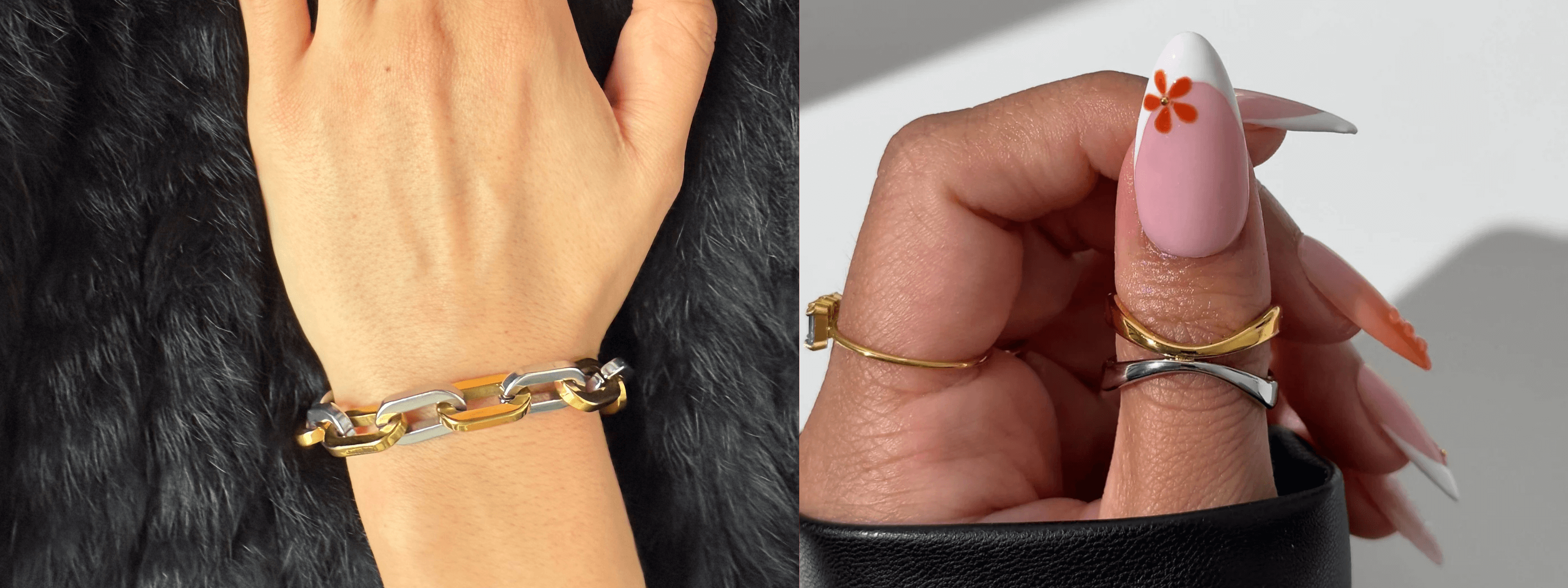
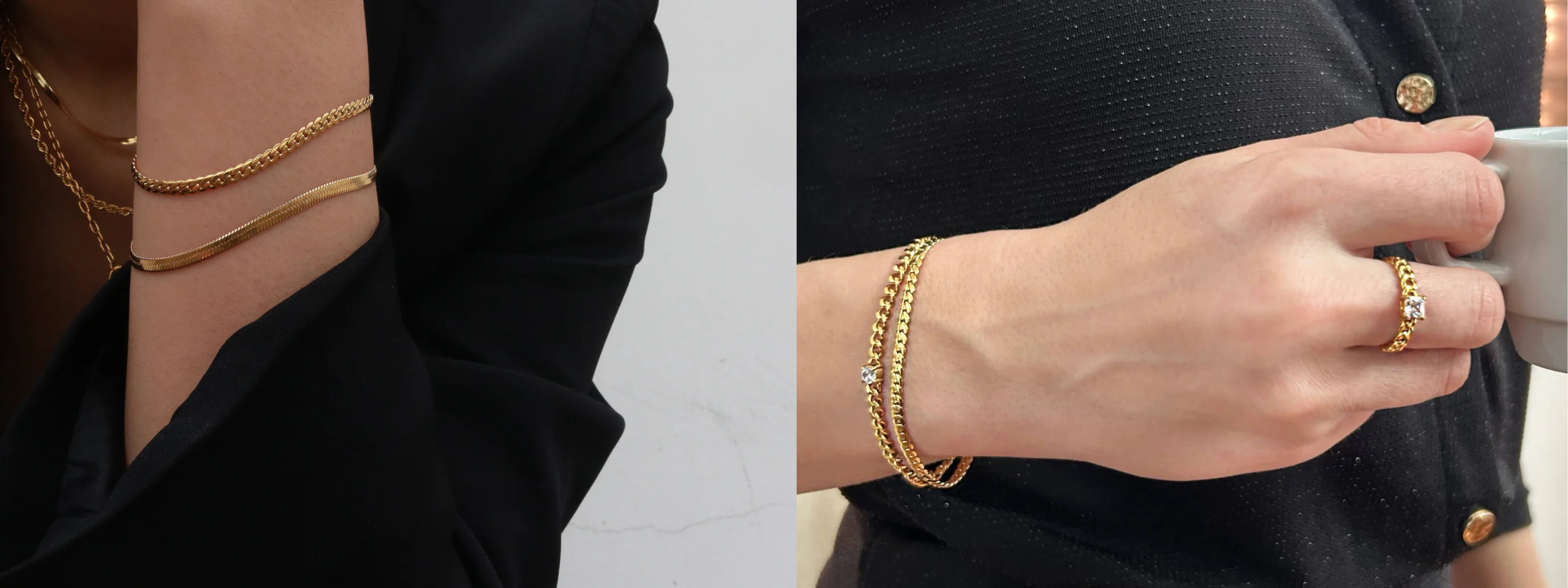
- For the wrist: Anchor your stack with a **Chunky Two-Tone Bracelet**, and pair it with a single gold-tone chain.
- For the hands: Layer a delicate gold-tone stacking ring with a mixed-tone **Mixed Harmony Ring** anchor.
Mia's 3 Golden Rules for the Ultimate Metal Stack
Use these simple rules to ensure your mixed stack always looks sophisticated, never chaotic.
Rule 1: Use a Visual Connector (The Two-Tone Anchor)
The easiest way to start mixing is to find an anchor that already contains both tones. Our **Mixed Harmony Ring** or the **Chunky Two-Tone Bracelet** are perfect examples. Wearing a piece that is intentionally half gold and half silver acts as a visual guarantee, immediately making all other mixed pieces look harmonious. The connector solves all the stylistic anxiety.
Rule 2: Vary the Textures and Weights
If you wear all thin, delicate pieces in both colors, the look can be messy. You need contrast to define the layers.
- If your primary base is a smooth, wide gold-tone bangle, use a highly textured silver-tone **rope chain** (on the neck or wrist) on top.
- Mix the materials: A cool steel accent looks fantastic next to the warm, organic texture of a pearl or a gemstone ring.
Rule 3: Establish a Primary Tone
Choose one tone to be the dominant color (the primary) and the other to be the accent (the secondary). For example, if you want a gold-forward stack, ensure about 70% of the metal volume is gold, and 30% is silver (usually provided by your mixed-tone rings and bracelets). This grounding effect provides harmony and avoids a fifty-fifty division that can look busy.

Featured: The Ultimate Mixing Material
Explore our entire collection. All pieces are built on the same durable, hypoallergenic 316L steel base, ensuring risk-free and beautiful gold and silver mixing.
Shop All Stainless Steel JewelryThe Stainless Steel Advantage: The Ultimate Mixing Material
For those mixing metals, choosing **stainless steel jewelry** provides a functional solution that traditional fine jewelry simply cannot offer.
Consistent Material Foundation
When you mix traditional sterling silver with gold vermeil (plated silver), the pieces have different maintenance needs and different levels of durability. When you mix our polished silver-tone steel with our PVD gold-tone steel, the underlying **316L stainless steel** is identical. This means:
- **No Tarnish Transfer:** The silver-tone accents in your rings and bracelets will not tarnish, meaning they won't dull or negatively affect the gold-tone pieces they rub against.
- **Uniform Durability:** Every piece, regardless of color, shares the same hardness, scratch resistance, and waterproof nature.
Unrivaled Safety and Comfort
Wearing a tight stack means jewelry is constantly in contact with your skin. The only way to guarantee a healthy, comfortable experience is to use a consistent, non-reactive material. Our **hypoallergenic 316L steel** ensures that the mixed aesthetic is also chemically safe and durable enough for 24/7 wear.
Frequently Asked Questions
Q1: Is it okay to mix gold and silver jewelry?
Absolutely! The old rule is dead. Mixing metal tones is now a sign of modern, personalized style. The key is to follow basic rules of balance, ensuring the mix looks intentional, not accidental.
Q2: How do I start mixing metals?
The easiest way is to start with a "connector" piece, such as a watch or a ring that already incorporates both gold and silver tones. This piece acts as a visual anchor, making the rest of your stacked jewelry look harmonious.
Q3: Will mixing jewelry colors cause tarnishing?
Mixing the colors themselves does not cause tarnishing. Tarnishing happens when soft metals (like sterling silver) react to air or moisture. By choosing 316L stainless steel for both your silver-tone and gold-tone pieces, you eliminate the risk of tarnishing and corrosion entirely.
Q4: Can I mix chunky and thin jewelry?
Yes, and you should! Mixing widths is essential for a good stack. Pair chunky necklaces (like a thick Curb chain) with thin chains, or a bold signet ring with delicate stacking bands. This contrast prevents the stack from looking heavy or uniform.

Hinterlasse einen Kommentar
Diese Website ist durch hCaptcha geschützt und es gelten die allgemeinen Geschäftsbedingungen und Datenschutzbestimmungen von hCaptcha.