
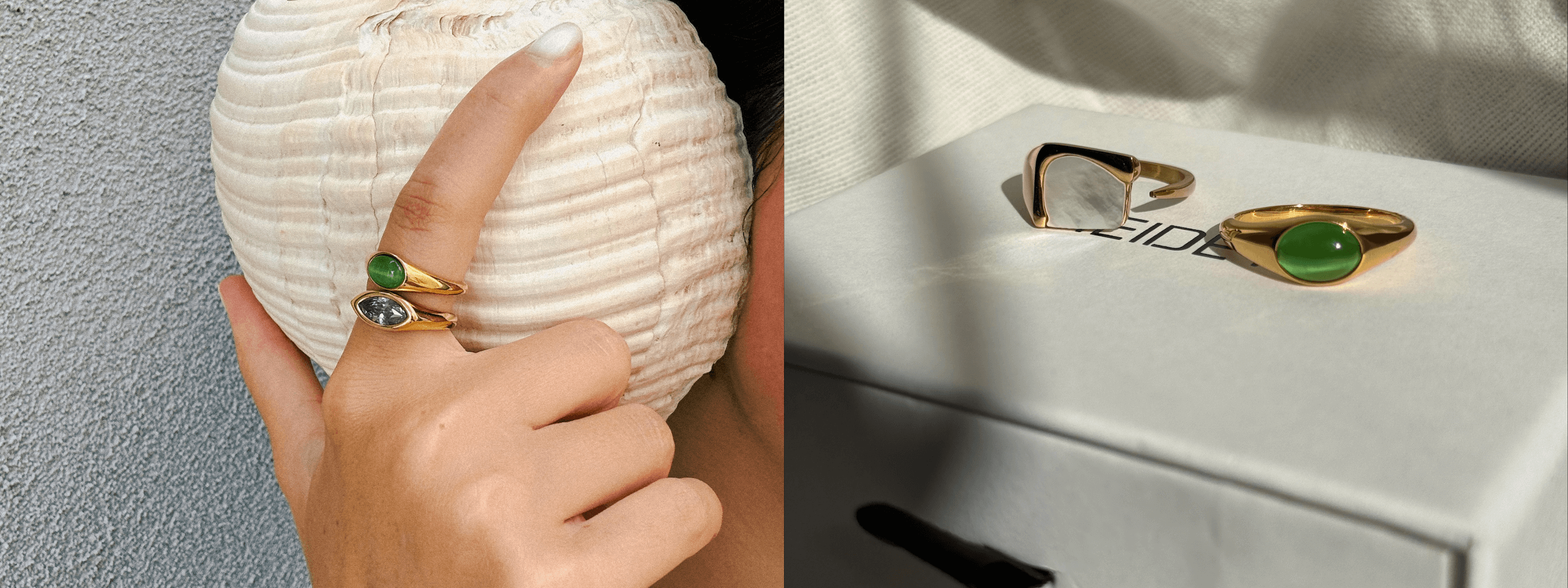
What Makes Cat's Eye Shine? The Science Behind Chatoyancy
Have you ever tilted a piece of Cat's Eye jewelry and watched, mesmerized, as a sharp, silky line of light seems to glide across its surface? It's an almost magical effect, reminiscent of a feline eye narrowing in the dark. This captivating phenomenon isn't an illusion; it's a specific optical property called chatoyancy, and understanding the science behind it only adds to the stone's allure.
But how does this happen? What secrets lie within the stone to create such a unique and focused beam of light? Let's dive into the simple science that gives Cat's Eye its signature shine.

Defining the Dazzle: What is Chatoyancy?
Chatoyancy, derived from the French "œil de chat" meaning "cat's eye," refers to that distinct band of reflected light seen in certain gemstones. Imagine shining a light onto a spool of silk thread – you'd see a bright line running perpendicular to the direction of the threads. Chatoyancy works on a similar principle, but on a microscopic scale within the stone.
The Secret Ingredient: Tiny Parallel Structures
The magic of chatoyancy originates from the internal structure of the gemstone. It occurs in stones that contain a multitude of very fine, parallel inclusions. These can be:
-
Needle-like mineral fibers (like rutile or asbestos, though the asbestos is safely encased within the quartz structure in Tiger's Eye, for example).
-
Hollow tubes or channels.
These inclusions must be densely packed and aligned in one specific direction within the host mineral. While the most famous Cat's Eye is Chrysoberyl, this effect is also commonly seen in quartz varieties (like Tiger's Eye, which is technically a Cat's Eye Quartz), as well as apatite, tourmaline, and other gems.

The Crucial Cut: Why the Dome Shape is Key
Simply having these parallel inclusions isn't enough to produce the distinct "eye." The way the gemstone is cut is absolutely critical. To display chatoyancy, the stone must be fashioned into a cabochon – a smooth, dome-shaped cut with a flat base.
Crucially, the base of the cabochon must be cut parallel to the direction of the tiny fibers or tubes inside. When light enters the domed top, it reflects off these aligned inclusions. The curved surface of the cabochon acts like a lens, focusing the reflected light into that sharp, bright band we perceive as the cat's eye. If the stone were faceted (cut with many flat faces like a diamond), the light would scatter, and the effect would be lost.
The Dance of Light: Why the "Eye" Moves
The final piece of the puzzle is movement. The chatoyant band isn't static; it glides across the surface as you tilt the stone or as the light source moves. This happens because the angle at which the light strikes the internal fibers changes, causing the focused reflection point to shift across the curved dome of the cabochon. This mesmerizing movement is what gives the stone its lifelike quality.
Showcasing the Shine: The Role of the Setting
A phenomenon as captivating as chatoyancy deserves a setting that lets it take center stage. This is where thoughtful jewelry design comes in, and why materials like high-quality stainless steel jewelry are such an excellent choice.
The clean lines and bright, reflective surface of polished 316L stainless steel provide a beautiful contrast to the often earthy tones of Cat's Eye stones (like Tiger's Eye). The setting doesn't compete for attention; instead, it frames the stone, allowing the unique optical effect to be the star. Whether it's a sleek bezel setting on a cat's eye ring or a simple bail on a pendant, the metal enhances the gem's natural magic.

Furthermore, the durability and hypoallergenic nature of stainless steel jewelry mean you can wear your chatoyant gem every day without worry. The strong setting protects the stone, while the body-safe metal ensures comfort against your skin. This practicality allows the natural wonder of chatoyancy to be a part of your daily life, not just reserved for special occasions.
Conclusion: Nature's Optical Masterpiece
The captivating shine of a Cat's Eye gem is a beautiful example of nature's artistry, a result of microscopic structures interacting perfectly with light and skillful cutting. It’s a reminder that incredible beauty can be found in the details.
Understanding the science behind chatoyancy doesn't diminish its magic; it enhances our appreciation for this natural wonder. When you choose a piece featuring this effect, especially one thoughtfully set in quality material like those found in our stainless steel jewelry collection, you're wearing a small piece of optical science, a conversation starter, and a testament to the beauty hidden within the earth.

Hinterlasse einen Kommentar
Diese Website ist durch hCaptcha geschützt und es gelten die allgemeinen Geschäftsbedingungen und Datenschutzbestimmungen von hCaptcha.