

14k Gold Earrings for Women: A Buyer's Guide
For most women, "14k gold earrings" means one of two very different things: solid 14k karat gold (real gold all the way through, priced accordingly) or a 14k-gold look at a fraction of the cost — and the right choice depends entirely on your budget and how hard you wear them. Solid 14k is an heirloom-grade metal that holds value but costs hundreds of dollars per pair; a quality gold-plated alternative gives you the same warm gold tone for everyday wear at a far lower price. This guide explains what the karat numbers actually mean, how to tell a durable pair from a green-finger disaster, and which option fits which buyer — so you can spend confidently either way.
Key takeaways
- 14k gold is 58.3% pure gold (14 of 24 parts); 18k is 75% pure. More karats means more gold, a richer color, and a higher price — not necessarily more durability, since pure gold is soft.
- "14k gold" and "14k gold-plated" are not the same purchase. Solid gold is the metal itself; plated is a thin gold layer over a base metal. The FTC requires plating to be at least 0.175 micron of 10k-or-higher gold to be called "gold plated."
- For daily, wear-everywhere earrings, the base metal matters more than the karat. Plating over 316L stainless steel resists tarnish far longer than plating over brass, which is what turns skin green.
- Quick pick: if you want a real-gold tone you can shower, sweat, and sleep in without babying it, a CZ-set, gold-plated 316L stud is the most practical pair for the money.
What "14k gold earrings" actually means — and how to choose
The karat number is a purity measure, not a quality grade. Gold is rated on a 24-part scale, so each karat is 1/24 of the whole. That gives you a few fixed reference points worth memorizing before you shop:
- Purity is fixed math. 14k gold is 58.3% pure gold (the rest is alloy metals like copper, silver, or zinc for strength); 18k is 75% pure; 24k is 99.9% pure but too soft for earrings that take daily knocks. Higher karat = more gold and a deeper yellow, but also softer and pricier.
- Solid vs. plated is the line that decides your budget. "Solid 14k gold" is that alloy throughout the piece. "14k gold-plated" (or "gold electroplated") is a microscopically thin gold surface bonded onto a different base metal. Under FTC rules (16 CFR Part 23), a piece can only be called "gold plated" if it carries at least a 0.175-micron layer of 10k-or-finer gold; "heavy gold electroplate" requires at least 2.5 microns.
- The base metal under the plating is the real durability story. Plating over brass is cheap and common — and brass contains copper, which is what reacts with skin and sweat to leave a green mark. Plating over 316L stainless steel doesn't do that, and stainless resists tarnish and corrosion far better.
- The stone is its own decision. Earrings labeled "14k gold" can be set with diamonds, cubic zirconia (CZ), moissanite, or pearls. CZ delivers the brilliant white-stone sparkle at a tiny fraction of a diamond's cost; just know it sits at 8.5 on the Mohs hardness scale versus a diamond's 10, so it can micro-scratch or cloud over many years.
- Match the back to the use. Studs with secure butterfly or screw backs are the safe everyday default; lever-backs and huggie hoops add security for active days. For sensitive ears, the post material matters as much as the look.
Best for each kind of buyer
There is no single "best" pair — the right earring depends on what you actually need from it. Here is how the common cases break down:
- Best for everyday wear you never take off: gold-plated 316L stainless studs. They survive showers, the gym, and the pool without tarnishing, and the secure post keeps them in all day.
- Best for sensitive ears: 316L stainless steel. It contains nickel but locks it into the alloy so very little is released — important because nickel is one of the most common causes of allergic contact dermatitis, per the American Academy of Dermatology and Mayo Clinic. Avoid unmarked brass posts.
- Best for an heirloom or milestone gift: solid 14k or 18k gold. It holds intrinsic metal value and can be passed down — worth the higher price if longevity and resale matter more than the upfront cost.
- Best for a budget that still looks luxe: gold-plated studs with CZ. You get the warm-gold-and-sparkle look for a fraction of solid-gold pricing, ideal for building a collection rather than buying one expensive pair.
- Best for active lifestyles: huggie hoops or screw-back studs in stainless — secure, low-snag, and corrosion-resistant through sweat and water.
Solid gold vs. gold-plated vs. gold-filled: the honest comparison
These three terms get used loosely, but they describe genuinely different products at very different prices. Here is what each one actually is, using the FTC's own definitions:
| Type | What it is | Durability of the gold | Best for | Typical price (pair) |
|---|---|---|---|---|
| Solid 14k / 18k gold | Real gold alloy throughout (14k = 58.3% gold; 18k = 75%) | Permanent — it's gold all the way through; can't wear off | Heirlooms, gifts, long-term value | Hundreds of dollars and up |
| Gold-filled | A bonded gold layer that is at least 1/20 (5%) of total weight, in 10k+ gold | Very long-lasting; the layer is many times thicker than plating | Daily wear without solid-gold cost | Mid-range |
| Gold-plated (over 316L steel) | A thin gold surface (FTC min. 0.175 micron of 10k+) over stainless steel | Resists tarnish for years with care; the plating is a surface layer, not forever | Affordable everyday luxury look | Lower — often under $60 |
| Gold-plated (over brass) | Thin gold over a copper-based base metal | Wears faster; copper base can turn skin green as plating thins | Short-term / fashion-only | Lowest |
The takeaway: if you want gold that lasts a lifetime and holds value, buy solid. If you want the gold look for everyday wear without the price tag, the column that wins is gold-plated over 316L stainless — you skip the brass problem and keep the tarnish resistance.
Where does Meideya fit? Honestly and clearly: Meideya earrings are 18k-gold-plated 316L stainless steel set with cubic zirconia — not solid gold, and not mined diamond. That is a deliberate choice. You get a warm 18k-tone finish over a tarnish-resistant, hypoallergenic-leaning stainless core, with CZ sparkle, all at an affordable-luxury price. If you specifically need solid 14k for resale value or a generational heirloom, a fine jeweler is the right call. If you want the look, the durability, and the freedom to wear them in the shower, read on.

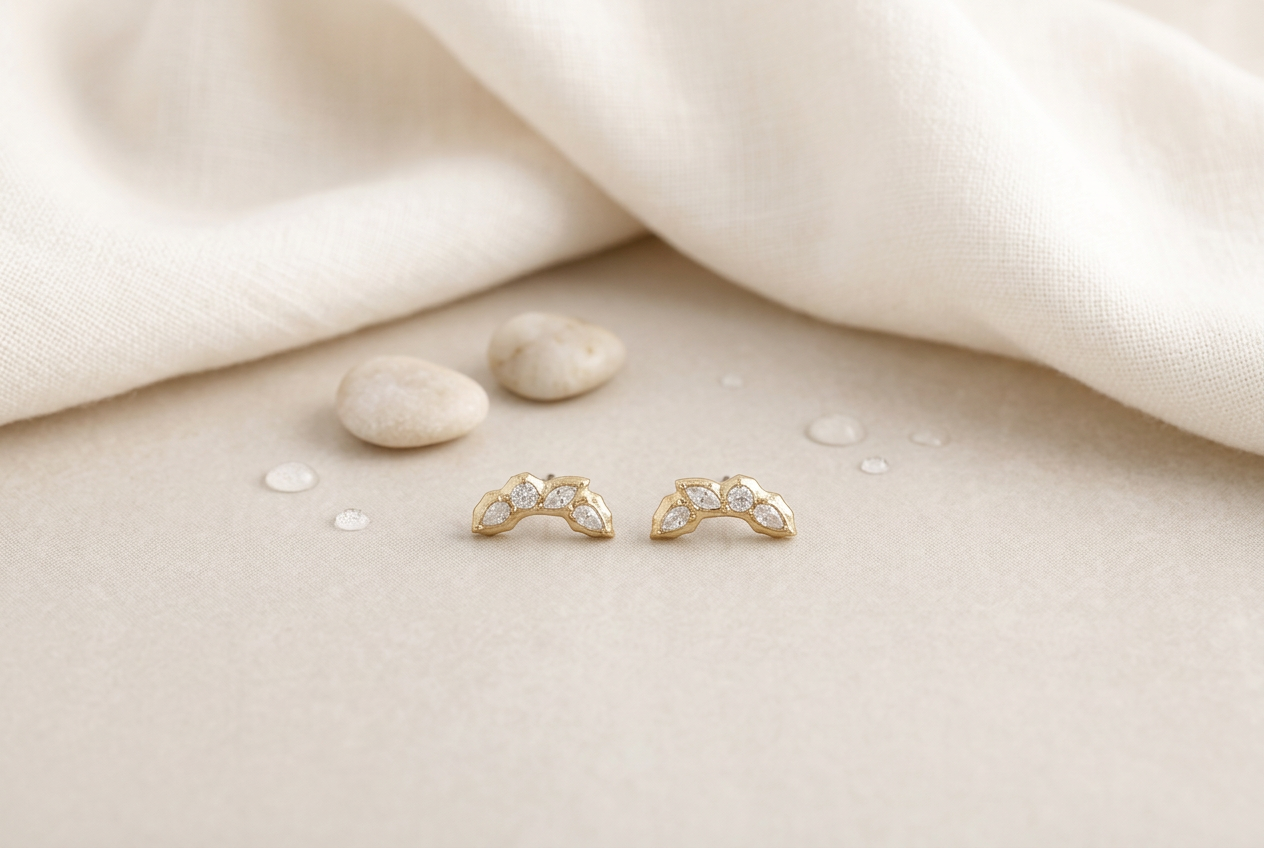
Elowen Stud Earrings
An arch-shaped design that hugs the earlobe, set with a cluster of three different CZ shapes — a marquise, a circle, and two pear-cut stones — for a mixed, eye-catching sparkle.
Shop this pair →Honest answers to the real objections
- Will it actually hold up, or tarnish like my last gold-plated set? The difference is the base metal. Cheap gold-plated earrings are usually plated over brass, and as that thin layer wears the copper underneath reacts with skin and sweat. Meideya plates over 316L stainless steel, which is corrosion-resistant thanks to its chromium and molybdenum content and doesn't cause the green-finger reaction. Plating is still a surface layer — it resists tarnish for years with reasonable care, not literally forever — but a stainless core is a different league from brass.
- Will it arrive looking tiny next to the photos? We'd rather you know up front: these are everyday earrings, not oversized statement pieces. Studs photograph close-up and large; on the ear they read as refined and proportionate rather than dramatic. If you want bold scale, choose hoops or a larger style on purpose — but a clustered stud like the Elowen is designed to be tasteful, not enormous.
- Are there any hidden costs or subscriptions? No. Every Meideya purchase is a one-time price for the piece — no membership, no auto-billing, no enrollment to cancel later. What you pay at checkout is what you pay.
Want to see the full range of finishes, stones, and silhouettes before you decide? Browse the complete stainless steel earrings collection.
Frequently asked questions
Are Meideya earrings solid 14k gold?
No. Meideya earrings are 18k-gold-plated 316L stainless steel set with cubic zirconia, not solid gold. They give you a real 18k-tone gold finish over a durable, corrosion-resistant stainless core at an affordable-luxury price. If you specifically need solid 14k or 18k gold for resale value or a generational heirloom, buy from a fine jeweler instead.
What is the difference between 14k gold and 14k gold-plated?
Solid 14k gold is a gold alloy that is 58.3% pure gold throughout the entire piece, so it never wears off and holds intrinsic value. 14k gold-plated means a thin layer of gold has been bonded onto a different base metal. Under FTC rules (16 CFR Part 23), a piece can only be marked "gold plated" if that layer is at least 0.175 micron of 10k-or-finer gold. Plated jewelry costs far less but the gold is a surface finish, not the whole piece.
Will gold-plated earrings turn my ears or skin green?
Only if they are plated over brass. Brass contains copper, and as the thin gold layer wears, copper reacts with skin and sweat to leave a green mark. Gold plated over 316L stainless steel does not cause this, because stainless steel is corrosion-resistant and copper-free at the surface. The base metal is what matters, so check what's under the plating.
Is cubic zirconia a good alternative to diamonds in gold earrings?
Yes, for the look and the price. Cubic zirconia is a synthetic stone that delivers brilliant, diamond-like sparkle at a tiny fraction of the cost. The trade-off is hardness: CZ measures 8.5 on the Mohs scale versus a diamond's 10, so over many years it can micro-scratch or slightly cloud with heavy wear. For affordable, everyday sparkle that looks luxe, CZ is an excellent choice.
Are gold-plated stainless steel earrings safe for sensitive ears?
For most people, yes. 316L stainless steel contains nickel but locks it tightly into the alloy, so very little nickel is released — which matters because nickel is one of the most common causes of allergic contact dermatitis, according to the American Academy of Dermatology and Mayo Clinic. Most wearers tolerate 316L well, though anyone with a severe nickel allergy may still prefer implant-grade titanium. Avoid unmarked brass posts.
The buying rule is simple: decide first whether you're buying gold for keeps (solid) or gold for everyday wear (a quality plated pair over stainless), then judge the base metal and the stone — not just the karat number on the tag. See also our guides on 18k gold earrings for women and 14k gold hoop earrings.
...)
Leave a comment
This site is protected by hCaptcha and the hCaptcha Privacy Policy and Terms of Service apply.