

Bracelets for Every Occasion: What to Wear When
The right bracelet depends less on what it's called than on what the occasion asks of it — how quiet it has to be, how much sleeve it has to clear, how much water it has to survive, and how much attention it's allowed to take. Most guides list the categories and leave you to guess which belongs at a Tuesday standup versus a Saturday wedding. This one starts with the occasion instead.
Key takeaways
- Choose by occasion, not category: how quiet, how much sleeve, how much water, how much attention.
- One anchor plus one supporting piece covers work and weekends; formal events want a single bracelet.
- Measure around the wrist bone, then add about half an inch for a snug fit or a full inch for a relaxed one.
- Water ratings vary piece to piece even inside one brand — read the product page, not the category.
- Three bracelets — everyday chain, clasp-free bangle, one stone-set piece — cover most of a calendar.
Start with the occasion, not the bracelet
Four questions eliminate most of your options before you open the drawer:
- How quiet? Rigid bangles and charm bracelets announce themselves against desks and dinner tables; flat and serpentine chains stay silent.
- How much sleeve? A blazer cuff wants something low-profile that slides underneath. Bare arms are where a cuff finally earns its scale.
- How much water and friction? Showers, workouts, pools and hand sanitizer shorten the life of the wrong piece — you want one the maker rates for water.
- How much attention? At a wedding, your outfit and your rings are the story. On an ordinary Wednesday, your wrist can carry the look.
What to wear when
The desk day. Flat and quiet — a herringbone, serpentine or fine link chain that slides under a sleeve and doesn't tap the keyboard. One piece reads polished; two of similar weight read intentional. See our office guide.
The casual weekend. The forgiving one: a bolder link chain, a mixed stack, a cuff you'd never wear to a meeting. Prioritize a secure clasp — coat sleeves are where bracelets get lost.
The gym, pool and beach. One piece or none, rated for water by the maker, close-fitting, free of dangling charms.
Dinner and date night. Movement and light, not volume. A tennis bracelet or single-stone chain catches candlelight every time you reach for a glass.
Weddings and black tie. One focal bracelet. If statement earrings or a ring lead, the wrist plays support — a slim line, nothing that clatters.
Travel days. What you can put on at 5 a.m. and forget — a slip-on bangle with no clasp to fail. See our travel jewelry guide.
Three pairing rules that hold everywhere
- One anchor, everything else supports. Decide which piece is the point and keep the rest smaller — two focal points on one wrist is the common misfire.
- Commit to a dominant tone across watch, rings and bracelet — mixing works when it reads as a choice, as our mixing metals guide explains.
- Run scale opposite the outfit. Busy print, one narrow piece; plain white shirt, let a cuff be the texture.
The watch is simplest on its own wrist. Wearing both? Keep the bracelet flat, narrow and same-tone, and stop at one.
Three bracelets that cover most of a calendar
Fill three roles rather than collecting seventeen categories: an everyday chain (flat, quiet under a sleeve), a slip-on bangle or cuff (no clasp to fail, holds its shape in a bag), and one stone-set piece that turns a work outfit into an evening one.
Two combinations cover most weeks: chain plus bangle for weekends and travel; chain alone by day, then the stone-set piece for dinner. For a fuller wrist, see our bracelet stacking guide.

Uma Bracelet
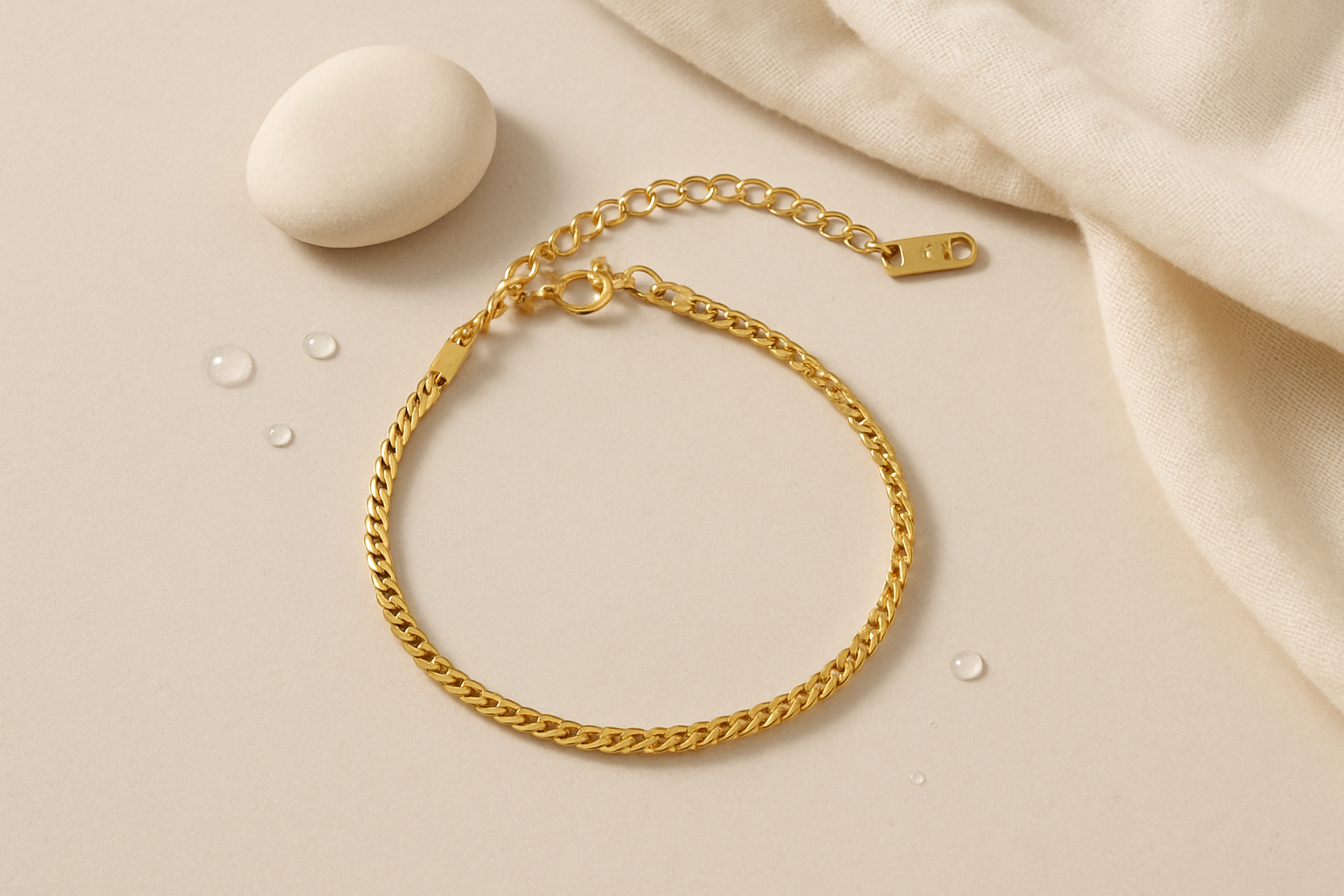
Our everyday-chain pick: a serpentine chain in 18k gold-plated stainless steel, listed water safe and tarnish resistant, 6" with or without a 2" extender.
Shop this bracelet →Four mistakes worth avoiding
- Shopping by category, not occasion. "I want a cuff" is how you end up with a beautiful piece that clears no sleeve you own.
- Sizing for the photo, not the wrist. Wrap a tape or a strip of paper around the wrist bone — snug, not tight — then add about half an inch for a classic fit or a full inch for a looser one. Our bracelet size guide has the full chart.
- Flat chains on the wrong wrist. A herringbone lies perfectly flat because its links sit flush, with no gap to absorb a twist — so a sharp bend can leave a crease. The risk is highest in the softer metals flat chains are traditionally made in, solid gold and sterling silver, and lower in harder stainless steel. Either way, give a flat chain the wrist that isn't carrying bags.
- Assuming every gold-toned piece survives the same day. Ratings differ piece by piece, even in one catalog: our Uma Bracelet is listed as water safe, while our Greta Bracelet is listed as tarnish resistant and makes no water claim. Read the individual product page before a piece goes in the pool.
Care that keeps a small set working
Put jewelry on last, after lotion, perfume and sunscreen, and take it off first. Rinse in clean water and dry after a pool, the ocean or heavy sweat — chlorine and salt both accelerate wear on any plated finish. Store flat chains flat, apart from harder pieces.
The occasion cheat sheet
Every spec below comes from that piece's own Meideya listing. Single-piece prices for these styles run $29–$49 as of August 2026.
| Occasion | What it demands | Style | How many | Meideya piece (spec from its listing) |
|---|---|---|---|---|
| Office / desk day | Silent, clears a sleeve | Flat or serpentine chain | 1–2 | Uma Bracelet — serpentine chain, 6" with or without a 2" extender |
| Casual weekend | Secure clasp | Bolder link chain | 2–3 | Cruz Chain Bracelet — elongated links, 6.5", adjustable lobster clasp |
| Gym, pool, beach | Rated for water, no charms | One close-fitting chain | 1 | Sia Chain Bracelet — listed waterproof, 6.5" plus a 1.5" extender |
| Dinner / date night | Light and movement | Tennis or stone-set chain | 1–2 | Boa Tennis Bracelet — 38 oval AAA cubic zirconia, about 6.8" |
| Wedding / black tie | One focal point | Slim tennis line or cuff | 1 | Emerald Tennis Bracelet — round-cut green stones, 6.8" |
| Travel day | Slip-on, no clasp | Bangle or cuff | 1–2 | Kyle Bracelet — bangle, 63 mm inner diameter, 3 mm thick |
The dressier the occasion, the fewer the pieces. Browse the full stainless steel bracelet range — one-time prices, nothing added at checkout.
Frequently asked questions
How many bracelets should I wear at once?
Let the formality set the number: one focal bracelet for black tie and weddings, one or two pieces of similar weight for a workday, two or three for a casual weekend.
Can the same bracelet work for the office and for a wedding?
Yes, if it is slim and quiet. A fine chain or narrow tennis bracelet reads professional under a sleeve by day and dressy on a bare wrist at night. What does not travel is scale and noise.
Should my bracelet match my necklace and rings exactly?
Match the tone, not the design. Keeping everything in one metal tone is what makes a look feel deliberate, but an identical matching set can look dated. Pick a dominant tone, then vary the shapes.
Which wrist should I wear a bracelet on, and what about my watch?
Give the watch one wrist and bracelets the other. If you wear them together, choose a flat, narrow bracelet in the same tone as the case and stop at one piece.
Can I wear a gold-plated bracelet in the pool or the ocean?
Check the specific piece rather than the brand, because ratings vary from style to style even within one catalog. Where a piece is rated for water, rinse and dry it afterwards, since chlorine and salt accelerate wear on any plated finish.
Decide where you're going and ask what it demands of your wrist — the answer picks the bracelet. See also our tennis bracelet guide and gold cuff styling guide, or start from the stainless steel bracelet collection.

Leave a comment
This site is protected by hCaptcha and the hCaptcha Privacy Policy and Terms of Service apply.