

Jade ring: A Buyer's Guide
A jade ring for women is worth buying when the jade is genuine and the listing is honest about whether the color is natural or dyed — that, far more than the metal, is what decides whether you're getting real value. Jade is a soft, earthy green stone that reads as quietly luxurious rather than flashy, which is exactly why it has stayed in style for centuries. This guide covers what to look for, which style suits which buyer, how jade compares to other stone rings, and the honest caveats — stone authenticity, dyed vs. natural, and the real metal under the plating — that a good seller should disclose up front.
Key takeaways
- "Jade" means one of two minerals — jadeite (Mohs ~6.5–7) or nephrite (Mohs ~6–6.5). Both are genuine stones suitable for everyday rings; jadeite is the harder, more prized of the two.
- The decision that matters most is natural vs. treated: more than 95% of jade on the market has been treated in some way, and dyed (Type C) jade is the single biggest buyer trap. A trustworthy listing tells you which it is.
- The stone is real; the metal is usually plated, not solid. Read the listing for the base — it can be 18k-gold-plated 316L stainless steel, sterling silver, or brass. Plating is a surface layer that resists tarnish for years, not forever.
- Quick pick for most: a vintage-leaning jade band with a clearly stated genuine-jade stone, in a comfortable 3–5mm width, sized up about half a size for a wide band.
What to look for in a jade ring — the buyer's decision criteria
A jade ring lives or dies on the stone, so judge the stone first and the setting second. Here is what actually separates a good buy from a regret.
- Jadeite or nephrite — and is it natural? Both are genuine "jade." Jadeite sits at roughly 6.5–7 on the Mohs hardness scale and nephrite at about 6–6.5, so both stand up to daily wear. The thing to verify is treatment: dealers grade jade as Type A (natural, only waxed), Type B (bleached and polymer-impregnated), and Type C (dyed). A reputable listing states which one — silence usually means treated.
- Translucency and color evenness. Natural jade has a soft, glowing translucency; dyed jade often looks cloudy, unnaturally even, or has color pooling in the cracks. Color that looks "too perfect" or slightly neon deserves a second look.
- The metal under the design. Most affordable jade rings are not solid gold. Check the base: 18k-gold-plated 316L stainless steel, gold-plated sterling silver, or gold-plated brass all wear differently. The plating is a thin surface layer — by FTC definition, "gold plated" means at least 0.175 microns of gold of 10-karat fineness or finer.
- Band width and fit. Jade bands run 3–5mm wide. A wider band sits tighter, so size up about half a size compared to a thin band if you want the same comfort.
- Honest scale photos. Jade charms and cabochons can look bigger online than on the hand. Look for a millimeter measurement, not just a styled close-up.
Best jade ring for each kind of buyer
Different buyers want different things from a green stone. Match the ring to the wearer.
- Best for everyday wear: a smooth jade band you can leave on. Jade's toughness — nephrite in particular has one of the highest toughness ratings of any natural mineral — makes it forgiving of daily knocks.
- Best for a vintage look: a carved, gold-toned setting around a pale jade stone. The warm metal against milky-white or soft-green jade is what gives jade its heirloom, old-world feel.
- Best for sensitive skin: a ring with a verified 18k-gold-plated 316L stainless steel base. 316L is the low-nickel-release, hypoallergenic option — note that a gold-plated sterling or brass base is a different material, so confirm the base if skin sensitivity is your priority.
- Best as a gift: a jade ring with a clear genuine-jade disclosure and a one-time price. Green jade carries meaning (prosperity, calm) and gives well when the buyer can trust what it is.
Jade vs. other stone rings — how they compare
If you're choosing between earthy, colored-stone rings, here's how jade stacks up against the alternatives Meideya carries, on the specs that matter.
| Stone | Best for | Hardness & key trait (verified) | Care |
|---|---|---|---|
| Jade (jadeite/nephrite) | Earthy, vintage, everyday | Mohs ~6–7; jadeite harder, nephrite tougher; natural vs. dyed is the buyer concern | Durable daily; avoid harsh chemicals that can attack treatments |
| Black onyx | Sleek, modern, unisex | Chalcedony quartz, Mohs ~7; often dyed black (common and accepted) | Hard and easy-going |
| Tiger's-eye | Warm, golden shimmer | Chatoyant quartz, Mohs ~7; the "cat's-eye" band of light is natural | Hard and easy-going |
| Moonstone | Soft glow, romantic | Feldspar, Mohs ~6–6.5; the floating blue-white sheen is called adularescence | Moderately hard; handle with some care |
| Mother-of-pearl | Luminous, delicate | Nacre, Mohs ~2.5–4.5 — soft; scratches more easily | Gentle care; keep off chemicals and abrasion |
The takeaway: jade wins for an earthy, heirloom look that still survives daily wear. If you want something harder and more modern, onyx or tiger's-eye; if you want luminous and don't mind babying it, mother-of-pearl or moonstone.

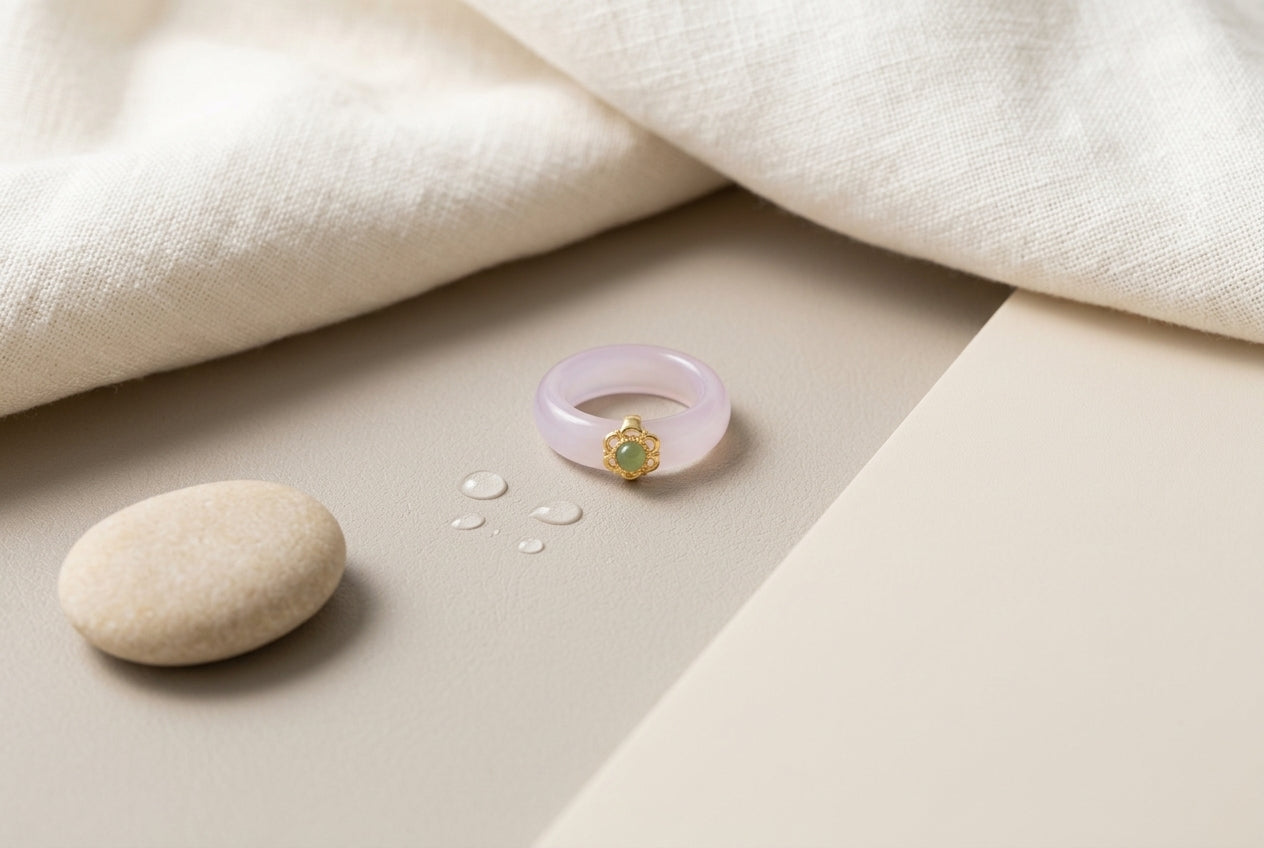
Lyla White Jade Band Ring
A small round green jade charm dotted on a genuine white jade band, on an 18k-gold-plated sterling-silver carved base — 3mm thickness, 5mm width, size US7.
Shop this ring →Honest caveats — the real objections answered
- Is the jade real, or dyed? The stone in a genuine jade ring is real jade — but "real" and "untreated" are not the same thing. Because most market jade is treated, dyed (Type C) stones are the trap. Buy where the listing states the stone is genuine jade, and ask whether the color is natural before paying a premium for it.
- Is it solid gold? No, and an honest seller won't pretend it is. Affordable jade rings use a gold-plated base — for the Lyla band above, that base is 18k-gold-plated sterling silver, not 316L or solid gold. Plating is a surface layer that resists tarnish for years, not forever; treat the gold tone as a finish, not a thickness.
- Will it irritate my skin? That depends on the base metal, not the jade. 18k-gold-plated 316L stainless steel is the hypoallergenic, low-nickel-release option; gold-plated sterling silver and brass are different metals. If you have a known nickel allergy, confirm the base is 316L. (Note: jade itself is inert and does not cause reactions.)
- Will it arrive looking like the photo? Jade rings are dainty by nature — a 3mm band and a small jade charm read delicate on the hand. Check the listed millimeters so the scale isn't a surprise.
- Any hidden costs? No. Meideya prices are one-time — no subscription, no auto-enrollment, no surprise renewals.
Ready to find your stone? Browse the full stainless-steel rings collection to compare jade, onyx, and other styles side by side.
Frequently asked questions
Are jade rings real jade?
A genuine jade ring uses real jade — either jadeite (Mohs ~6.5–7) or nephrite (Mohs ~6–6.5), both true forms of jade. The catch is treatment: more than 95% of market jade has been treated in some way, and dyed (Type C) jade is the most common trap. Buy from a listing that states the stone is genuine jade and discloses whether the color is natural.
What is the metal in a jade ring, and is it solid gold?
Almost never solid gold at this price. The stone is genuine; the band is usually a gold-plated base — 18k-gold-plated 316L stainless steel, sterling silver, or brass. "Gold plated" by FTC definition means at least 0.175 microns of gold at 10-karat fineness or finer. The Lyla White Jade Band Ring, for example, has an 18k-gold-plated sterling-silver base with a genuine white jade band.
How hard is jade, and can I wear a jade ring every day?
Yes. Jadeite sits around 6.5–7 on the Mohs hardness scale and nephrite around 6–6.5, and nephrite has one of the highest toughness ratings of any natural mineral, so jade resists chipping in daily wear. Avoid harsh chemicals, which can attack any treatment in the stone.
How do I tell natural jade from dyed jade?
Natural jade has a soft, glowing translucency, while dyed jade often looks cloudy, unnaturally even in color, or shows color pooling in cracks. Color that looks too perfect or slightly neon is a red flag. For certainty, only a gemological lab (using infrared spectroscopy) can confirm treatment — so the simplest protection is a clear written disclosure from the seller.
Is a jade ring hypoallergenic?
Jade itself is inert and doesn't cause reactions, so the answer depends on the band's base metal. An 18k-gold-plated 316L stainless-steel base is the hypoallergenic option — 316L contains nickel but releases very little (below the EU/REACH 0.5 μg/cm²/week threshold), and won't turn skin green the way copper-heavy brass can. Gold-plated sterling silver and brass are different metals, so confirm the base if you have a nickel allergy.
The buying rule for jade is simple: judge the stone first — genuine, and natural or disclosed — then judge the metal honestly as a plated finish, not solid gold. Get those two right and a jade ring is one of the most quietly luxurious pieces you can own. See also our guides on chunky ring styles and the stainless-steel ring guide.

Leave a comment
This site is protected by hCaptcha and the hCaptcha Privacy Policy and Terms of Service apply.