

Non-Tarnish Gold Rings: What Actually Lasts
The gold rings that actually resist tarnish are the ones whose base metal can't corrode — solid karat gold, or 316L stainless steel under a gold finish — not the ones with a thicker plating over reactive brass. "Non-tarnish" is a property of what's underneath the gold, not of the gold itself. If you want a gold-look ring that survives daily wear, handwashing, and the gym without turning your finger green, this guide explains exactly what to look for, which build wins for which budget, and the honest trade-offs nobody puts on the product page.
Key takeaways
- Tarnish and green skin come from the base metal: brass and copper oxidize; solid gold and 316L stainless steel do not.
- Plating thickness matters, but base metal matters more — a thick plate over brass still fails once the layer wears through.
- For an everyday gold-look ring under $60, 18k-gold-plated 316L stainless steel is the sweet spot: it resists tarnish, water, and skin discoloration for years at a fraction of solid-gold cost.
- No gold finish lasts literally forever — but a steel base means even surface wear won't leave you with a green stain.
What to look for in a non-tarnish gold ring
Most "gold tarnish" complaints aren't really about the gold — they're about the metal hiding under it. Use these criteria, roughly in order of importance:
- The base metal, first and always. Pure gold doesn't tarnish; neither does 316L stainless steel. Brass and copper do. When the thin gold layer on a plated-brass ring eventually wears at the back of the band, the exposed copper reacts with sweat and lotion to form green copper salts — the classic green finger. A 316L stainless base is inherently non-reactive, so even worn spots don't discolor your skin.
- How the gold is applied. The best stainless rings use PVD (physical vapor deposition), which bonds the gold-tone layer to the steel at an atomic level inside a vacuum chamber. Because 316L has such a stable surface, a PVD finish adheres tightly and resists chipping, bubbling, and peeling far better than a dipped electroplate.
- Plating thickness and karat. The U.S. FTC (16 CFR Part 23) sets the floor for what can even be called "gold plated": at least 0.175 micron of 10k-or-higher gold. "Heavy gold electroplate" requires at least 2.5 micron. Thicker is more durable — but a thick plate over brass still leaves you exposed once it wears through, which is why base metal trumps thickness.
- A realistic "non-tarnish" claim. Plating is a surface layer. Honest brands say it resists tarnish for years, not forever — and they pair it with a non-reactive base so wear never means discoloration. Be skeptical of any ring promising a gold finish that "never wears" at a budget price.
- Stone setting, if it has one. A gemstone ring adds a second durability question. Softer stones scratch; the band finish is only half the story. Tiger's eye, for example, sits at Mohs 7 — hard enough for everyday wear, but it should be kept away from harder stones and sharp impacts.
Best for X — pick by how you'll wear it
Different buyers weigh cost, longevity, and look differently. Here's the honest match:
- Best for everyday wear on a budget: 18k-gold-plated 316L stainless steel. It shrugs off water, sweat, and handwashing, won't turn your skin green, and costs a fraction of solid gold.
- Best for a once-in-a-lifetime heirloom: solid 14k or 18k gold — genuinely never tarnishes and holds resale value, but you pay full karat-gold prices and it scratches more easily than steel.
- Best middle ground: gold-filled (at least 1/20, or 5%, of the item's weight in 10k+ gold). The gold layer is 5–10x thicker than standard plating, so it lasts longer than plated — but it's still bonded to a brass core, so a deeply worn piece can eventually discolor.
- Best for sensitive skin: 316L stainless steel. It releases very little nickel — well below the EU's regulatory limit of 0.5 µg/cm²/week (the threshold measured by the EN1811 test) — which is why it's the standard recommendation for people prone to contact allergies (nickel is the most common contact allergen, per the AAD and Mayo Clinic).
- Best statement ring: a gemstone style like a tiger's eye band — the warm chatoyant stone does the talking while a gold-plated steel band keeps the upkeep near zero.
Solid gold vs gold-filled vs gold-plated steel vs plated brass
The single table that explains why two "gold rings" can behave completely differently:
| Build | Base metal | Tarnish / green-skin risk | Typical price (ring) |
|---|---|---|---|
| Solid 14k / 18k gold | Gold alloy (14k = 58.3% pure, 18k = 75% pure) | None — never tarnishes | Highest (hundreds+) |
| Gold-filled | Brass core, ≥5% gold by weight bonded on | Low for years; possible only after deep wear-through to brass | Mid (often $40–$150) |
| 18k-gold-plated 316L stainless | 316L stainless steel (non-reactive) | Very low — base can't corrode, so no green skin | Low (often ~$20–$60) |
| Gold-plated brass | Brass / copper (reactive) | Higher — plating wears, then brass oxidizes & greens skin | Low |
The takeaway: if your budget rules out solid gold, the deciding factor is the base metal. Plated steel beats plated brass every time on tarnish and skin discoloration, because a worn spot on steel is still inert.

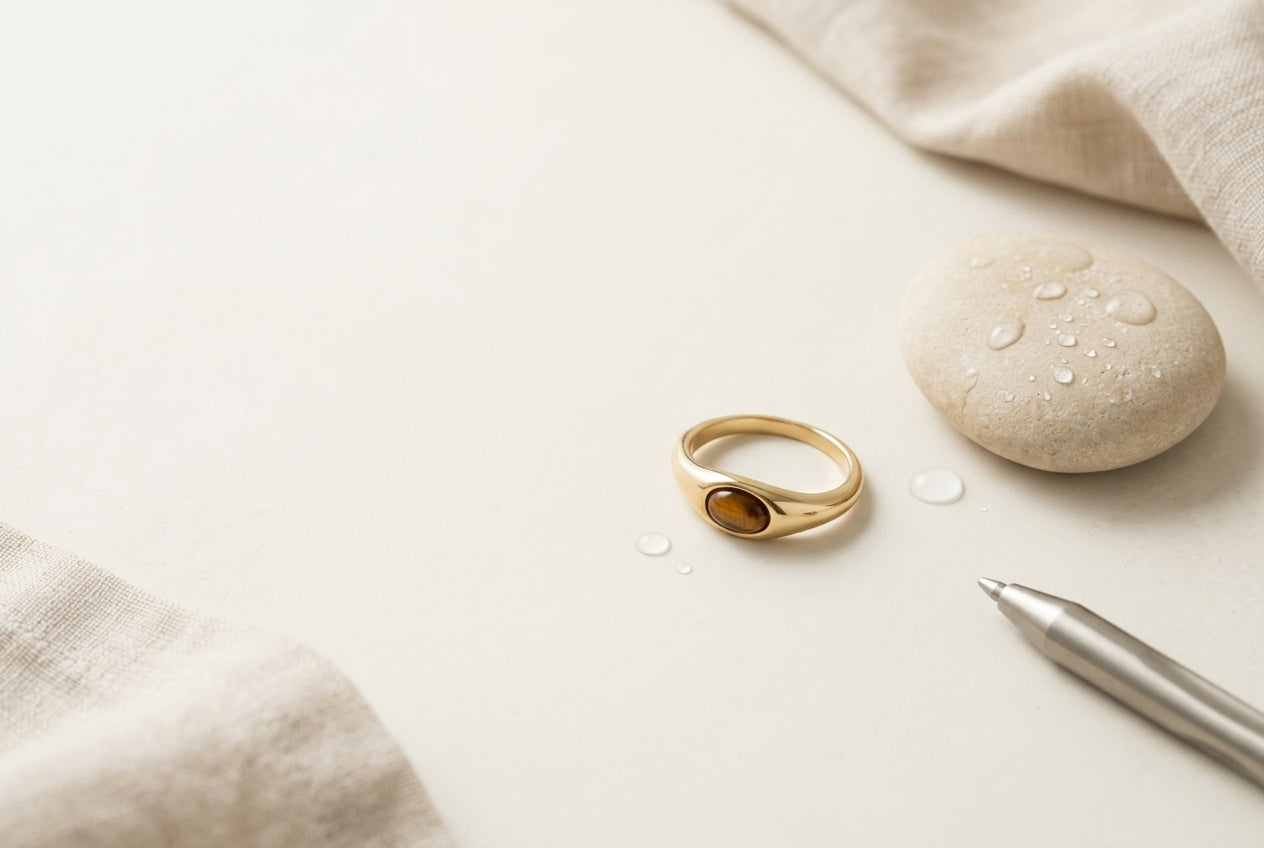
Kori Ring - Tiger's Eye
A statement ring featuring a tiger's eye gemstone set within a sleek 18k-gold-plated 316L stainless steel band — a gold look with a non-reactive base.
Shop this ring →Honest caveats — the objections worth answering
- Will it actually hold up, or tarnish like my last gold-plated set? The difference is the base. Meideya's gold rings are 18k-gold-plated 316L stainless steel, not plated brass — so even if surface plating wears at high-friction points over years, the corrosion-resistant steel won't rust or leave a green stain. A well-made PVD finish on 316L commonly stays bright for two-plus years of regular wear with basic care. To be transparent: plating is still a surface layer, so we say it resists tarnish for years — not "forever."
- Will it arrive looking like the photo? Rings are easier to judge than necklaces because sizing is standardized — you choose a US ring size, so the band fits as expected. A statement stone like tiger's eye reads as a real, warm gemstone rather than the over-saturated render you sometimes see; the chatoyant "cat's-eye" banding is a natural feature, so each stone varies slightly. We'd rather you know that than be surprised.
- Any hidden costs or subscription? No. Every Meideya ring is a one-time purchase at a single listed price — no auto-enrollment, no membership, no recurring "jewelry club" charge. What you pay at checkout is the whole cost.
Ready to compare styles? Browse the full stainless steel rings collection to see the gold-plated and gemstone options side by side.
Frequently asked questions
Do gold-plated stainless steel rings tarnish?
The stainless steel base does not tarnish — 316L is corrosion-resistant and non-reactive. The gold plating on top is a surface layer that resists tarnish for years rather than forever, but because the base metal can't oxidize, even a worn finish won't rust or turn your skin green the way plated brass does.
What is the most tarnish-resistant gold ring for everyday wear?
Solid 14k or 18k gold never tarnishes but costs the most. For an affordable everyday option, an 18k-gold-plated 316L stainless steel ring is the practical winner: it resists water, sweat, and tarnish, won't discolor your skin, and costs a fraction of solid gold. The key is that the base is steel, not brass.
Why does some gold jewelry turn my finger green?
Green skin comes from copper, usually in a brass base metal. When the thin gold plating on a brass ring wears through, the exposed copper reacts with sweat and lotion to form green copper salts that transfer to your skin. Stainless steel does not contain reactive copper at the surface, so a gold-plated steel ring will not cause this.
Is gold-plated the same as gold-filled or solid gold?
No. Solid gold is karat gold throughout (14k is 58.3% pure, 18k is 75% pure). Gold-filled has at least 5% of its weight in 10k-or-higher gold bonded to a brass core, making its gold layer much thicker than plating. Gold-plated has a thin gold surface layer — at least 0.175 micron of 10k+ gold to meet the U.S. FTC definition — applied over a base metal such as stainless steel or brass.
Are stainless steel rings safe for sensitive skin?
Generally, yes. 316L stainless steel releases very little nickel — well below the EU's regulatory limit of 0.5 micrograms per square centimeter per week, the threshold measured by the EN1811 test — which is why it's commonly recommended for people with sensitive skin or nickel sensitivity. Nickel is the most common contact allergen, according to the American Academy of Dermatology and Mayo Clinic, so a low-release metal like 316L is a sensible default.
The buying rule is simple: judge a "non-tarnish gold ring" by its base metal first, its finish method second, and the headline karat number last. A gold-plated 316L stainless ring gives you the look you want with upkeep close to zero. See also our guide on chunky ring jewellery style.

Leave a comment
This site is protected by hCaptcha and the hCaptcha Privacy Policy and Terms of Service apply.