

Diamond Cross Necklace
A dainty "diamond" cross necklace under about $60 almost always uses cubic zirconia (CZ), not a mined diamond — and that is fine, as long as you know what you are buying and the stones are set in something that will not tarnish. If you want the bright, faceted sparkle of a small diamond cross for everyday wear, the honest decision is not "diamond vs. fake." It is "which diamond simulant, on which base metal, at which size." This guide covers how CZ compares to a real diamond, how to read the millimeter sizing so the piece does not arrive smaller than the photo, and how to make sure it survives the shower and the gym.
Key takeaways
- A "diamond" cross at affordable-luxury prices is realistically cubic zirconia — a lab-made diamond simulant that looks bright and clear but rates about 8–8.5 on the Mohs hardness scale versus a diamond's 10.
- The decision that matters most is the base metal under the stones: a CZ cross is only as durable as the metal it is set in. Look for 316L stainless steel with PVD gold plating, not flash-plated brass, if you want it to last and stay waterproof.
- Don't overpay for "diamond" wording. The honest caveat is that no $40–$60 cross holds a real mined diamond; pay for the metal quality and the setting, not the marketing.
- Quick pick for everyday wear: a small CZ cross on 18k gold-plated 316L stainless steel — dainty, faceted, and shower-safe.
How to choose a dainty diamond cross necklace
"Dainty" and "diamond" both push you toward small, sparkly, and delicate — which is exactly where the misleading listings live. Here is what actually separates a good everyday cross from one that disappoints.
- The stone: CZ, not mined diamond. Cubic zirconia is a synthetic gemstone engineered to mimic a diamond's clarity and fire. It is the standard at this price because mined or even lab-grown diamonds would put a small cross into the hundreds or thousands. CZ reads as "diamond" to the eye but is softer (about Mohs 8–8.5 against diamond's 10), so it can pick up surface scratches over years of hard wear. For a piece you rotate into a collection rather than wear in the same spot daily, that trade-off is reasonable.
- The base metal under the plating. This is the real durability driver. 316L stainless steel contains roughly 16–18% chromium, 10–14% nickel, and 2–3% molybdenum; that molybdenum is what gives it stronger resistance to pitting and corrosion than common 304 steel — the reason it holds up to sweat and water. Gold-plated brass, by contrast, relies entirely on its thin coating; once that wears, the brass underneath can tarnish.
- The plating type and the honest gold question. An affordable cross is gold-plated, not solid gold or gold-filled. Gold plating is a thin gold layer (commonly 0.5–2.5 microns) bonded to the base metal; gold-filled carries a much thicker layer (at least 5% of the item's weight by U.S. standard); solid gold is gold alloy throughout. PVD (physical vapor deposition) plating bonds more durably than basic electroplating. None of these is "fake gold" — but only solid gold is gold all the way through, and you should never pay solid-gold money for a plated piece.
- The actual size in millimeters. Dainty means small. Ask for the cross dimensions in mm before you buy so the scale matches your expectation rather than the zoomed-in photo.
- Skin safety. If you react to cheap jewelry, the base metal matters here too — see the FAQ on nickel below.
Best for X — scenario-based picks
Different buyers weigh sparkle, size, and durability differently. Match the piece to how you'll actually wear it.
- Best for everyday + shower/gym wear: a small CZ cross on 18k gold-plated 316L stainless steel — the steel base shrugs off water and sweat, so you never have to take it off.
- Best for a layered, dainty look: a petite cross (roughly 10mm wide) on a 16-inch chain that sits high and stacks cleanly under longer pendants.
- Best for a meaningful gift: a cross paired with a birthstone, so the piece carries a personal date alongside the symbol.
- Best for sensitive skin: a stainless-steel-based cross rather than a plated-brass one — 316L releases very little nickel even though it contains some (more on this below).
- Best if you truly want a mined diamond: a fine-jewelry cross from a jeweler — but expect to pay accordingly and to handle it more carefully than a steel everyday piece.
CZ cross vs. lab diamond vs. mined diamond — the honest comparison
Here is how the three realistic options for a small cross stack up. The numbers below are the material facts, not a Meideya rating.
| Option | Best for | Key spec (verified) | Typical price tier |
|---|---|---|---|
| Cubic zirconia (CZ) on 18k gold-plated 316L steel | Everyday, waterproof, budget-friendly sparkle | CZ ~Mohs 8–8.5; steel base is corrosion-resistant, water-safe | Affordable luxury (roughly $40–$60) |
| Lab-grown diamond cross | A "real" diamond on a tighter budget than mined | Same chemistry/hardness as mined diamond (Mohs 10) | Mid fine-jewelry (often hundreds) |
| Mined diamond cross | Heirloom / maximum resale and prestige | Mohs 10; natural origin | Fine jewelry (hundreds to thousands) |
The takeaway: if the goal is a dainty cross you can wear in the shower without worry, CZ on stainless steel wins on practicality and price. If the stone itself must be a genuine diamond, that is a fine-jewelry purchase — and no piece in the affordable-luxury tier is selling you one.

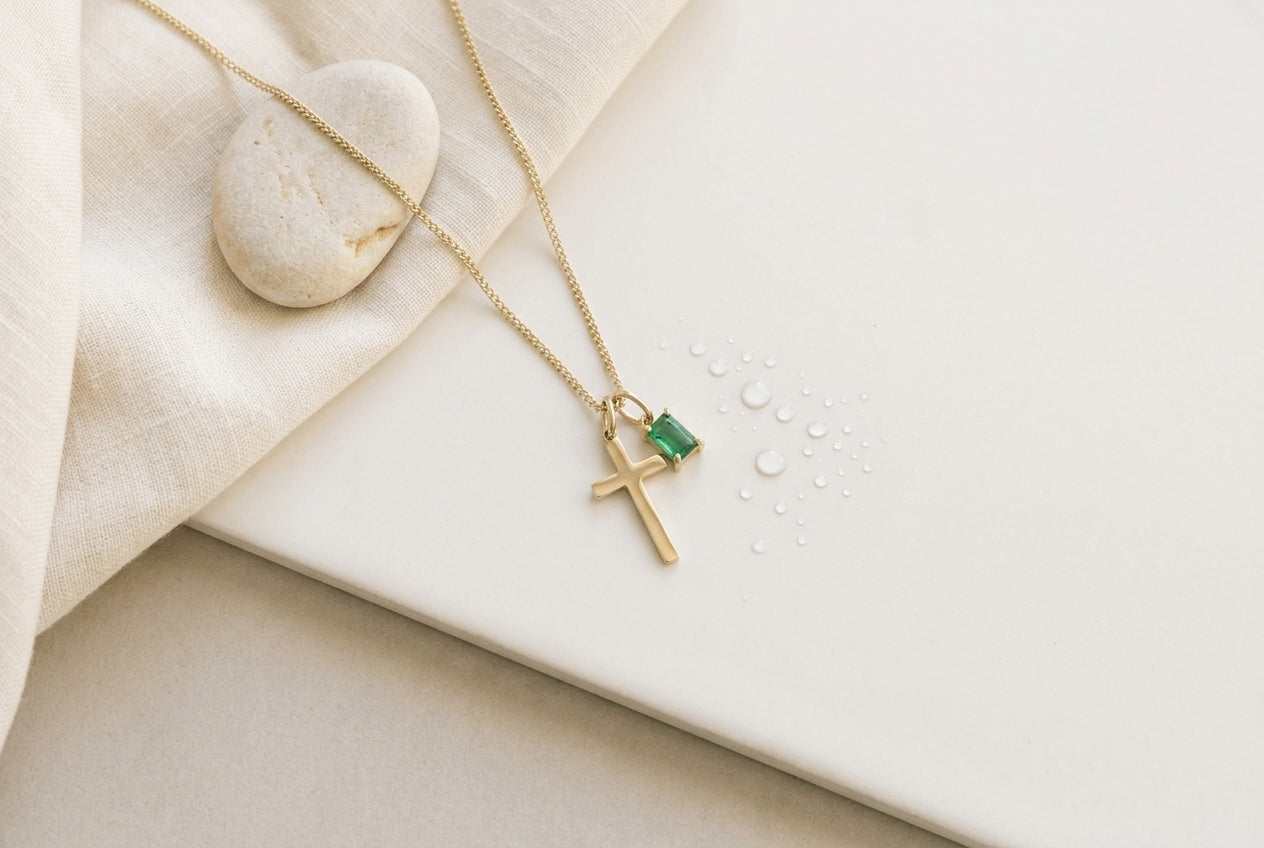
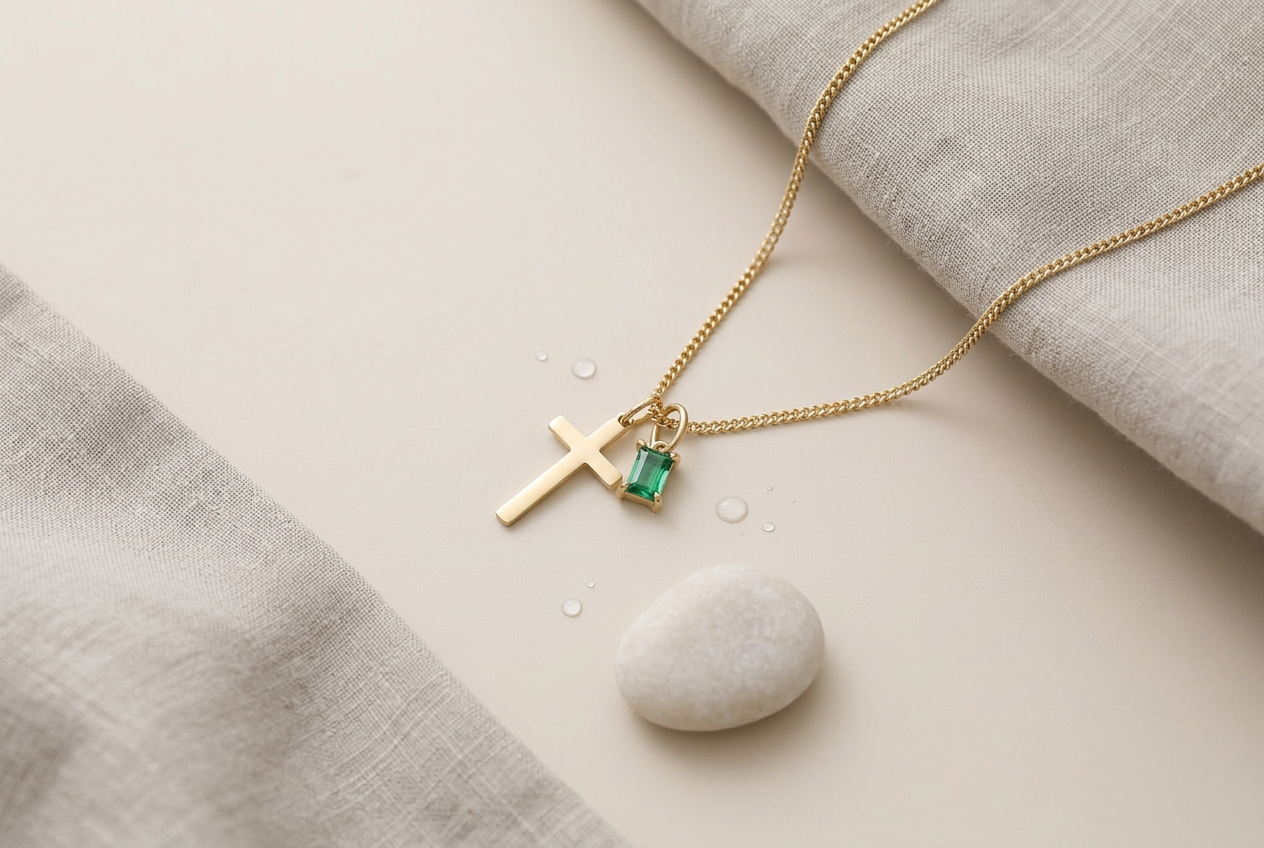
Cross and Birthstone Necklace
A sleek 18k gold-plated cross on a stainless-steel base, paired with a colorful rectangular birthstone — waterproof and tarnish-free. Cross measures 10mm×20mm; birthstone 4mm×6mm; 16"+2" chain.
Shop this necklace →Honest caveats — your real questions, answered
- Will it actually hold up in water? If the base is 316L stainless steel with PVD gold plating, yes — that steel is built to resist sweat- and chloride-driven corrosion, which is what "waterproof" honestly means for jewelry (corrosion-resistant, not literally indestructible). The CZ stones themselves are unaffected by water; the thing to protect is the plated finish from heavy abrasion over years. If a cross is plated brass with no stainless core, it is far more likely to tarnish once the coating wears.
- Will it arrive looking like the photo, or tiny? Dainty crosses are genuinely small, and that is the most common letdown when sizing isn't stated. We list real millimeters so you can picture it before it ships: the Cross and Birthstone Necklace above is a 10mm×20mm cross with a 4mm×6mm birthstone on a 16-inch chain (plus a 2-inch extender). Hold a ruler up to those numbers — that is the actual footprint, photo zoom aside.
- Am I being signed into a hidden subscription? No. Meideya charges a one-time price for the piece you choose. There is no auto-enrolled membership, no recurring "luxe" fee slipped into checkout — the number on the product page is what you pay, once.
If you want to compare a few dainty silhouettes side by side, browse the full pendant necklace collection.
Frequently asked questions
Is a dainty diamond cross necklace a real diamond?
At affordable-luxury prices, almost never. A small "diamond" cross in the $40–$60 range uses cubic zirconia, a lab-made diamond simulant that mimics a diamond's clarity and sparkle. A genuine mined or lab-grown diamond cross is a fine-jewelry purchase that costs hundreds to thousands. Honest sellers describe the stone as CZ; if a low-priced listing implies a real diamond, treat that as a red flag.
How does cubic zirconia compare to a real diamond?
CZ is engineered to look like a diamond and reads as bright and clear to the eye. The main difference is hardness: cubic zirconia rates about 8–8.5 on the Mohs scale, while diamond is a 10 — the hardest natural material. In practice that means CZ can collect surface scratches over years of constant wear, where a diamond won't. For an everyday or rotated-in cross, CZ is a sensible, affordable choice.
Will a gold-plated cross tarnish or turn my neck green?
It depends on the base metal. A cross built on 316L stainless steel with PVD gold plating resists tarnish and water well, because the steel core is corrosion-resistant. A gold-plated brass cross depends entirely on its thin coating, and once that wears the brass underneath can tarnish or react with skin. Gold plating is a thin layer (commonly 0.5–2.5 microns); it is real gold, but it is not solid gold — so look at what is underneath.
Is a stainless-steel cross safe for sensitive skin?
For most people, yes. 316L stainless steel does contain nickel (about 10–14%), but the nickel is locked into a stable alloy and the amount that actually releases onto skin is very low — well under the European Union's regulatory limit for prolonged skin contact. That is why it is widely considered hypoallergenic. People with a strong, diagnosed nickel allergy should still note that low release is not zero, but stainless steel is a far safer bet than unsealed plated brass.
How big is a dainty cross necklace?
Dainty crosses are small by design — often around 10mm wide and 20mm tall — on a short chain, typically 16 to 18 inches, that sits high on the collarbone for layering. Always check the millimeter measurements before buying so the scale matches your expectation rather than a close-up photo.
Bottom line: shop the metal, not the marketing. A dainty CZ cross on 18k gold-plated 316L stainless steel gives you the diamond-look sparkle that lasts through real life, at an honest one-time price. See also our guides on dainty gold cross necklaces and the full cross necklace collection.
,%20not%20a%20mined%20diamond%20%E2%80%94%20and%20that%20is%20fine,%20as%20long%20as%20you%20kn...)
Leave a comment
This site is protected by hCaptcha and the hCaptcha Privacy Policy and Terms of Service apply.