

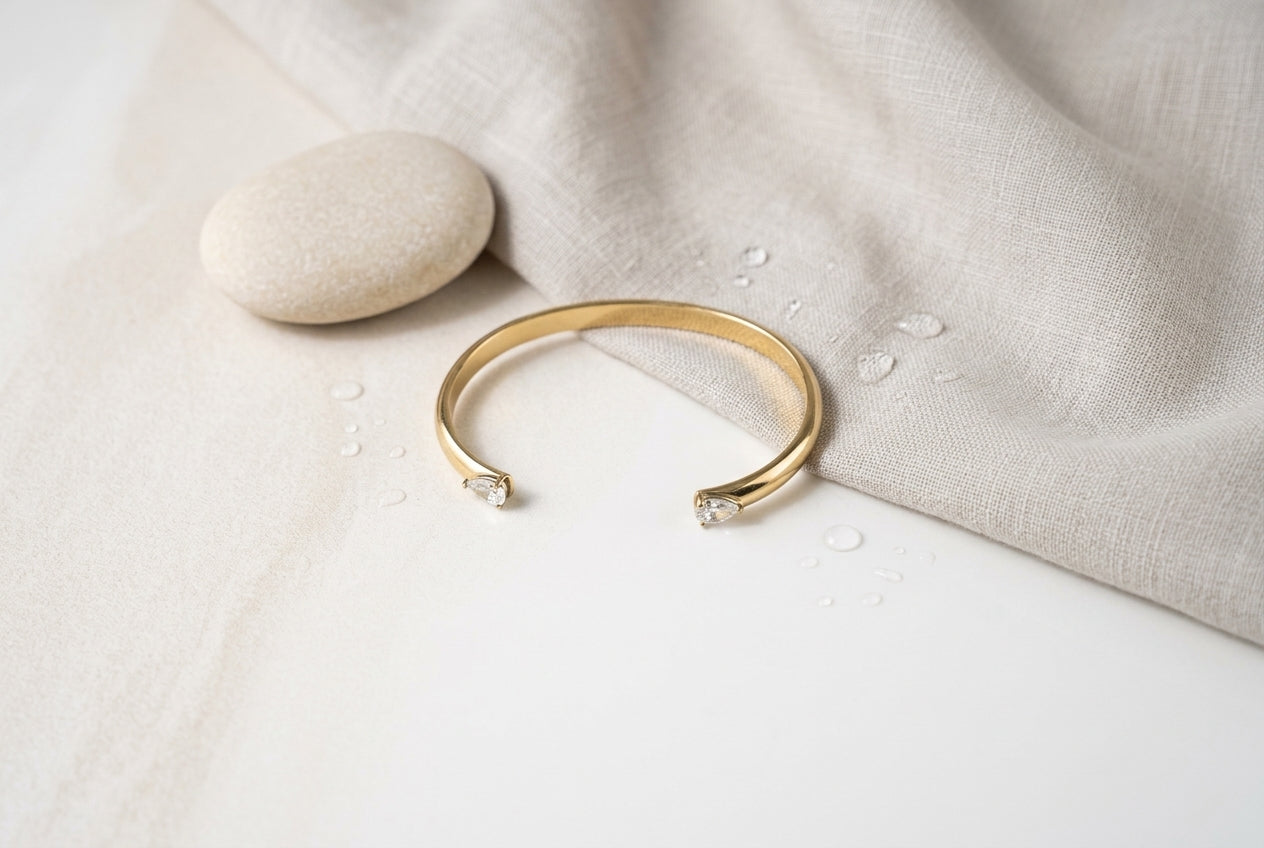
Gold cuff bracelet: A Style Guide
A gold cuff bracelet is a rigid, open-backed band that slips over the wrist without a clasp — pick one by its width, its finish quality, and whether the metal can actually survive your daily routine. This guide is for anyone who wants the bold, sculptural look of a cuff but is tired of pieces that fade or irritate sensitive skin. The decision that matters most is the metal: a thin flash of gold over a cheap core looks identical in a photo and falls apart in a month. Below: how to choose, which cuff suits which occasion, how the materials honestly compare, and the objections worth answering before you buy.
Key takeaways
- A cuff is open-backed and clasp-free — you roll it on from the underside of the wrist, so fit comes from the opening width, not a chain length.
- The finish decides longevity: 18k-gold-plated 316L stainless steel resists tarnish and water for years; a thin plate over brass does not last as long.
- Don't overpay for "solid gold" you can't see — a quality gold-plated 316L cuff gives the same look at a fraction of the cost, and the stones are honest CZ, not diamond.
- For most people, a medium-width gold-tone cuff with a clean open design is the everyday pick: dressy enough alone, easy to stack.
How to choose a gold cuff bracelet: the buyer's decision criteria
A cuff lives or dies by a few details. Before the look wins you over, run it past these:
- The base metal under the gold. Most affordable gold cuffs are plated — a gold surface bonded to a core metal. The core is what matters. A 316L stainless steel base is corrosion-resistant, water-safe, and won't turn your skin green (the green tint comes from copper in brass, not from steel). A plated-brass core can still look beautiful, but it relies entirely on the plating for protection and can react with skin over time. Check the listing for the actual base before you buy.
- Plating thickness and method. Under U.S. FTC jewelry guides, a piece can only be called "gold-plated" if it carries a gold layer of at least 10k and at least 0.175 microns thick. Better cuffs use PVD (physical vapor deposition) or thicker electroplating, which bonds the gold-tone finish more durably than a quick flash plate. Thicker, well-bonded plating is the difference between "still gold in two years" and "fading at the edges by summer."
- Width and profile. Narrow cuffs stack and read everyday; wide cuffs stand alone and read formal. Match the width to how often you'll wear it.
- Stones, and what they really are. Sparkle on an affordable cuff is almost always cubic zirconia (CZ) — a lab-made stone rated about 8–8.5 on the Mohs hardness scale. CZ is honest sparkle at an honest price; it is not a diamond (Mohs 10), and any seller calling CZ a "diamond" is misleading you.
Best cuff for each occasion
Different wrists, different jobs. Here's the quick match:
- Best for everyday wear: a medium-width, 18k-gold-plated 316L cuff with a smooth or lightly detailed open design — it survives the shower and the gym, and pairs with a watch or a stack.
- Best for sensitive skin: a cuff with a genuine 316L stainless steel base. 316L contains nickel but releases very little of it — well below EU safety limits — which is why it's a go-to for people who react to cheaper metals. Avoid unmarked plated-brass cores if you're nickel-reactive.
- Best for a gift: an open cuff in classic gold tone with a couple of CZ accents. The open design means it fits a range of wrists without you needing an exact size, and gold-tone reads as "fine" without the solid-gold price.
- Best for a stack: two or three narrow cuffs of varying texture; mixing one with CZ and two plain reads layered, not loud.
How gold cuff types compare
The label "gold cuff" hides very different pieces. Here's how the common options actually stack up — verified properties only, prices as ranges because exact figures vary by piece and sale:
| Type | Best for | Key facts (verified) | Typical price |
|---|---|---|---|
| 18k-gold-plated 316L stainless steel | Everyday, sensitive skin, water exposure | 316L releases minimal nickel (below EU limits); plating ≥0.175 micron per FTC; waterproof, won't turn skin green | ~$30–$80 |
| 18k-gold-plated brass | A specific look at a low price | Relies fully on plating for protection; copper content can tint skin if plating wears; not inherently hypoallergenic | ~$15–$50 |
| Gold vermeil (plated sterling silver) | A precious-metal core under the gold | FTC requires sterling base + ≥2.5-micron, ≥10k gold layer; softer than steel, can tarnish where plating thins | ~$60–$150 |
| Gold-filled | Long-lasting plated look | FTC requires gold layer ≥1/20 of total weight — far thicker than plating; durable but pricier | ~$80–$200 |
| Solid 14k/18k gold | Heirloom, maximum longevity | 14k = 58.3% gold, 18k = 75% gold; no plating to wear off | $$$ (hundreds+) |
The honest takeaway: for a cuff you'll actually wear in the shower and at the gym, plated 316L wins on value and durability. Vermeil and gold-filled get you closer to a precious-metal core; solid gold is the heirloom play if budget allows.

Tearlight Cuff Bracelet
Its open design and polished gold tone create a timeless balance between minimalism and elegance.
Shop this cuff →Honest caveats — the real objections
- Will it actually hold up? A gold-plated 316L cuff is corrosion-resistant and built for water and sweat — shower, swim, and work out in it without tarnishing. Be clear-eyed, though: plating is a surface layer. It resists wear for years, not forever, and friction at high-contact spots eventually shows on any plated piece — ours included.
- Will it arrive looking like the photo? Cuffs are rigid, so the shape you see is the shape you get — no chain to drape unpredictably. The fit comes from the opening: measure your wrist, then plan for the open gap (typically about half an inch to an inch). You can gently bend an open cuff at the middle to adjust it — but do it once and leave it. Repeated flexing weakens any metal over time.
- Are the stones real diamonds? No, and we won't pretend otherwise. The sparkle on an affordable cuff is cubic zirconia — a lab-made stone that's genuinely brilliant and rated about 8–8.5 on the Mohs scale, but it is not a mined diamond. CZ is honest, affordable sparkle.
- Is it solid gold? No. A plated cuff is gold-tone over a base metal (316L stainless, in our case), not solid gold. That's exactly why it costs a fraction of the price while giving the same look — and we'd rather tell you than let you assume.
- Any hidden costs? None. The price you see is a one-time price. No subscription, no auto-enrollment, no "membership" to keep your bracelet — something worth checking before you buy from anyone.
If you want to see the range of widths and styles before deciding, browse the full All Bracelets collection.
Frequently asked questions
What is the difference between a cuff bracelet and a bangle?
A cuff is a rigid or semi-rigid band with an open back — you slide it on through a small gap and it stays put without a clasp. A bangle is a fully closed circle that slips over your hand. Cuffs let you adjust the fit by gently bending the opening; bangles rely on choosing the right diameter.
How do I size an open gold cuff bracelet?
Wrap a strip of paper snugly around your wrist over the wrist bone, mark where it overlaps, and measure that length — that's your wrist circumference. Then subtract for the opening gap, which on most cuffs runs about half an inch to an inch. Because open cuffs flex slightly at the middle, they fit a forgiving range of wrist sizes.
Will a gold-plated cuff turn my skin green or tarnish?
A cuff with a 316L stainless steel base won't turn your skin green — that tint comes from copper in brass, and steel has none. A quality 18k-gold-plated 316L cuff is also waterproof and tarnish-resistant for years. The plating is still a surface layer, so it isn't permanent, but everyday wear including showers and workouts is fine.
Is a gold cuff safe for sensitive skin?
If it has a genuine 316L stainless steel base, it's a strong choice. 316L contains nickel but releases very little — below EU safety thresholds — which is why it's widely used for sensitive skin. "Hypoallergenic" means low risk, not zero risk, and individual reactions vary, so the safest bet is a verified 316L base rather than an unmarked plated-brass one.
Are the stones on a gold cuff real diamonds?
On affordable cuffs, the sparkle is almost always cubic zirconia (CZ), a lab-created stone rated about 8–8.5 on the Mohs hardness scale. It is genuinely brilliant but is not a mined diamond (which is a 10 on that scale). CZ is honest, budget-friendly sparkle — any seller calling it a diamond is being misleading.
The buying rule stays simple: choose the cuff by the metal under the gold, the width that fits your day, and a seller who tells you plainly what the stones are. Get those right and a gold cuff is one of the most wearable, hard-working pieces in a jewelry box. For a softer, more delicate take on the same idea, see our guide to dainty gold bracelets.

Leave a comment
This site is protected by hCaptcha and the hCaptcha Privacy Policy and Terms of Service apply.