

Article: How to Store Jewelry So It Actually Lasts
How to Store Jewelry So It Actually Lasts
Store jewelry clean, dry, dark and separated — one piece per compartment or pouch, in a cool room that isn't the bathroom. Most guides stop there, which treats a drawer like one problem when it is really three: tarnish is chemistry, worn plating is friction, knotted chains are slack and movement. Each has a different fix, and buying the wrong one is why "properly stored" pieces still come out looking tired.
Key takeaways
- Clean, dry, separated and out of the bathroom covers most of it. The rest depends on the material.
- Tarnish is chemical, abrasion is mechanical, tangling is geometric — anti-tarnish strips only address the first.
- The classic felt-lined wooden jewelry box is a poor home for sterling silver: felt and wool carry sulphur compounds, and plywood and chipboard release formaldehyde.
- Gold-plated and stainless pieces don't sit and tarnish in a dry drawer the way silver does — they wear. Stop them touching and you've solved most of it.
Your jewelry has four homes, and each fails differently
Before you buy an organizer, work out where your pieces actually spend their off-hours.
- The nightly drop. The dish where everything lands at 11pm. This is where humidity and contact overlap — and it's the easiest of the four to fix: move it out of the bathroom, add dividers.
- The long-term drawer. Pieces worn a few times a year. Nothing gets knocked around, so the risk is slow chemistry — the one place anti-tarnish materials earn their keep.
- The travel bag. Everything moves at once for hours: chains knot, clasps scrape plating, hard stones sand soft ones. Individual pouches beat one clever case.
- The gym bag. Damp, loose, forgotten. No storage fixes this — wear something that handles the day instead.
Three failure modes, three different fixes
- Tarnish is chemical. Silver corrodes into black silver sulphide, and conservation guidance names the culprits: sulphur compounds in the air (hydrogen sulphide) from car exhausts, rubber products and cigarette smoke, plus protein-based materials such as wool, felt, silk and leather, and acids from cardboard, paper and plastics such as PVC (Museum of Applied Arts & Sciences conservation sheet). The fix is to remove the gas and drop the humidity: a charcoal cloth or silver-impregnated cotton bag, acid-free tissue, a sealed polyethylene bag. The EPA advises keeping indoor relative humidity below 60%, ideally 30–50% (US EPA), and a bathroom sits well above that whenever the shower runs. The same conservation sheet puts the silver-specific line in the same place: in a damp environment over 60%, dust settled on the metal absorbs moisture and starts corroding it.
- Abrasion is mechanical. Gold is chemically unreactive (Royal Society of Chemistry), so plating doesn't sit and tarnish in a drawer — it disappears because something harder sands it off. No sachet helps, only separation.
- Tangling is geometric. A chain knots when it has slack and something to move it. Remove either: fasten the clasp, then hang it or lay it flat in its own channel instead of coiling it into a pile.
Match the storage to the piece, not to the whole box
Once you know the failure mode, the per-material rules get short. Sterling silver is the metal most likely to tarnish just sitting in a drawer — it reacts with the sulphur compounds in ordinary indoor air, no contact required — so it alone earns the sealed bag and the charcoal cloth. Plated pieces, over steel or brass, mainly need to stop touching harder things. Pearls need their own rules: pearl sits at 2.5 on the Mohs scale, "very soft and easily scratched or abraded," and is damaged by many chemicals and all acids, including hairspray, perfume and perspiration (GIA). The table below puts it side by side.

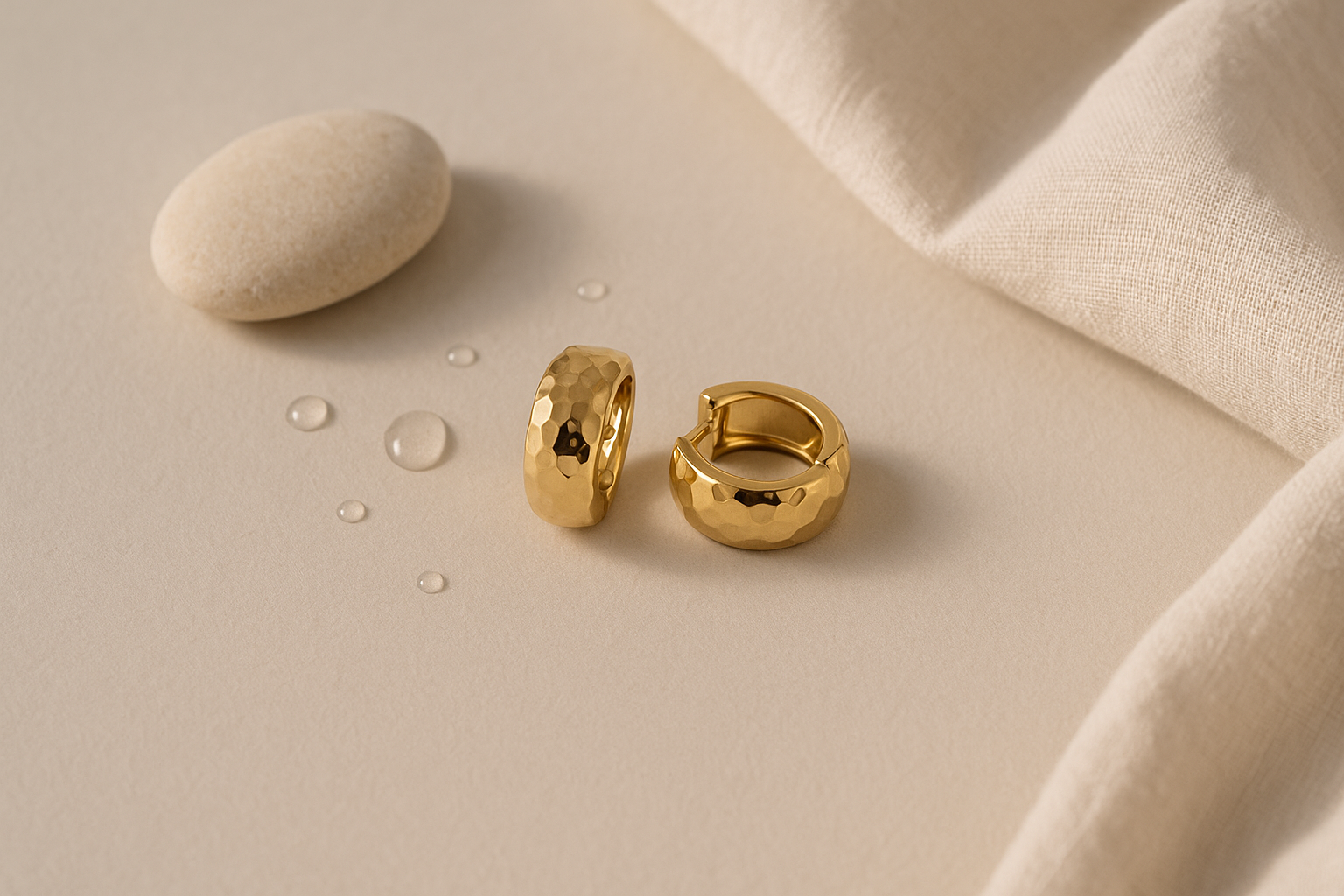
Hammered Small Hoops
18k gold plating over a stainless-steel base, tagged waterproof and tarnish-free — a hammered everyday hoop that stays in the rotation instead of the drawer.
Shop this hoop →The mistakes that quietly do the damage
- Storing it in the bathroom. Convenient — and the room where humidity spikes hardest, every day.
- One dish for everything. Every piece is sanding every other piece — this is how plating goes patchy on jewelry that was barely worn.
- Felt, silk or a wooden box, for silver. Felt and silk are both on the conservation sulphur list, and wooden cabinets built from plywood or chipboard release formaldehyde, which corrodes silver. Fine for plated pieces, poor for a silver chain.
- Rubber bands, cardboard, newspaper. Rubber products are a named source of the sulphur gas that tarnishes silver, and cardboard and paper are named acid sources — so bundling a silver chain with a rubber band puts the problem in direct contact with it.
- Putting it away dirty or damp. The salts and grease from fingerprints keep corroding after the drawer closes, and an airtight bag over a wet piece traps exactly what you were avoiding.
The sixty-second habit that does most of the work
None of this needs to become a hobby. Wipe each piece with a soft, dry, lint-free cloth when you take it off, give it a minute of air before anything is sealed, and put it back in the same slot every time.
An honest note on our own pieces: most Meideya jewelry is 18k gold plating over a stainless-steel base, with a small number of sterling silver and gold-plated brass styles — and none of it is solid gold. On a plated piece you're protecting a surface, not a metal, so we'd rather you bought separate pouches than tarnish sachets a plated hoop will never use. If you own one of our sterling silver styles, treat that one by the silver row below.
Quick reference: what each piece actually needs
| Piece | What goes wrong | What fixes it | What's wasted on it |
|---|---|---|---|
| Sterling silver (925) | Tarnish (silver sulphide) | Sealed polyethylene bag, acid-free tissue, charcoal cloth | Felt-lined boxes, silk pouches, rubber bands |
| 18k gold-plated stainless steel | Plating wear from contact | Its own pouch — nothing else | Anti-tarnish strips; no tarnish reaction to absorb |
| Gold-plated brass | Plating wear, then a reactive base | Separation, plus fully dry | Abrasive polishes; they take the plating too |
| Pearls and soft stones | Scratches; acids and perfume | Own soft pouch, wiped, laid flat | Ultrasonic and steam cleaners (GIA rules them out) |
| Solid gold (fine jewelry) | Scratches and dings; lower-karat alloys can dull | Its own slot, away from stones | Silver-grade anti-tarnish kits |
Read down the last column: the things sold as a "jewelry storage" upgrade — anti-tarnish strips, charcoal sachets, tarnish-inhibiting cloth linings — are all built for silver, and a drawer of plated and stainless everyday pieces isn't silver. If yours leans waterproof and everyday, the routine collapses to separation and a dry cloth — which is what our own stainless steel jewelry collection is built around.
Frequently asked questions
What is the best way to store jewelry at home?
Store each piece clean, dry and separated, in a cool, dark, low-humidity room that isn't the bathroom. Individual compartments or soft pouches fix the two commonest problems at once: pieces stop scratching each other and chains stop tangling. Add anti-tarnish materials only for what actually tarnishes — usually just sterling silver.
Should I store jewelry in the bathroom?
No. The EPA advises keeping indoor relative humidity below 60%, and ideally between 30% and 50%; a bathroom runs well above that whenever the shower does. Conservation guidance is stricter still for silver: in a damp environment over 60%, dust settled on the metal absorbs moisture and starts corroding it. And a piece put away damp keeps the salts and grease from your skin in contact with the metal, which is corrosive in its own right. Move your drop spot to a dresser.
Do anti-tarnish strips work on gold-plated and stainless steel jewelry?
Not meaningfully. They work by absorbing the sulphur-containing gases behind the reaction that darkens silver. Gold is chemically unreactive, and stainless steel resists corrosion through a chromium-oxide film that reforms on its own in air, so neither produces the tarnish those products are designed to capture. For plated and stainless pieces, separation is the upgrade worth paying for.
How do I keep necklace chains from tangling in a drawer?
Remove the slack and the movement. Fasten the clasp before you put a chain away, then hang it or lay it flat in its own pouch so it can't fold back on itself. Knots form when a loose chain can shift around in a shared space — which is why a pile tangles and a hung chain doesn't.
Is it bad to store jewelry in a felt-lined or wooden jewelry box?
It depends what's inside. For gold-plated, stainless steel and solid gold pieces it's fine, and the lining prevents scratches. For sterling silver it's a poor choice: conservation guidance identifies wool and felt as protein-based materials containing sulphur compounds harmful to silver, and notes that wood products such as plywood and chipboard contain formaldehyde, which causes silver to corrode. Keep silver in a sealed bag instead.
Good storage isn't a shopping list — it's knowing which failure mode your pieces face, and buying only for that. For a rotation that sidesteps the question, see our guides to everyday jewelry and non-tarnish rings for everyday wear.

Leave a comment
This site is protected by hCaptcha and the hCaptcha Privacy Policy and Terms of Service apply.