

Small Stud Earrings: A Style & Buyer's Guide
For everyday wear, a small stud earring in the 3–5 mm range is the sweet spot: small enough to stay subtle and comfortable, big enough to read as "finished" rather than invisible. The harder question isn't the size — it's what the stud is made of, because a tiny earring sits against your skin all day and the metal decides whether it tarnishes, irritates, or lasts. This guide covers how to pick a size, which scenario calls for which stud, and how plated stainless steel actually compares to solid gold and a mined diamond — honestly.
Key takeaways
- 3–5 mm is the everyday size. 2–4 mm reads as delicate (and is the usual pick for a second piercing); 5–6 mm is the most popular "noticeable but understated" stud.
- The metal matters more than the size. For all-day, get-it-wet wear, the deciding factor is whether the metal resists tarnish and releases little nickel — not how shiny it looks in the listing photo.
- Don't overpay for "diamond" sparkle you can't tell apart. At stud scale, a quality cubic zirconia (CZ) reads as bright white sparkle; the price gap to a mined diamond buys hardness you'll rarely test on a 4 mm stud.
- Quick pick: for waterproof everyday studs that won't turn your ears green, 18k-gold-plated 316L stainless steel with CZ is the practical default — just know it's plated, not solid gold.
How to choose: the buyer's decision criteria
A stud is the lowest-maintenance earring there is, which is exactly why people wear them every single day. That changes what you should optimize for — durability and skin-comfort beat "biggest sparkle." Here is what actually decides a good everyday stud:
- Size, in millimeters. Studs are measured by the diameter (or longest dimension) of the stone. If you have smaller lobes, 3–5 mm looks more refined; fuller lobes can carry 6 mm and up. Check the millimeters on the listing, not the photo.
- The metal that touches your skin. This is the real durability question. Solid gold never tarnishes but costs the most; gold-plated is affordable but the gold is a surface layer (it resists tarnish for years, not forever). The base metal underneath matters most — see the comparison below.
- The stone. A "diamond" stud can be a mined diamond, a lab-grown diamond, moissanite, or cubic zirconia. They look broadly similar at small scale but differ enormously in price and hardness (how well they resist scratching over years).
- Skin sensitivity. If your last cheap pair made your ears itch or weep, the culprit is almost always nickel — the single most common contact allergen (per the American Academy of Dermatology and Mayo Clinic). The fix is a metal that releases very little nickel, which is where surgical-grade 316L stainless steel earns its reputation.
- Backing and security. Push-backs are easiest; screw-backs and locking backs are worth it for studs you sleep in or never want to lose — independent of size or stone.
Best for X — scenario-based picks
Different buyers want different things from a "small stud." Match the stud to how you'll actually wear it:
- Best for everyday, low-maintenance wear: a 4–5 mm 18k-gold-plated 316L stainless-steel stud with CZ — it survives the shower, gym, and beach without you taking it off, and the size disappears into any outfit.
- Best for sensitive skin: 316L stainless steel (or titanium for an extreme nickel allergy). Its very low nickel release makes it safe for the vast majority of people who react to costume jewelry.
- Best for a second or third piercing: a tiny 2–4 mm stud, which sits proportionally next to a larger first-hole stud and reads as intentional, not crowded.
- Best for an heirloom or gift to keep: a solid-gold setting with a mined or lab-grown diamond — the only option that's both tarnish-proof at the metal level and maximally scratch-resistant at the stone level. Expect to pay for it.
- Best for a budget gift that still looks luxe: a plated stainless stud with CZ — affordable-luxury looks without the heirloom price, as long as the recipient knows it's plated.
- Best for stacking: a small cluster or curved stud that follows the ear line, so it layers cleanly with hoops and other studs up the lobe.
Solid gold vs gold-plated vs gold-filled (and CZ vs diamond)
"Gold" on a product page can mean four very different things, and the FTC actually defines them. Here is how the metal options compare, plus how the common stone choices stack up — verified figures and honest price ranges only.
| Option | What it actually is | Key spec (verified) | Typical stud price |
|---|---|---|---|
| Solid gold | Gold alloy all the way through | 14k = 58.3% pure gold; 18k = 75% pure. Never tarnishes. | $$$ — hundreds and up |
| Gold-filled | A bonded gold layer over base metal | FTC: gold layer ≥ 1/20 (5%) of the item's weight, ≥ 10k. Thicker and longer-lasting than plating. | $$ — mid-range |
| Gold vermeil | Gold over a sterling silver base | FTC: ≥ 2.5 micron of ≥ 10k gold on sterling. | $$ — mid-range |
| Gold-plated | A thin gold layer over base metal (e.g. 316L steel) | FTC: ≥ 0.175 micron of ≥ 10k gold. Surface layer — resists tarnish for years, not forever. | $ — most affordable |
On the stone side, what you're really buying is hardness, which is what keeps a stud bright over years of wear:
| Stone | What it is | Mohs hardness (verified) | Honest trade-off |
|---|---|---|---|
| Mined diamond | Natural carbon crystal | 10 (hardest mineral) | Most scratch-resistant; highest price. |
| Moissanite | Lab-created silicon carbide | 9.25 | Very durable, more fire than diamond; mid price. |
| Cubic zirconia (CZ) | Synthetic zirconium dioxide | 8.5 | Bright white sparkle, lowest price; can micro-scratch or cloud over years. |
The takeaway: for a small everyday stud, plated stainless with CZ wins on value — the differences in stone hardness and metal purity are real but rarely the thing you notice on a 4 mm earring. For a forever piece, solid gold with a diamond is the only no-compromise column.

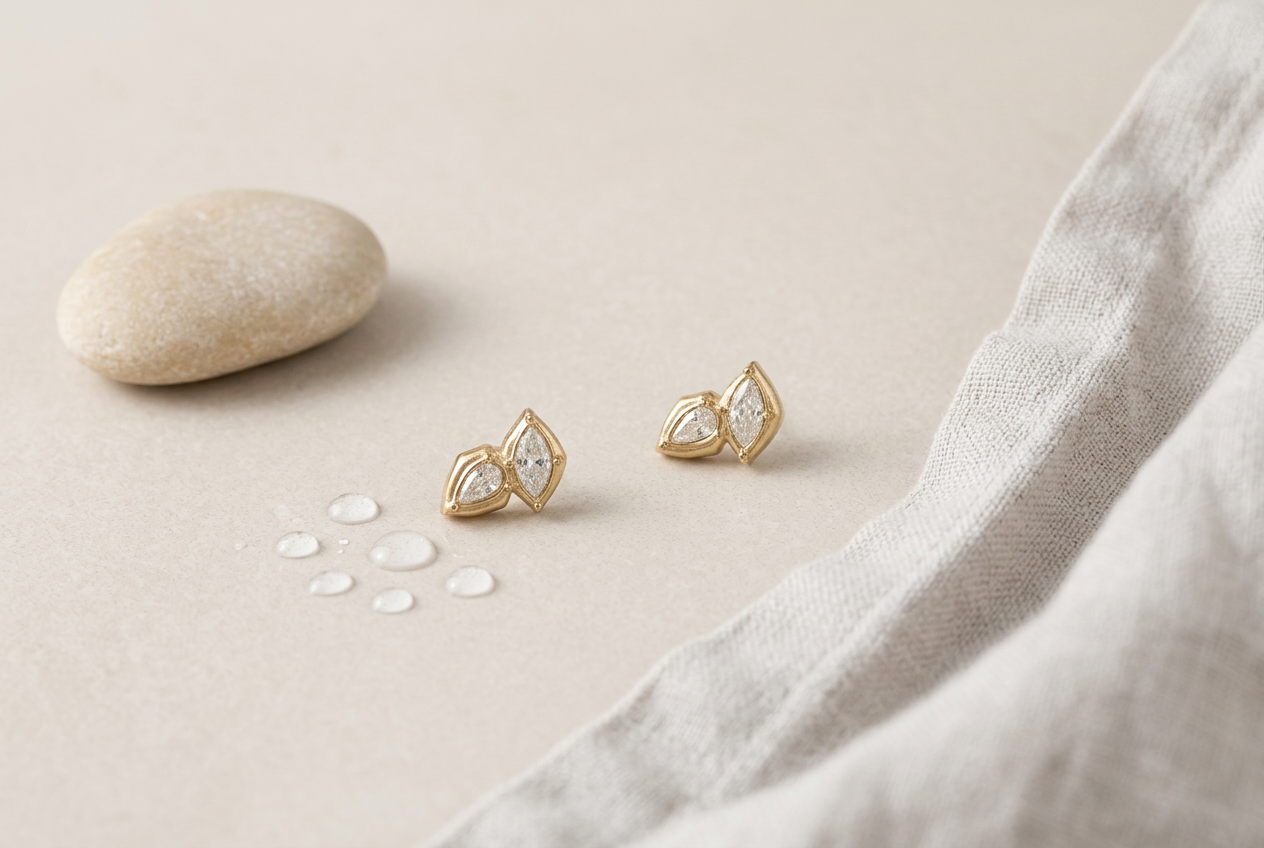
Bella Stud Earrings
A marquise-and-pear-cut CZ cluster that follows the natural curve of your ear — designed to look like mini crawler studs and made for earstacking.
Shop this stud →Honest caveats — answering the real objections
- Is it actually waterproof, or will it tarnish like my last gold-plated set? The base metal here is 316L stainless steel, which is corrosion-resistant — it won't rust or turn your ears green the way plated brass does. The gold tone is plating, so the honest line is "waterproof and tarnish-resistant for everyday life," not "indestructible — plated forever." If your last set went dull fast, it was likely thin plating over brass, which is a different (and cheaper) construction.
- Will it arrive looking tiny compared to the photo? Studs photograph larger than they wear, so go by the millimeters: a 3 mm stud is a subtle dot, 4–5 mm is the everyday size most people picture, and 5–6 mm is the largest that still reads as "small." Meideya pieces are dainty by design — if you want presence across a room, size up rather than expecting a 3 mm stud to look bigger than it is.
- Any hidden subscription or recurring charge? No. It's a one-time purchase — you pay once for the earrings, full stop. No membership to cancel, no auto-enrollment.
Ready to browse by size and finish? Explore the full stainless-steel earrings collection.
Frequently asked questions
What size is a small stud earring?
Small studs generally run 2–6 mm. The 3–5 mm range is the everyday sweet spot — subtle and comfortable but still visible. The single most popular size is 5–6 mm, which balances "noticeable" with "understated," while 2–4 mm reads as delicate and is the usual choice for a second or third piercing.
Are stainless-steel stud earrings good for sensitive ears?
Yes, for most people. Skin reactions to earrings are almost always caused by nickel, the most common contact allergen (per the American Academy of Dermatology and Mayo Clinic). Surgical-grade 316L stainless steel contains nickel but releases very little of it because the nickel is locked tightly in the alloy, so it's safe for the vast majority of people with sensitive skin. If you have an extreme nickel allergy, titanium or niobium — which contain no nickel — are the safest options.
Do gold-plated stud earrings turn your ears green?
Plated jewelry only turns skin green when the base metal underneath is brass, because brass contains copper, and copper is what reacts with skin to leave a green mark. Gold plating over 316L stainless steel does not cause green skin, since stainless steel doesn't react that way. Green marks are a base-metal problem, not a gold-plating problem.
Is cubic zirconia a good choice for stud earrings?
For an everyday stud, yes. Cubic zirconia is a synthetic stone that reads as bright white sparkle at a fraction of a diamond's price. Its trade-off is hardness: CZ sits at 8.5 on the Mohs scale versus moissanite at 9.25 and diamond at 10, so it can micro-scratch or cloud over years of heavy wear. For a small stud you rotate through, that trade-off is usually worth the savings; for a forever piece, a diamond or moissanite holds up longer.
How can I tell if a stud is solid gold or just gold-plated?
Check how "gold" is described against the FTC definitions. Solid gold is a gold alloy throughout, stamped with its karat (14k = 58.3% pure, 18k = 75%). "Gold-filled" means a bonded gold layer that's at least 1/20 of the item's weight; "vermeil" is at least 2.5 micron of gold over sterling silver; and "gold-plated" only requires a 0.175-micron gold layer over a base metal. If a piece is labeled gold-plated or gold-tone, it isn't solid gold — it's a thin gold surface over another metal, which is why it costs far less.
Bottom line: pick the size by your lobe and your piercing (3–5 mm for everyday), then let the metal and stone decide based on how hard you'll wear it — plated stainless with CZ for affordable, get-it-wet daily studs; solid gold with a diamond for a forever piece. See also our guide on 18k gold-plated gold earrings.

Leave a comment
This site is protected by hCaptcha and the hCaptcha Privacy Policy and Terms of Service apply.