

Dainty Gold Cross Necklace: The Honest Buyer's Guide
A dainty gold cross necklace is a small, fine-chain pendant in a gold tone — and the honest decision comes down to one trade-off: solid gold lasts a lifetime but costs hundreds, while 18k gold-plated stainless steel gives you the same delicate look for $40–$55 and survives daily wear if the base metal is right. This guide is for anyone who wants a cross they can layer and forget about — wear it in the shower, at the gym, every day — without paying solid-gold money or babying it. We will cover what "gold" actually means on a price tag, how to read the real scale before you buy, and the one objection that catfishes most online shoppers.
Key takeaways
- "Dainty gold" almost always means gold-plated, not solid gold — at $40–$55 it has to be. The question is what's underneath the plating.
- The decision criterion that matters most is the base metal: 18k gold-plated 316L stainless steel resists tarnish and water far better than plated brass at the same price.
- Don't overpay for "solid gold" if you mostly want the everyday look — but don't expect any plated piece to last forever, either. Plating wears; the trade is durability for affordability.
- Quick pick: for a delicate, waterproof everyday cross, a 316L stainless-steel base with 18k gold plating in the $40–$55 range is the sweet spot.
What "gold" really means on a $50 cross — and why it matters
The word "gold" hides three very different products. Knowing which one you're buying is the whole game with a dainty cross necklace, because the price is too low for solid gold and the marketing rarely spells it out.
- Solid gold (10k/14k/18k). The entire piece is a gold alloy — 14k is roughly 58% gold, 18k roughly 75%. It never tarnishes, but a dainty solid-gold cross runs into the hundreds of dollars. It's an heirloom buy, not an everyday-impulse buy.
- Gold-filled. A thick layer of real gold — by the FTC standard, at least 1/20 (5%) of the item's total weight, and at least 10k fineness — is mechanically bonded to a base metal. It wears far longer than plating, often many years, and sits in a mid price band, but it's still not solid gold.
- Gold-plated. A thin micron layer of gold is electroplated over a base metal. This is what nearly every affordable "dainty gold" cross is, including ours. The honest caveat: the plating wears over time, and base-metal atoms (copper especially, from a brass base) can slowly diffuse up into the thin gold layer — so the base metal underneath decides how well it holds up.
That last point is the one most buyers miss. Two plated crosses can look identical online and cost the same, yet one is plated brass (which can tarnish and react with sensitive skin) and the other is plated over 316L stainless steel (corrosion-resistant, very low nickel release). The finish is the same gold; the durability is not.
How to choose: the buyer's decision criteria
Skip the photo styling and check four things on the product page before you add to cart.
- Base metal. Look for an explicit "stainless steel base" or "316L." 316L is the grade used in surgical tools and marine hardware — its ~2–3% molybdenum content gives it pitting and chloride resistance that plain 304 and brass don't have, which is exactly why it shrugs off sweat, chlorine, and salt water.
- Plating spec. "18k gold plated" tells you the gold tone and that it's plated, not solid. Pair good plating with a stainless base and you get a piece that keeps its color through everyday wear.
- Real scale in millimeters. "Dainty" should be a deliberate choice, not a surprise. A listing that publishes actual mm dimensions for the cross and chain is telling you it won't catfish you — more on this below.
- One-time price, stated plainly. The price you see should be the price you pay — no membership, no auto-enrollment at checkout. Some popular brands quietly sign you up for a recurring "luxe" fee. A trustworthy listing has nothing to bury.
Best for X — scenario-based picks
Different buyers want different things from a cross. Match yours to the right trade-off.
- Best for everyday + water: 18k gold-plated 316L stainless steel. It's the only affordable option built to survive showers, workouts, and the beach without tarnishing.
- Best for an heirloom or a milestone gift: solid 14k/18k gold — if the budget is there. It lasts forever and re-sells, but you're paying several times more for a similar look.
- Best for "looks delicate but I'm rough on jewelry": gold-filled, if you can find a dainty cross in it — the thick bonded gold layer outlasts plating.
- Best for sensitive skin on a budget: a stainless-steel-based plated cross. 316L releases nickel well under the EU EN 1811 limit, so it's a safer bet than plated brass, which can react.
- Best for a personalized touch: a cross with a birthstone or initial accent — meaningful without losing the dainty silhouette.
Gold-plated stainless vs gold-filled vs solid gold
Here's how the three real options compare on the things that decide a daily-wear cross. Prices are typical market ranges, not exact quotes.
| Option | Best for | Key spec (verified) | Typical price (dainty cross) |
|---|---|---|---|
| 18k gold-plated 316L stainless | Everyday, water, sensitive skin, budget | Thin gold layer over corrosion-resistant 316L (2–3% molybdenum); very low nickel release | $36–$55 |
| Gold-filled | Daily wear with longer color life | Bonded gold layer ≥1/20 (5%) of total weight, ≥10k (FTC); wears years longer than plating | ~$60–$200+ |
| Solid 14k/18k gold | Heirloom / milestone gift | 14k ≈ 58% gold, 18k ≈ 75%; never tarnishes | $200–$800+ |
| Gold-plated brass (avoid for water) | Looks only, occasional wear | Same gold tone, but brass base can tarnish and react with skin | $15–$50 |
The takeaway: if you want the dainty gold look and you want to actually live in it, plated-over-316L wins on value. Pay up to gold-filled or solid gold only if longevity outranks price for you — and steer clear of a plated-brass base if water and skin contact are part of the deal.

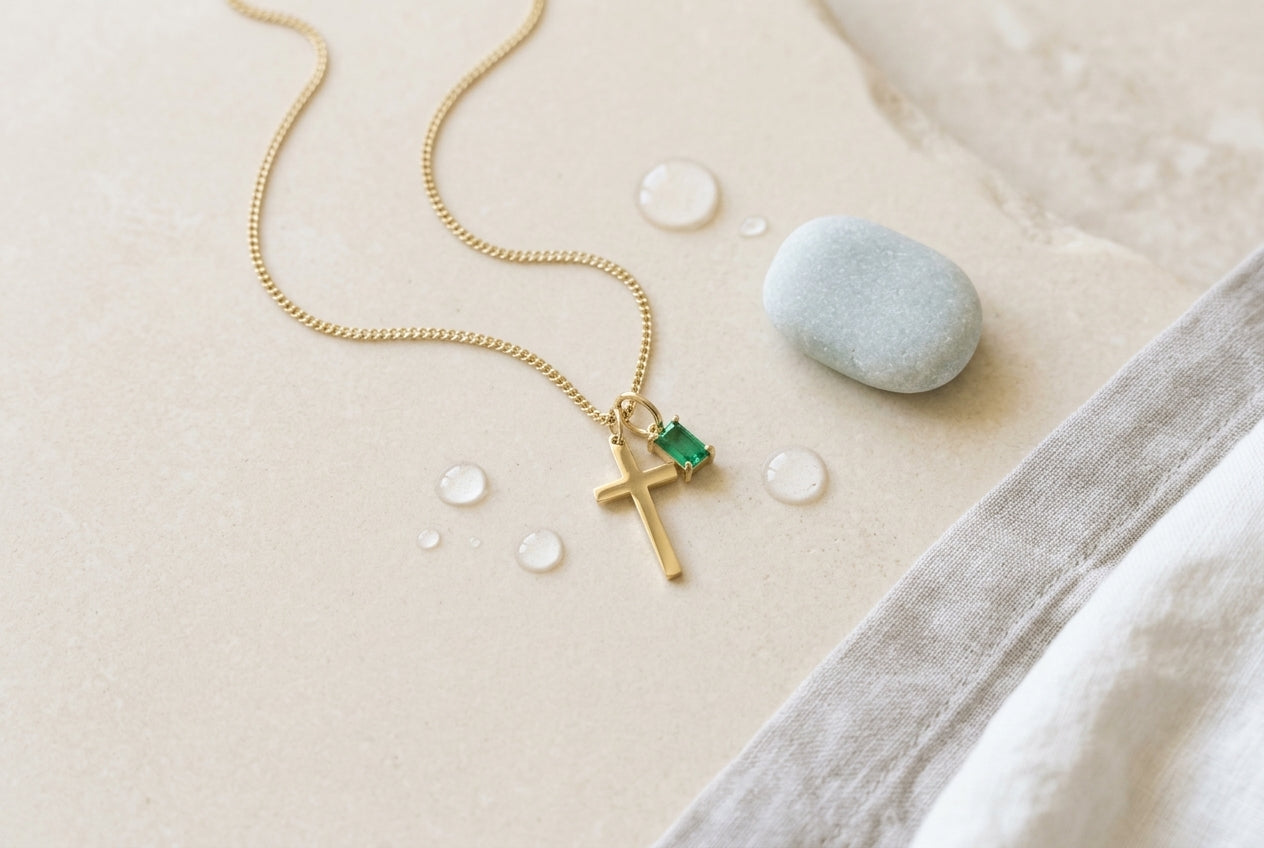
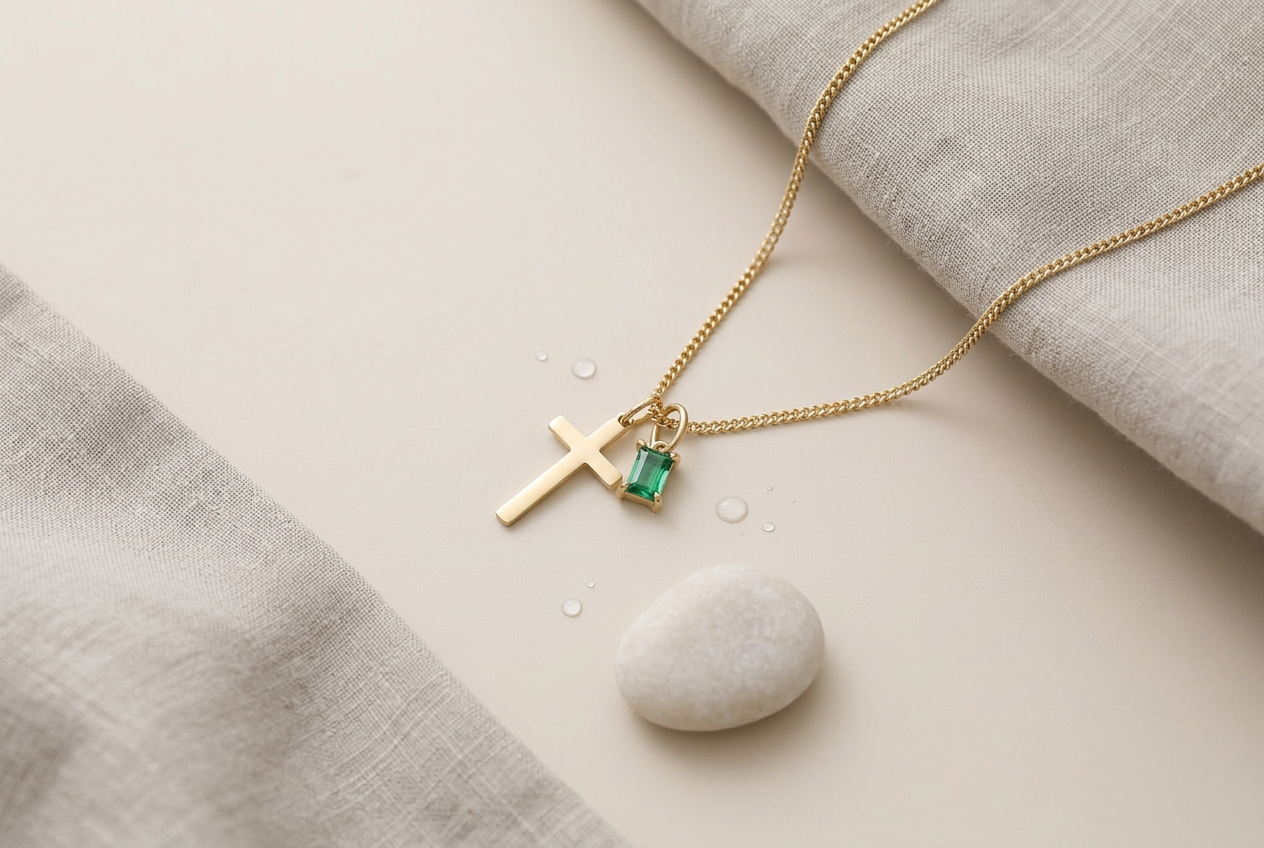
Cross and Birthstone Necklace
A sleek 18k gold-plated cross on a stainless-steel base — waterproof and tarnish-free — with a delicate rectangular birthstone (4mm x 6mm) for a personalized everyday charm.
Shop this necklace →Honest caveats — the real objections, answered
- Is it actually waterproof, or will it tarnish like my last "gold-plated" set? On a 316L stainless-steel base, yes — it's built for the shower, gym, and beach. 316L resists corrosion because of its molybdenum content, and the gold plating sits on a base that won't rust underneath. Be honest with yourself about one thing: plating is still plating, so very heavy daily wear over years can show eventually. A stainless base is what keeps that horizon far out instead of a few weeks.
- Will it arrive looking like the photo, or tiny and unrecognizable? This is the most common online-jewelry complaint, and the fix is simple: buy by the millimeter, not the styled photo. "Dainty" means deliberately small and fine — our Cross and Birthstone Necklace, for example, has a 4mm x 6mm birthstone accent, so you know the scale before it ships. A listing that hides its dimensions is the one to be wary of.
- Am I being signed up for a hidden monthly fee? No. The price is one-time, full stop — no membership, no "luxe" auto-enrollment slipped in at express checkout. You buy the necklace and you're done. If you've ever been surprised by a recurring charge from a jewelry brand, that's a deal-breaker we don't make you accept.
Want to see the dainty gold crosses side by side before deciding? Browse the full pendant necklace collection.
Frequently asked questions
Is a dainty gold cross necklace real gold?
At the affordable price point, almost always no — it's 18k gold-plated, meaning a thin layer of real gold is electroplated over a base metal. Solid gold dainty crosses exist but cost several hundred dollars. The smart middle ground is 18k gold plating over a 316L stainless-steel base, which gives you the gold look for $36–$55 while resisting tarnish and water.
Will a gold-plated cross necklace tarnish or turn my skin green?
It depends on the base metal. Gold plating over 316L stainless steel resists tarnish and corrosion and releases very little nickel, so it's well suited to daily and water wear. Gold plating over brass is the one that can tarnish and react with skin, so check that the listing names a stainless-steel base.
How small is a "dainty" cross necklace?
Dainty means a fine, lightweight chain and a small pendant — chosen deliberately for delicate, layerable everyday wear rather than a statement piece. Always buy by the published millimeter dimensions instead of the styled photo; our Cross and Birthstone Necklace, for instance, uses a 4mm x 6mm birthstone accent so you know the exact scale before it arrives.
Can I shower and swim in a gold-plated stainless steel cross necklace?
Yes, when the base is 316L stainless steel, which is corrosion-resistant by design thanks to its molybdenum content. Our crosses on a stainless base are waterproof and tarnish-free, so the shower, gym, and beach are fine. Plated-brass pieces, by contrast, should be kept dry.
Is there a hidden subscription when I buy a Meideya cross necklace?
No. Every Meideya purchase is a one-time price with no membership or recurring "luxe" fee added at checkout. You pay once for the necklace and nothing else.
The buying rule is short: decide whether you want the everyday gold look or a lifetime heirloom, then read the base metal before the price. For most people the answer is an 18k gold-plated 316L stainless cross — delicate, waterproof, and honestly priced. See also our guides on diamond (CZ) cross necklaces and the full gold cross necklace collection.

Laisser un commentaire
Ce site est protégé par hCaptcha, et la Politique de confidentialité et les Conditions de service de hCaptcha s’appliquent.