

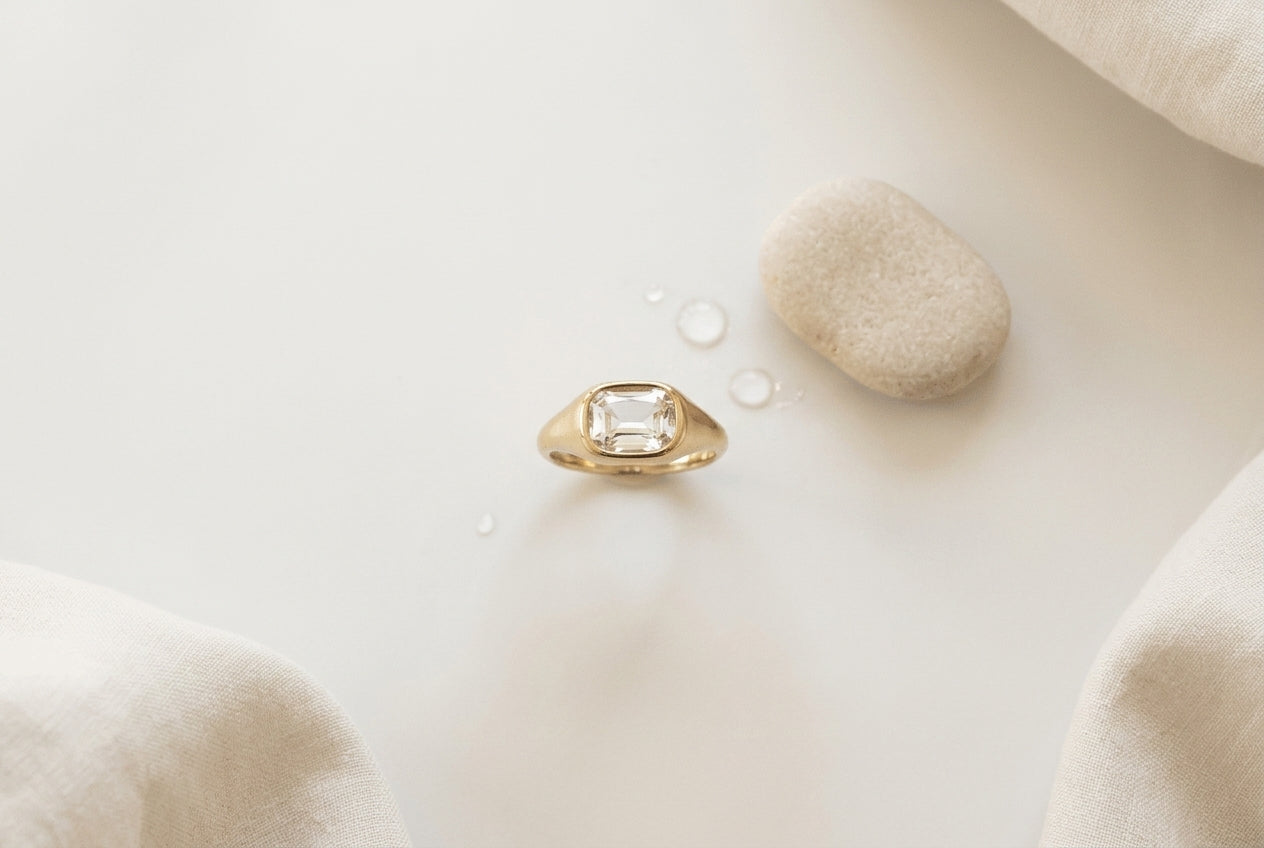
Gold-Plated Rings: A Buyer's Guide
A good gold-plated ring gives you a real gold finish for a fraction of solid-gold prices — the catch is that plating is a surface layer, so what's underneath the gold decides whether it lasts years or fades in months. This guide is for anyone who wants the look of gold without the four-figure receipt, and who has been burned before by a plated ring that turned their finger green or wore thin by spring. We'll cover what "gold-plated" legally means, how to read the difference between plated, gold-filled, vermeil, and solid gold, which base metal actually matters, and how to pick a ring that survives real life.
Key takeaways
- "Gold-plated" is a thin real-gold surface over a base metal — under U.S. FTC rules, a layer of at least 0.175 microns of 10k-or-finer gold. The base metal underneath is what makes or breaks longevity.
- The green-finger problem comes from copper in brass bases, not from the gold. A ring plated over 316L stainless steel resists tarnish and is friendly to sensitive skin.
- Solid gold is forever but expensive; gold-filled lasts longest among coated options; gold-plated is the most affordable real-gold look. Match the tier to how hard the ring will live.
- For an everyday or shower-proof ring under $60, choose 18k-gold-plated 316L stainless steel — it gives the gold finish without the upkeep, the green skin, or a surprise subscription.
What to look for: the buyer's decision criteria
Two rings can both say "gold-plated" and behave completely differently. Here's what actually separates a ring that holds up from one that disappoints, in roughly the order that matters:
- The base metal underneath. This is the single most important spec, and the one most listings hide. Gold-plated over brass can leave a green mark because brass contains copper that reacts with skin and moisture. Gold-plated over 316L stainless steel does not — stainless steel does not cause green skin, and its chromium-and-molybdenum oxide layer keeps it corrosion- and tarnish-resistant. If a listing won't tell you the base, treat that as a warning.
- How "real-gold" the plating is. Under the FTC's jewelry guides (16 CFR Part 23), a ring can only be called "gold plated" if it carries at least 0.175 micron of gold that's 10k or finer. "Heavy gold electroplate" requires at least 2.5 microns — over ten times thicker. Thicker plating wears down more slowly, so it's worth knowing which you're buying.
- Skin-friendliness. If you've reacted to jewelry before, the usual culprit is nickel — the most common contact allergen per the American Academy of Dermatology and Mayo Clinic. A 316L stainless base is the safer bet: it does contain nickel (about 10–14%), but it releases very little — lab testing shows well under the European Union's legal limit in synthetic-sweat tests.
- Waterproof claims, read honestly. "Waterproof" for stainless steel means corrosion-resistant — you can shower, sweat, and swim in it without it rusting or tarnishing quickly. It does not mean the gold layer is indestructible. Plating resists wear for years, not forever; abrasion, harsh chemicals, and constant friction will eventually thin any plated finish.
- Honest sizing. Rings are sold by U.S. size, which maps to a physical inside diameter. A glamour photo can make any band look chunkier than it is, so check the size chart, not the styling.
Best for X: scenario-based picks
Different buyers are solving different problems. Here's how to choose by use case rather than by hype:
- Best for everyday wear you never take off: 18k-gold-plated 316L stainless steel. It's the combination that survives handwashing, the gym, and the shower without tarnishing, so you're not pulling it off a dozen times a day.
- Best for sensitive skin: a stainless-steel base. The low nickel release is what makes 316L a standard for people who react to costume jewelry — and no copper means no green mark.
- Best for a gift or trend-driven look: gold-plated. You get the current style at a price that doesn't sting if tastes change next season, and the giftee gets a genuine gold finish.
- Best for an heirloom or daily engagement-style ring: solid gold. If a ring will be worn for decades and never come off, solid gold has no surface layer to wear through — you're paying for permanence.
- Best for a budget that still looks luxe: 18k-gold-plated 316L with a cubic-zirconia stone. CZ delivers diamond-like sparkle for a tiny fraction of the cost, on a base built to last.
Gold-plated vs gold-filled vs vermeil vs solid gold
These four terms describe completely different amounts of real gold, and the U.S. FTC defines most of them precisely. Here's how they actually compare:
| Type | What it is (FTC definition) | Real-gold amount | Typical price band (rings) |
|---|---|---|---|
| Gold-plated | A thin gold electroplate over a base metal | ≥ 0.175 micron of ≥ 10k gold | ~$20–$80 |
| Heavy gold electroplate | A thicker electroplate of the same fineness | ≥ 2.5 microns of ≥ 10k gold | ~$40–$150 |
| Gold vermeil | Gold over a sterling-silver base | ≥ 2.5 microns of ≥ 10k gold over sterling | ~$60–$200 |
| Gold-filled | A bonded gold layer that's a set fraction of total weight | ≥ 1/20 (5%) of weight in ≥ 10k gold | ~$50–$250 |
| Solid gold | Gold alloy all the way through (14k = 58.3% pure, 18k = 75% pure) | The whole piece | $200–$1,000+ |
The pattern is simple: as you move down the list, you get more real gold and a longer-lasting finish — and you pay more for it. Gold-filled outlasts plated because the gold layer is far thicker and mechanically bonded; vermeil splits the difference but always uses sterling silver underneath. Gold-plated wins on price and gives you a genuine gold surface, which is exactly why it's the smart pick for everyday and trend pieces. Price bands are general market ranges, not exact quotes.

Pink Emerald Cut Ring
A polished gold dome band with a vibrant pink emerald-cut stone in a sleek, secure bezel setting — vintage weight meets modern minimalism.
Shop this ring →Honest caveats: answering the real objections
- Will it actually hold up, or tarnish like my last gold-plated set? The difference is the base metal. The plated rings that tarnish or wear fast are usually plated over reactive bases. Meideya plates over 316L stainless steel, whose chromium-and-molybdenum oxide layer is what makes it corrosion- and tarnish-resistant — so it shrugs off showers, sweat, and daily wear. Be honest with yourself about expectations, though: plating is a surface layer. It resists wear for years, not forever, and any plated finish will eventually thin with enough abrasion.
- Will it arrive looking tiny next to the photos? Rings are the one piece where this is easy to verify: order by your real U.S. ring size. A whole size is about 0.81 mm of inside diameter apart, and common women's sizes land around 16.5 mm (size 6), 17.3 mm (size 7), and 18.1 mm (size 8) inside diameter. If you don't know your size, measure a ring that already fits the right finger across its inside diameter — that's a physical measurement no photo can spin.
- Any hidden costs or subscription? No. A Meideya ring is a one-time purchase — what you pay is what you pay. There's no auto-enrollment, no membership, and no recurring charge hiding in the checkout. That's deliberate: the whole point of affordable luxury is that the price is the price.
If you want to see the full range of finishes and styles in one place, browse the complete stainless-steel rings collection.
Frequently asked questions
What does "gold-plated" actually mean?
Gold-plated means a thin layer of real gold has been electroplated onto a base metal. Under the U.S. FTC jewelry guides (16 CFR Part 23), a ring can only be marked "gold plated" if that layer is at least 0.175 micron thick and is 10k gold or finer. "Heavy gold electroplate" requires a much thicker layer of at least 2.5 microns. So gold-plated rings do contain genuine gold — it's just a surface finish rather than gold throughout.
Do gold-plated rings turn your finger green?
That depends entirely on the base metal, not the gold. Green skin is caused by copper, which is common in brass bases — the copper reacts with skin and moisture and can leave a green mark. A ring plated over 316L stainless steel does not cause this, because stainless steel does not contain the reactive copper that brass does. If you've had green-finger problems before, check what's under the plating.
Is gold-plated stainless steel safe for sensitive skin?
Generally yes. The most common cause of jewelry skin reactions is nickel, the most frequent contact allergen per the American Academy of Dermatology. 316L stainless steel does contain nickel — roughly 10–14% — but it releases very little of it; lab testing in synthetic sweat shows release well below the European Union's legal limit. That low release, plus no copper, is why 316L is a common choice for people with sensitive skin.
How long do gold-plated rings last?
It varies with the base metal, the plating thickness, and how you wear it. Plating is a surface layer, so it resists wear for years rather than forever — eventually friction and abrasion will thin any plated finish. A ring plated over corrosion-resistant 316L stainless steel and worn sensibly (kept away from harsh chemicals and heavy abrasion) holds its finish far longer than one plated over a reactive base. Gold-filled lasts longer still because its gold layer is much thicker, and solid gold never wears through because there's no layer to lose.
Is a cubic-zirconia stone worth it in a gold-plated ring?
For an affordable ring, yes. Cubic zirconia is a lab-made stone that gives diamond-like brilliance at a tiny fraction of the price. It rates about 8.5 on the Mohs hardness scale — hard, but below moissanite (9.25) and diamond (10) — so over years of daily wear CZ can pick up micro-scratches and slowly lose some sparkle. For a fashion or everyday ring that's an easy trade-off, and pairing CZ with a durable 316L base gives you a luxe look without the diamond price.
The buying rule is short: judge a gold-plated ring by what's underneath the gold. Pick a stainless-steel base for everyday wear and sensitive skin, step up to gold-filled or solid gold only when you need maximum longevity, and never overpay for plating thickness you won't notice. See also our guide on how to style chunky rings.

Laisser un commentaire
Ce site est protégé par hCaptcha, et la Politique de confidentialité et les Conditions de service de hCaptcha s’appliquent.