

Jade jewelry: A Style Guide
Jade jewelry is built around a genuine natural stone — jadeite or nephrite — set into metal, and styling it well comes down to two honest questions: is the jade natural rather than dyed, and what is the hardware actually made of. Jade has carried meaning for thousands of years (it is the Chinese "stone of heaven," tied to prosperity, protection, and longevity), but as a buyer your decisions are practical: the stone's authenticity, its everyday durability, and whether the gold-tone setting will last. This guide covers what jade really is, how to read natural-vs-treated honestly, which pieces suit which wearer, and how to pick jade jewelry that looks luxe without the upkeep.
- "Jade" means one of two real minerals — jadeite (Mohs ~6.5–7) or nephrite (~6–6.5) — both genuine natural stones, durable enough for everyday wear with light care.
- The decision that matters most is natural vs. treated: Type A is untreated, while Type B (bleached and polymer-filled) and Type C (dyed) are altered, so it is fair to ask which you are buying.
- Don't overpay assuming jade jewelry is solid gold — affordable-luxury pieces set genuine jade into 18k-gold-plated 316L stainless steel, a surface plating, not solid gold.
- For an everyday quick pick, genuine green jade on a waterproof 18k-gold-plated 316L stainless hoop gives you the luxe, meaningful look with no tarnish and no fuss.
What jade actually is — and what it means
"Jade" is a single name for two different minerals, and both are genuine natural stones. Knowing which one you have — and what the green is really doing — is the foundation of buying well.
- Jadeite. The harder, rarer, and generally more valuable of the two, sitting at roughly 6.5–7 on the Mohs hardness scale — hard enough that it can scratch ordinary glass. This is the material behind the most prized "imperial" green jade.
- Nephrite. Slightly softer at about 6–6.5 Mohs but exceptionally tough thanks to its fibrous, interlocking structure, which makes it resistant to chipping and breaking. Nephrite is the classic jade of much historic Chinese carving.
- The meaning. In Chinese culture jade is the "stone of heaven," long associated with prosperity, wisdom, protection, and longevity. The classic round jade disc with a hole in the center — the bi — symbolized heaven and was worn for good fortune, which is exactly the silhouette echoed in modern jade donut hoops and pendants.
How to choose jade jewelry — the criteria that matter
A jade piece you'll actually wear lives or dies on four practical points.
- Natural vs. treated. This is the single most important question in jade. Type A is natural, untreated jadeite. Type B has been acid-bleached and impregnated with polymer to improve clarity; Type C has been dyed; and Type B+C is both. Treated jade can look like fine natural stone but is worth a fraction, and dyed color can fade over time with heat and light. At affordable prices, expect natural-but-modest jade rather than top-grade imperial — and look for a listing that's clear about it.
- Hardness and toughness. Both jadeite (~6.5–7) and nephrite (~6–6.5) are durable enough for daily wear with light awareness — comparable to quartz-family stones like tiger's-eye and onyx. They are not as scratch-proof as a sapphire or cubic zirconia, so store jade so it isn't knocking against harder gems.
- The setting, not just the stone. A beautiful jade charm on hardware that tarnishes or turns your skin green is a bad buy. Check the base metal and how the gold tone is applied (more below). The most wearable everyday jade pairs the stone with an 18k-gold-plated 316L stainless-steel hoop or chain.
- Scale and color. Jade tone ranges from pale apple-green to deep forest; translucency and an even, glowing color generally read more natural than a flat, uniform, or unnaturally vivid hue. Read the listed dimensions so the charm arrives the size you pictured.
Best jade jewelry for each kind of buyer
Match the piece to how you'll wear it and why you're buying it.
- Best for everyday, low-fuss wear: green jade charms on a waterproof 18k-gold-plated 316L stainless hoop. The jade is genuine and sturdy; the stainless setting shrugs off showers and sweat.
- Best for meaning or a gift: a round jade donut or bi-style pendant — the heaven symbol, tied to protection and good fortune, which makes it a thoughtful, story-rich present.
- Best for sensitive skin: jade set into 18k-gold-plated 316L stainless steel. 316L is the implant-grade alloy used in medical devices precisely because it releases very little nickel — the single most common cause of jewelry-related contact allergy.
- Best on a budget: a single small jade stud or pendant rather than a full carved bangle. Genuine natural jade in a modest size gives you the color and the symbolism without imperial-grade pricing.
Jade vs. other gemstones — an honest hardness and care comparison
Here's how genuine jade compares with the other natural stones you'll see across affordable-luxury jewelry, on the two things that decide everyday wearability. Prices are typical ranges, not exact quotes — check the live product page for the current price.
| Stone | What it is | Mohs hardness | Care reality |
|---|---|---|---|
| Jade (jadeite) | Genuine jadeite | ~6.5–7 | Sturdy for daily wear; ask if it's natural (Type A) vs. dyed |
| Jade (nephrite) | Genuine nephrite | ~6–6.5 | Slightly softer but very tough; resists chipping |
| Tiger's-eye | Chatoyant quartz | ~6.5–7 | Fine for daily wear with light care |
| Black onyx | Chalcedony (quartz family) | ~6.5–7 | Durable everyday stone |
| Moonstone / labradorite | Feldspar, with a shifting glow | ~6–6.5 | Softer; an occasion stone, handle with care |
| Mother-of-pearl / freshwater pearl | Genuine nacre | ~2.5–4.5 | Softest here — keep from chemicals, wipe gently |
| Cubic zirconia | Lab-made diamond simulant | ~8.5 | Hardest of the group; honest sparkle, not a diamond |
The takeaway: jade sits comfortably in the everyday-wearable band alongside tiger's-eye and onyx — tough enough to enjoy daily, soft enough to keep away from harder stones in your jewelry box. Save the truly gentle handling for pearl and mother-of-pearl.

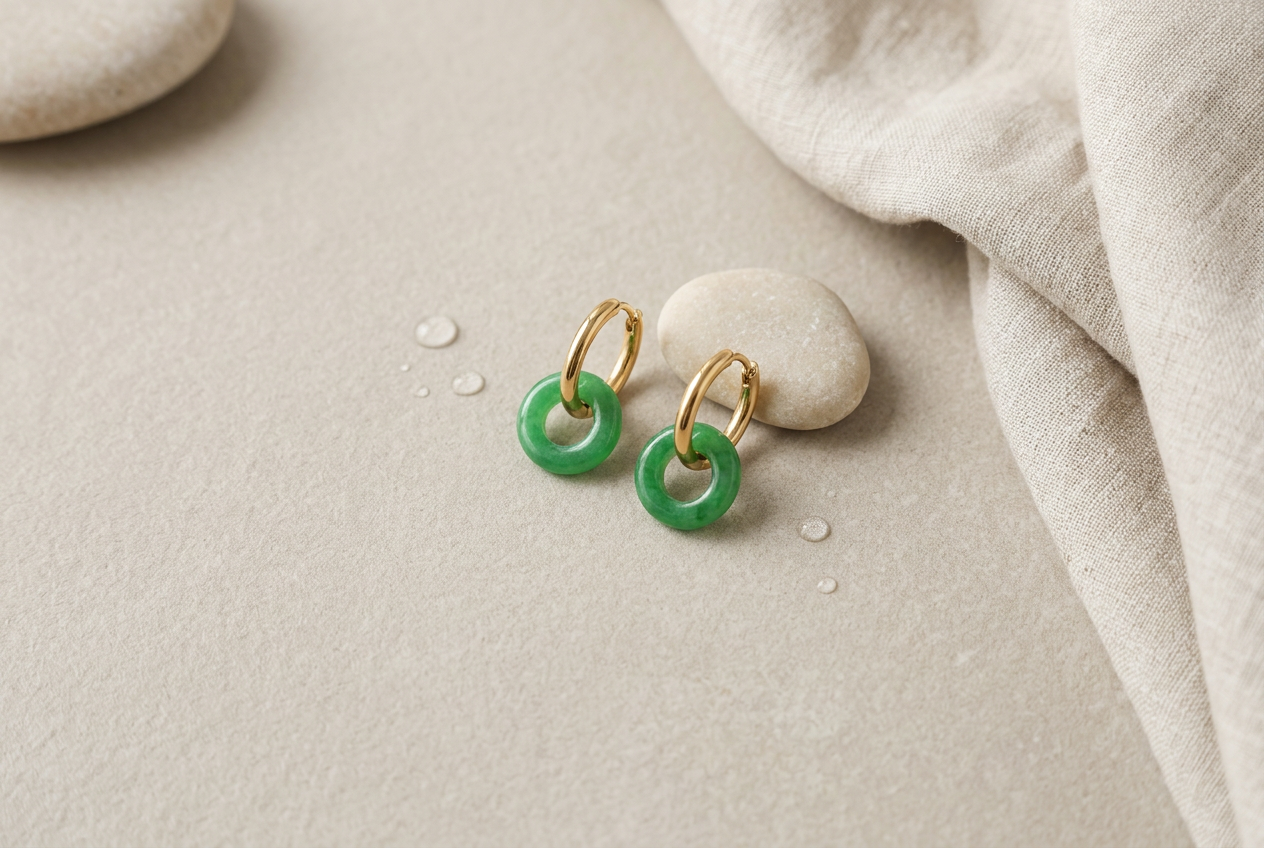
Green Jade Donut Hoop Earrings
Vibrant, polished green jade charms suspended from sleek gold hoops — blending traditional symbolism with a modern look.
Shop these earrings →Honest caveats — the questions worth asking before you buy
- Is the jade genuine — or dyed? The jade itself is a real natural stone. The real question is treatment: natural Type A jade versus Type B (bleached and polymer-filled) or Type C (dyed). Dyed color tends to pool unevenly along fractures and can fade with time and heat, while natural jade shows a softer, even, glowing translucency. At affordable-luxury prices you're buying natural-but-modest jade, not imperial grade — and a trustworthy listing will be clear about it.
- Is the setting solid gold? No — and any honest brand will say so. Our jade hoops set genuine jade into a 316L stainless-steel base with 18k gold plating on the hoops. By the FTC's jewelry guides, "gold-plated" means at least 0.175 microns of 10-karat-or-finer gold — a durable surface layer that resists tarnish for years, but a plating, not solid gold, and not permanent.
- Will it hold up to water and turn my skin green? A 316L stainless setting is corrosion-resistant — "waterproof" in the everyday sense of surviving showers, pools, and sweat — and it won't turn your skin green, because that green tint comes from copper in cheap brass, not stainless steel. Because 316L releases so little nickel, it suits most sensitive skin. The jade stone itself is best kept away from harsh chemicals and stored apart from harder gems.
- Will it look like the photo, and are there hidden costs? Read the listed charm dimensions so the size is no surprise — jade pieces are often a deliberate, dainty scale. And there are no hidden costs: a one-time price, no membership, and no auto-enrolled subscription.
Ready to add a piece of the "stone of heaven" to your everyday rotation? Browse the full Stainless Steel Earrings collection and find the jade tone that suits you.
Frequently asked questions
Is jade jewelry made of real jade?
Genuine jade jewelry uses a real natural stone — either jadeite (Mohs ~6.5–7) or nephrite (~6–6.5), the two minerals both called jade. The more important question is treatment: natural untreated jade is "Type A," while Type B has been bleached and polymer-impregnated and Type C has been dyed. The stone is genuine in all cases, but natural Type A holds its color and value best, so a trustworthy listing should describe which you are getting.
How can I tell natural jade from dyed jade?
Natural jade tends to show a soft, even, glowing translucency, while dyed (Type C) jade often has color that pools unnaturally along cracks and grain boundaries and can fade over time with heat and light. Polymer-filled (Type B) jade can look slightly plastic-like. Visual clues help, but the only definitive confirmation comes from gemological lab testing such as FTIR or spectroscopy, so for fine pieces ask the seller about treatment and certification.
Is jade durable enough for everyday wear?
Yes, with light awareness. Jadeite (~6.5–7 Mohs) and nephrite (~6–6.5) are both genuinely durable, and nephrite in particular is exceptionally tough and resistant to chipping. Jade sits in the same everyday-wearable hardness band as tiger's-eye and onyx — harder than pearl or moonstone but softer than cubic zirconia, so store it apart from harder stones and avoid hard knocks.
Is gold-plated jade jewelry good for sensitive skin?
Yes, when the setting is 316L stainless steel. 316L is the implant-grade alloy used in medical devices, and it releases very little nickel even though nickel is the single most common cause of jewelry-related contact allergy. The 18k gold plating sits on top of that stable stainless core, and the jade stone is inert, so most people with sensitive skin wear jade-on-stainless pieces comfortably.
What does jade symbolize?
In Chinese culture jade is the "stone of heaven," long associated with prosperity, wisdom, protection, and longevity. The round jade disc with a central hole — the bi — symbolized heaven and was worn for good fortune, a silhouette echoed in modern jade donut hoops and pendants. That meaning is part of why jade makes such a thoughtful gift.
Choose jade jewelry by working backward from how you'll wear it: ask whether the stone is natural rather than dyed, confirm the setting is a waterproof 316L stainless base so it survives daily life, and buy the size that suits your scale. See also our guides on the dainty pearl necklace and the dainty gold necklace guide.

Laisser un commentaire
Ce site est protégé par hCaptcha, et la Politique de confidentialité et les Conditions de service de hCaptcha s’appliquent.