

Moonstone ring: A Buyer's Guide
The best moonstone ring is the one whose glow you actually love in person — moonstone gives a soft, milky blue sheen that floats under the surface, while its close feldspar cousin labradorite throws sharp, electric flashes of color, so the choice is really about which light-play matches your taste. This guide is for the buyer who wants that ethereal look without overpaying or getting catfished on scale. We will cover what to check before you buy, how moonstone and labradorite differ, an honest comparison of stones and settings, and the one trade-off that decides most purchases: both stones are relatively soft, so the band metal and the care it needs matter as much as the gem.
Key takeaways
- Moonstone and labradorite are both genuine feldspar gemstones at about 6–6.5 on the Mohs hardness scale — beautiful, but softer than quartz and prone to cleavage, so treat them gently.
- The optical effect is the real decision: moonstone shows a soft, hovering blue adularescence; labradorite shows sharp, angle-dependent color flashes called labradorescence (or schiller).
- Don't overpay for "diamond" sparkle around the stone — cubic zirconia (CZ) is an honest, brilliant accent at a fraction of the price, not a mined diamond.
- For a single statement ring you'll wear daily, pick an adjustable band you can size to your finger, and confirm the real stone dimensions in millimeters so the photo matches reality.
What to look for in a moonstone or labradorite ring
Because these stones are valued for their light, the most important checks are about the gem and how it's held — not just the metal:
- The phenomenon, in person. Moonstone's beauty is its adularescence — a soft blue or white glow that appears to move just under the surface as you tilt it. Labradorite's beauty is labradorescence, sharper flashes of blue, green, gold, and occasionally orange that switch on and off with the angle. Both come from the stone's internal layered structure scattering light, so photos under flat light can undersell them. Look for a stone that still flashes in ordinary indoor lighting.
- Genuine stone, stated clearly. Both should be natural feldspar, not glass or doublets. A reputable listing names the stone and ideally gives its size; "authentic labradorite" or "natural moonstone" with measured dimensions is what you want to see.
- Stone size and ring scale. The single biggest disappointment with online gemstone rings is scale. Look for the stone's measured dimensions (for example, a 4mm round) so you know whether you're getting a subtle accent or a statement face.
- The setting and band. Soft stones need a setting that protects them. A bezel or a low, snug prong setting shields a feldspar gem better than tall, exposed prongs. An adjustable band is forgiving on fit, which matters more on rings worn every day.
- The honest metal. Gemstone rings come in different bases — some are 316L stainless steel, some are gold-plated brass, and some are sterling silver with gold plating. None of those is "solid gold," and the right answer depends on whether your priority is waterproof low-maintenance wear (stainless) or a classic precious-metal base (sterling). Read the material line, don't assume.
Moonstone vs. labradorite: best for which buyer
These two stones are cousins in the feldspar family and share the same hardness, so the choice comes down to the look you want and how it will live on your hand.
- Best for a soft, romantic, "ethereal" look: moonstone. Its milky body and floating blue sheen read delicate and dreamy — ideal if you want subtlety.
- Best for a bold, color-shifting statement: labradorite. Its darker base and electric flashes are dramatic and read as a conversation piece.
- Best for a gift when you're unsure of taste: labradorite, paired with an adjustable band — the flashes photograph well and the open band sidesteps the need to know an exact ring size.
- Best for daily, low-fuss wear: a feldspar stone in a 316L stainless steel band, because the metal is waterproof and won't tarnish; just keep in mind the stone still needs gentle care regardless of the metal.
- Best for a precious-metal feel on a budget: a sterling-silver-based, gold-plated style — a traditional silver base with a warm gold tone, with the honest caveat that plating is a surface layer.
Stones, settings, and sparkle compared
Here's how the elements you'll see in a moonstone or labradorite ring actually stack up. Every figure below is verified; prices are typical ranges, not exact quotes.
| Element | What it is | Key spec (verified) | Typical price impact |
|---|---|---|---|
| Moonstone | Genuine alkali (orthoclase) feldspar; soft blue adularescence | Mohs ~6–6.5; perfect cleavage; no ultrasonic/steam cleaning | Affordable; finer "rainbow" stones cost more |
| Labradorite | Genuine plagioclase feldspar; sharp color flashes (labradorescence/schiller) | Mohs ~6–6.5; perfect cleavage; no ultrasonic/steam cleaning | Affordable; bright, multi-color flash costs more |
| Cubic zirconia (CZ) accent | Lab-made zirconium dioxide; brilliant sparkle, not a diamond | Mohs ~8.5 (harder than the feldspar it accents); high fire | Inexpensive; adds sparkle without diamond pricing |
| 316L stainless band | Surgical-grade steel; waterproof, hypoallergenic | Very low nickel release (EN 1811); molybdenum aids corrosion resistance; won't turn skin green | Budget-friendly; lowest upkeep |
| Gold-plated band | A surface layer of gold over a base metal (brass or silver) | FTC "gold-plated" = ≥0.175 micron of ≥10k gold; plating is a finish, not solid gold | Mid; plated look at a fraction of solid-gold cost |
The takeaway: pick your stone for the light-play you love, then pick your band for how the ring will live — stainless for the most carefree everyday wear, gold-plated for a warm precious-metal look. Either way, the soft feldspar gem sets the care rules.

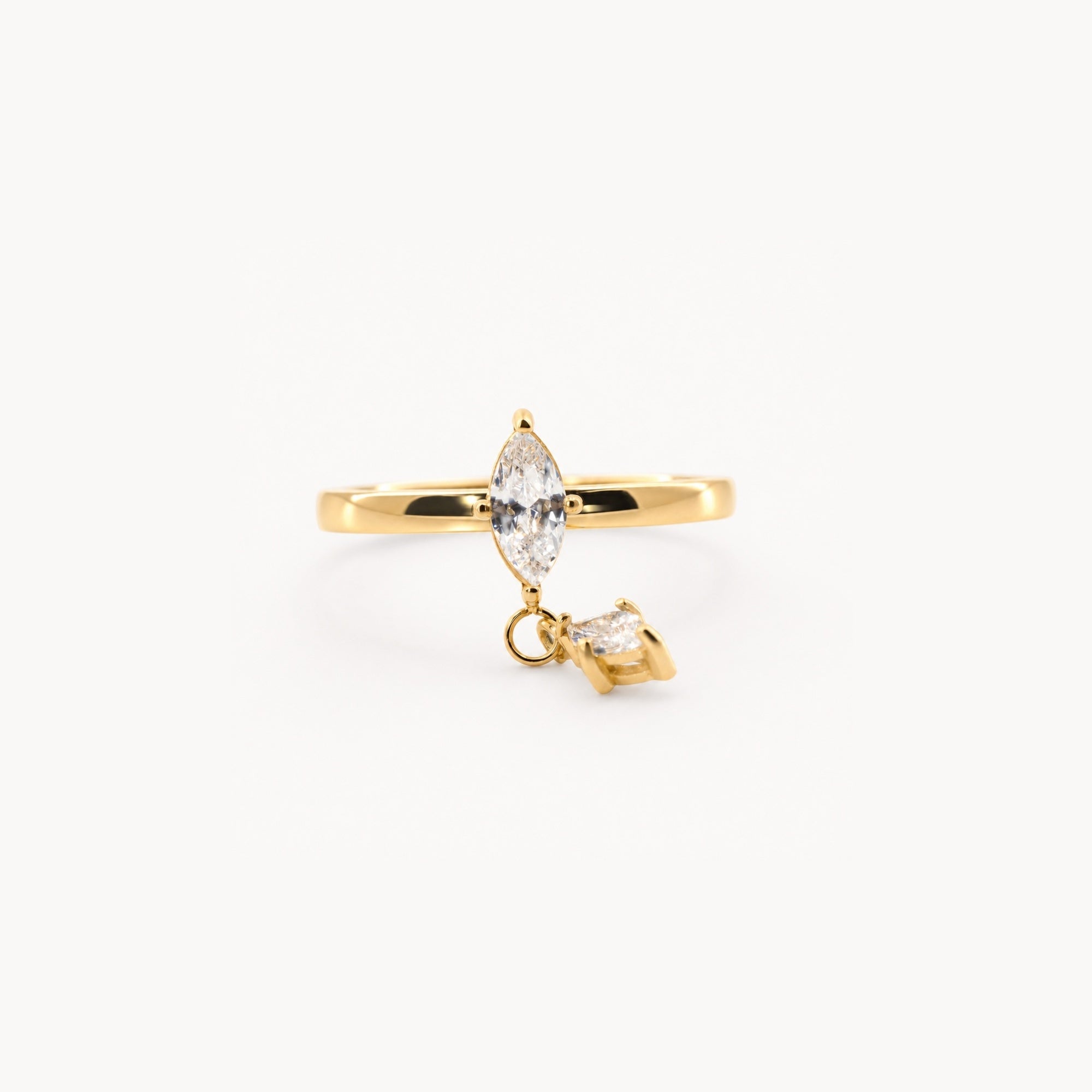
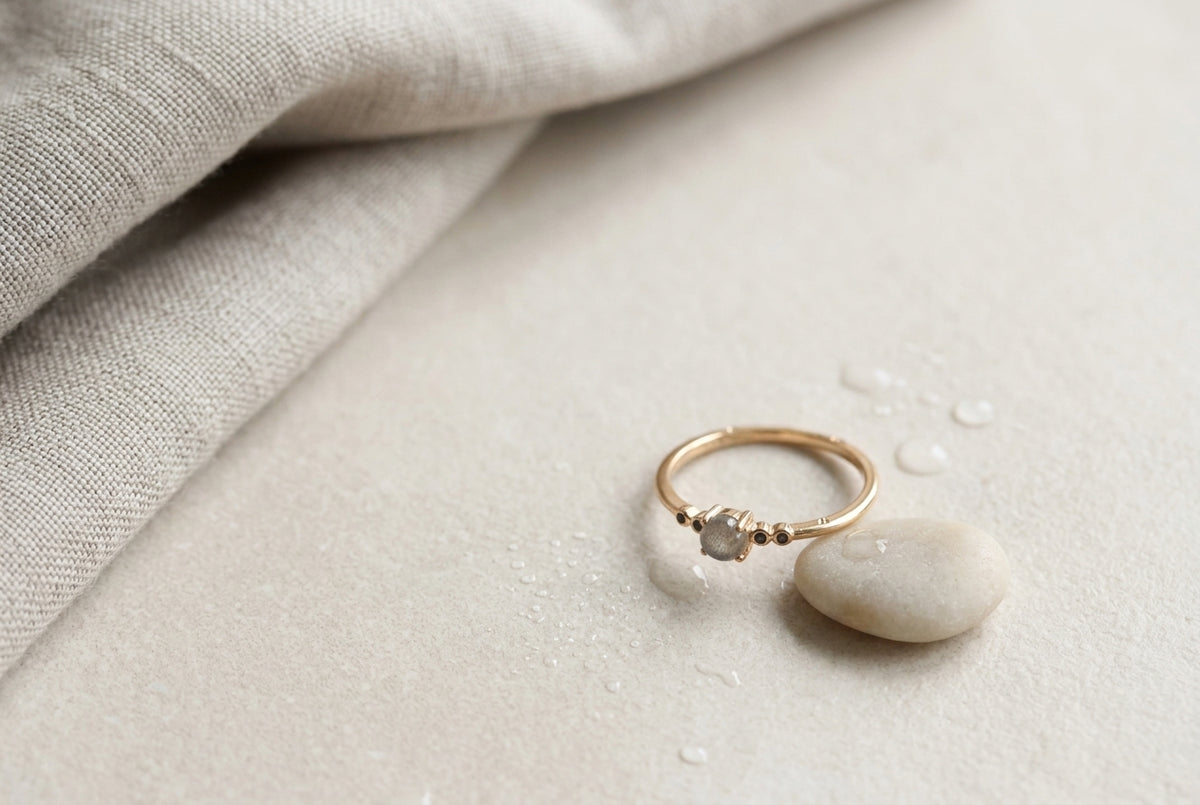
Labradorite and Black CZ Ring
Featuring a round 4mm authentic labradorite and 4 black cubic zirconia accents on a 9k gold-plated sterling silver band — genuine stone, plated finish — adjustable to fit.
Shop this ring →Honest caveats — the real objections
- Will it actually hold up? The band can be very durable — 316L stainless steel is waterproof, corrosion-resistant, and won't tarnish — but the stone is the limiting factor. Moonstone and labradorite are about 6–6.5 on the Mohs scale with perfect cleavage, which means they can scratch or chip more easily than quartz or a diamond. Take a feldspar ring off for the gym, gardening, and rough chores. If a band is gold-plated, remember the plating is a surface layer that resists tarnish for years, not forever — it is not solid gold.
- Is the stone real, or dyed/imitation? Genuine moonstone and labradorite are natural feldspar; reputable listings say so and give the stone's measurements. Be wary of glass imitations or stones described only as "moonstone-style." With these gems, dyeing is far less of an issue than with stones like jade, but always confirm the listing says authentic or natural, and that the flash looks structural (it moves with angle) rather than painted on.
- Will it arrive looking like the photo? Scale is the usual culprit. Check the stone's measured size — a 4mm round labradorite is a refined accent, not a cocktail-ring face. Knowing the millimeters up front is the single best way to avoid being catfished on size.
- How do I clean it without ruining it? Never use ultrasonic or steam cleaners on moonstone or labradorite — the vibration and heat can damage cleaved feldspar. Use lukewarm water with a drop of mild, non-acidic soap and a soft cloth, then dry gently. Avoid harsh household chemicals.
- Any hidden costs? No. Meideya rings are a one-time purchase — there's no subscription, no auto-enrollment, and no membership to buy the price you see.
If you love the ethereal feldspar look but want to compare faces and finishes, browse the full stainless steel rings collection to see scale and styling options side by side.
Frequently asked questions
What is the difference between a moonstone ring and a labradorite ring?
Both stones are genuine feldspar with the same hardness (about 6–6.5 on the Mohs scale), but they show different optical effects. Moonstone has adularescence — a soft, milky blue glow that seems to float under the surface. Labradorite has labradorescence (also called schiller) — sharper flashes of blue, green, and gold that switch on and off as you change the angle. Moonstone reads softer and more romantic; labradorite reads bolder and more dramatic.
Is moonstone or labradorite durable enough for an everyday ring?
Both are wearable but relatively soft — about 6–6.5 on the Mohs scale, with perfect cleavage that makes them prone to chipping under impact. They are fine for regular wear if you treat them gently: take the ring off for the gym, cleaning, and hands-on chores, and store it separately so harder jewelry doesn't scratch it. A protective bezel or low setting helps.
Is the gold on a gold-plated ring real gold?
Yes, but it is a surface layer, not solid gold. Under the U.S. FTC jewelry guides, a piece can be called "gold-plated" when it has a coating of at least 0.175 micron of 10-karat or finer gold over a base metal. Plating gives a real gold tone and resists tarnish for years, but because it is a finish rather than the whole metal, it is not the same as solid gold. For the lowest upkeep with no plating to wear, a 316L stainless steel band is the most carefree option.
Is the sparkle around the stone a diamond?
No. The accent stones on these rings are cubic zirconia (CZ), a lab-made stone of zirconium dioxide that gives bright, honest sparkle. CZ is about 8.5 on the Mohs scale — actually harder than the feldspar it accents — and has lots of fire, but it is not a mined or lab-grown diamond and we never describe it as one.
How do I clean a moonstone or labradorite ring?
Use lukewarm water with a single drop of mild, non-acidic soap and a soft cloth, then rinse lightly and dry. Never use ultrasonic or steam cleaners on moonstone or labradorite, and avoid harsh household chemicals — the stones are cleaved feldspar and can be damaged by vibration, heat, and strong solvents.
The buying rule is simple: choose the stone for the light-play you love, choose the band for how the ring will live on your hand, and respect that a soft feldspar gem needs gentle care no matter how tough the metal is. See also our guides on chunky ring styling and our stainless steel ring guide.

Laisser un commentaire
Ce site est protégé par hCaptcha, et la Politique de confidentialité et les Conditions de service de hCaptcha s’appliquent.