

Solid Gold Initial & Letter Necklace: What to Know Before You Buy
A true "solid gold" initial necklace is karat-marked metal all the way through (14k or 18k), and at that purity an everyday letter pendant typically runs several hundred dollars and is too soft to wear in the shower or gym without scratching. If you want the look of a fine initial necklace you can actually live in — pool, sweat, daily layering — an 18k gold-plated 316L stainless-steel piece is the honest sweet spot. This guide explains the difference between solid, gold-filled, vermeil, and plated, so you know exactly what you are paying for before you buy.
Key takeaways
- "Solid gold" means karat-marked gold throughout (not hollow) — it is the most valuable option but also the softest and the priciest for an initial pendant.
- The terms that actually decide durability and price are solid gold vs gold-filled vs vermeil vs gold-plated — they are not interchangeable.
- You do not need solid gold for an everyday letter necklace. A thick PVD gold plating over 316L stainless steel gives the same gold tone with far better scratch and water resistance for a fraction of the cost.
- Quick pick: for a personalized initial or nameplate you will wear daily, an 18k gold-plated 316L piece is the practical buy. Reserve solid gold for a once-in-a-lifetime keepsake.
Solid, filled, vermeil, or plated — what the labels actually mean
Most "gold" initial necklaces fall into four categories, and the label changes both the price and how long it lasts. Here is the plain-English version, with the standards that define each term.

- Solid gold. The piece is karat-marked gold throughout (and not hollow). The karat number tells you the purity: 14k is 58.3% gold, 18k is 75% gold, with the rest being alloy metals for strength. It holds value and never wears off — but pure gold is soft, so high-karat pieces scratch and bend more easily, and the price for a custom letter pendant is the highest of the four.
- Gold-filled. A layer of at least 10k gold is mechanically bonded to a brass core. The U.S. Federal Trade Commission requires that gold layer to be at least 1/20 (5%) of the item's total weight. That makes the gold layer dramatically thicker than standard plating, so it lasts for years — but it is still not solid gold, and most gold-filled jewelry is not specifically rated for constant water exposure.
- Gold vermeil. Gold over sterling silver, with the FTC requiring a minimum gold thickness of 2.5 microns. Pretty, but the plating is thin enough that it can wear through with heavy daily use, and the silver base can tarnish.
- Gold-plated. A coating of gold over a base metal. Quality varies enormously here — traditional electroplating can fade in months, while thick PVD (physical vapor deposition) plating over stainless steel is a different animal entirely (more on that below).
To be completely clear: Meideya pieces are 18k gold-plated over 316L stainless steel — not solid gold, not gold-filled, not vermeil. We say that up front because the whole point of this guide is helping you match the right category to how you actually wear jewelry.
Best for each kind of buyer
There is no single "best" — it depends on what the necklace is for.
- Best for an heirloom or investment keepsake: solid 14k or 18k gold. If the piece is meant to be passed down and you are comfortable handling it gently, nothing beats karat-marked gold for longevity and resale value.
- Best for everyday wear without babying it: 18k gold-plated 316L stainless steel. The stainless core is hard and corrosion-resistant, and a thick PVD gold layer resists fading — so it survives showers, workouts, and constant layering.
- Best for sensitive skin: a piece on a true surgical-grade 316L stainless-steel base. 316L is one of the lowest nickel-releasing metals used in jewelry, which matters because nickel is the most common cause of allergic contact dermatitis.
- Best for a gift on a real budget: a quality gold-plated initial or nameplate necklace. You get the personalized, fine-jewelry look without the solid-gold price tag — just confirm the base metal and plating type before buying.
Solid gold vs gold-plated 316L — the honest comparison
This is the decision that matters for most shoppers searching "solid gold initial necklace." Here is how the two options actually compare on the things you can verify.
| Option | Best for | What it really is (verified) | Typical price (initial pendant) |
|---|---|---|---|
| Solid 14k / 18k gold | Heirloom keepsake; holds value | Karat-marked gold throughout; 14k = 58.3% gold, 18k = 75% gold; soft (scratches/bends easier at higher karat) | Several hundred dollars and up |
| Gold-filled | Long-lasting look without solid-gold cost | 10k+ gold layer bonded to brass; FTC min. 1/20 (5%) of total weight; not specifically water-rated | Mid-range |
| Gold vermeil | Pretty everyday wear | Gold over sterling silver; FTC min. 2.5 microns; thin plating, silver base can tarnish | Lower-mid |
| 18k gold-plated 316L (Meideya) | Daily, shower, gym, layering | Thick PVD gold plating over 316L stainless steel; corrosion-resistant, low nickel release; waterproof | About $29–$55 (varies by style) |
The takeaway: if you want the necklace as a long-term store of value, buy solid gold. If you want a gold initial necklace you can wear every single day without worrying about it, a thick-PVD 18k gold-plated 316L piece wins on durability per dollar — and it looks the same in every photo.

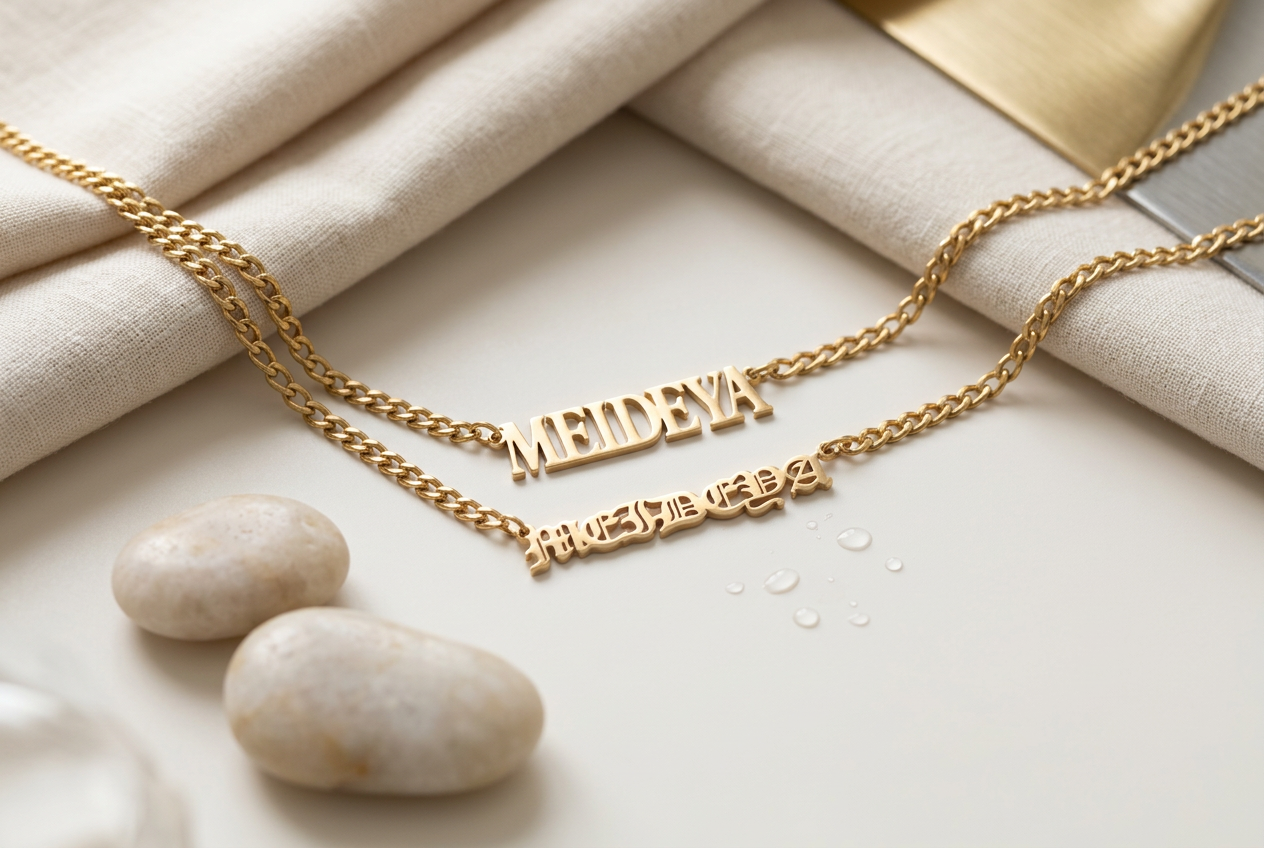
Nameplate Necklace-Preorder
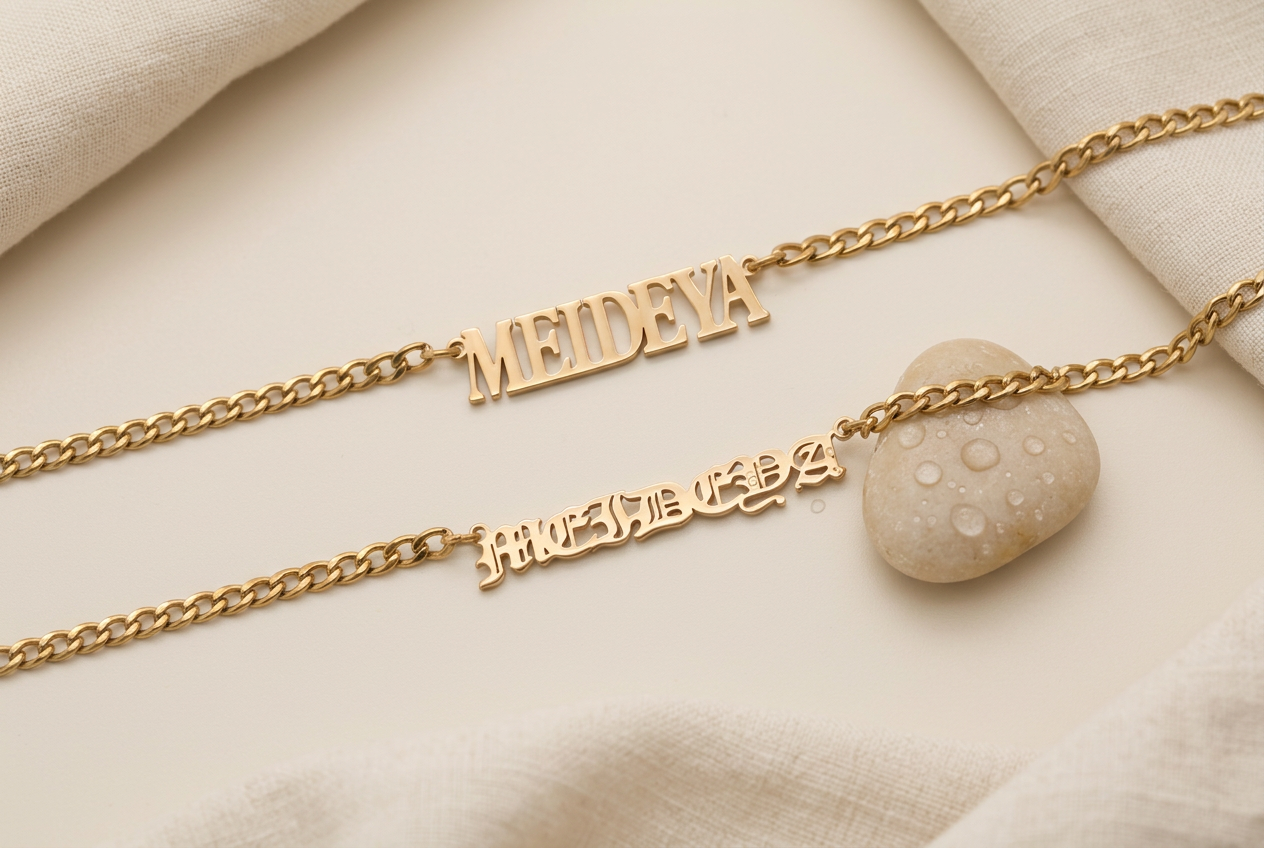
18k gold-plated over stainless steel, fully customizable with your name or initials — durable, waterproof, and shower-safe, on an 18" chain with a 2" extender. Can be worn by anyone.
Shop this necklace →Honest answers to the real worries
- Will gold-plated tarnish like my last cheap set? The answer depends entirely on the plating method. Thin traditional electroplating often fades within roughly 6–18 months. Thick PVD plating over a stainless-steel base is bonded at a molecular level and resists oxidation and discoloration far longer, typically holding its color through years of regular wear. The stainless core also will not corrode the way a plated-brass piece can. "Waterproof" here means corrosion-resistant for everyday water contact — showers, sweat, a swim — not that you should treat it carelessly, but you do not have to take it off at the sink.
- Will it arrive looking like the photo, or tiny? This is the single most common jewelry complaint, so we will be specific: our initial and nameplate pieces are dainty, demi-fine personalized jewelry — designed to sit delicately at the collarbone, not as a chunky statement plate. The nameplate necklace ships on an 18" chain with a 2" extender (adjustable to 20"). If you want a longer drop or a bolder pendant, check the listed measurements before ordering rather than guessing from a close-up.
- Any hidden costs or surprise subscriptions? No. Every Meideya piece is a one-time price. There is no membership, no auto-enrollment, and nothing added at checkout that signs you up for a recurring charge. The number you see on the product page is the number you pay.
Ready to compare specific styles? Browse the full Personalization collection to see every initial and nameplate option side by side.
Frequently asked questions
Is a Meideya initial necklace solid gold?
No. Meideya initial and nameplate necklaces are 18k gold-plated over a 316L stainless-steel base, not solid gold. They give you the gold tone and the fine-jewelry look of a custom initial piece, with far better scratch and water resistance for everyday wear than soft solid gold — at a fraction of the price.
What is the difference between solid gold, gold-filled, and gold-plated?
Solid gold is karat-marked gold throughout the piece (14k is 58.3% gold, 18k is 75%). Gold-filled has a thick gold layer mechanically bonded to a brass core that the FTC requires to be at least 1/20 (5%) of the item's total weight. Gold-plated has a thinner coating of gold over a base metal; its durability depends heavily on the plating method, with thick PVD plating lasting far longer than traditional electroplating.
Will a gold-plated initial necklace tarnish or turn green?
A thick PVD gold plating over a 316L stainless-steel base resists tarnish and discoloration for years of regular wear because the coating is bonded at a molecular level and the stainless core does not corrode like brass. Cheap, thinly electroplated pieces are the ones that fade or discolor — which is exactly why the base metal and plating type matter more than the word "gold" on the label.
Is a 316L stainless-steel necklace safe for sensitive skin?
316L stainless steel is one of the lowest nickel-releasing metals used in jewelry and is widely considered safe for prolonged skin contact. That matters because nickel is the most common cause of allergic contact dermatitis. If you have a known nickel allergy, choosing a true surgical-grade 316L base is one of the most reliable ways to reduce the risk of a reaction.
Can I get my actual name or initial customized?
Yes. The Nameplate Necklace is made to order: you add it to your cart and leave a note with your chosen font number and the name or initials you want (for example "Font1" and "LISA"). Custom orders take about 7–10 days to process before they ship.
The rule of thumb is simple: buy solid gold when the piece is an investment or heirloom, and buy a thick-PVD 18k gold-plated 316L piece when you want a gold initial necklace you will actually wear every day. See also our guides on the diamond initial letter necklace and birthstone initial letter necklace.
,%20and%20at%20that%20purity%20an%20everyday%20letter%20pendant%20typically%20...)
Laisser un commentaire
Ce site est protégé par hCaptcha, et la Politique de confidentialité et les Conditions de service de hCaptcha s’appliquent.