

Dainty Gold Necklace: How to Choose One That Lasts (Honest Buyer's Guide)
A dainty gold necklace is a thin, delicate chain (roughly 1–2mm wide) in a warm gold tone — and for everyday wear, an 18k gold-plated stainless-steel piece gives you that look at $36–55 instead of the hundreds a solid-gold version costs. The catch is that "gold" can mean four very different things, and the price gap is mostly about what's underneath the gold. This guide explains how to read a dainty necklace listing honestly — chain width, gold type, base metal, and clasp — so the piece you order actually survives the shower, the gym, and a year of real life.
Key takeaways
- "Dainty" describes the width — a fine 1–2mm chain that lies flat and layers easily, not a statement piece.
- The word that decides longevity is the gold type: gold-plated (thin gold over a base metal), gold-filled (a thicker mechanically bonded layer), or solid gold (gold throughout, and the most expensive by far).
- Don't overpay for "gold" without checking the base metal — a gold-plated chain over a corrosion-resistant 316L stainless-steel core holds up to water far better than plating over plain brass.
- Quick pick for everyday layering: an 18k gold-plated 316L herringbone or fine chain in the $36–55 range — affordable, waterproof, and genuinely tarnish-resistant.
What "gold" actually means on a dainty necklace
Most disappointment with a dainty gold necklace comes from one assumption: that "gold" means solid gold. It usually doesn't, and that's fine — as long as you know what you're buying. Here is the honest breakdown of the four terms you'll see, because the price almost always tracks this rather than the look.
- Solid gold. Gold alloy all the way through (10k–18k, mixed with other metals because pure 24k is too soft to wear). It never wears through and won't tarnish, which is exactly why a dainty solid-gold chain runs into the hundreds.
- Gold-filled. A meaningfully thick gold layer mechanically bonded to a base core under heat and pressure — by definition at least 5% gold by weight. It lasts years and sits in the mid-price tier.
- Gold-plated. A thin layer of gold (commonly around 0.5–2.5 microns) electroplated onto a base metal. This is where affordable-luxury jewelry lives, and where quality varies most — because the result depends almost entirely on the plating quality and the metal underneath.
- Gold vermeil. A regulated form of plating: at least 2.5 microns of 10k+ gold over a sterling-silver base. Better than ordinary plating, priced above it.
Meideya's dainty necklaces are 18k gold-plated over a 316L stainless-steel base — we say "plated," never "solid," because that's the truth. What makes ours hold up where a cheap plated chain fails is the base metal: 316L stainless steel is corrosion-resistant, so the chain underneath the gold doesn't rust or react the way plated brass does.
The buyer's decision criteria — what to check before you order
Four specs decide whether a dainty gold necklace looks great in the photo and a year later. Read them in this order.
- Chain width. "Dainty" should mean roughly 1–2mm. A fine herringbone or cable chain at this width lies flat against the skin and layers cleanly under a heavier piece. If a listing won't give the width in mm, that's a signal it may photograph thicker than it arrives.
- Gold type (see above). Plated, filled, or solid — this is the single biggest driver of both price and how long the color lasts. A trustworthy listing states it plainly.
- Base metal under the plating. The most-skipped spec, and the one that decides water resistance. A 316L stainless-steel core resists corrosion; plated brass is more prone to reacting and turning skin green where the plating thins. 316L is also why a piece can honestly be called hypoallergenic.
- Length and clasp. A choker sits around 13–16 inches; a classic everyday length is 16–18. An extender chain lets one necklace work at several lengths, which matters a lot for layering.
Best for X — scenario-based picks
Different buyers weigh these specs differently. Match the piece to how you'll actually wear it.
- Best for everyday + water (shower, gym, beach): an 18k gold-plated 316L stainless-steel chain — waterproof and tarnish-resistant, so you never have to take it off.
- Best for sensitive skin: a genuinely 316L stainless-steel base — its very low nickel release is what makes it safe for most people who react to costume jewelry.
- Best for a gift on a budget: a dainty plated 316L necklace at $36–55 looks high-end and ships ready to wear, without the solid-gold price.
- Best for a forever heirloom: solid 14k–18k gold — the only option that never wears through, at a price to match.
- Best for layering: a flat herringbone or fine cable chain (1–2mm) with an extender, so it sits cleanly under or over other pieces.
Dainty gold necklace types compared
Here's how the four gold types stack up on the things that actually decide your purchase. Price tiers are general market ranges, not exact quotes.
| Type | Best for | Construction (verified) | Typical price tier |
|---|---|---|---|
| Gold-plated 316L stainless | Everyday wear, water, sensitive skin, gifting | Thin gold layer (~0.5–2.5 microns) electroplated over a corrosion-resistant 316L core | $ (budget–affordable luxury) |
| Gold-plated brass | Occasional / fashion wear only | Same thin plating, but over brass — more prone to reacting and tarnishing where plating thins | $ (budget) |
| Gold vermeil | Step-up gifting | ≥2.5 microns of 10k+ gold over sterling silver (regulated) | $$ (mid) |
| Solid 14k–18k gold | Heirloom / forever piece | Gold alloy throughout; never wears through or tarnishes | $$$$ (premium) |
The takeaway: if you want the gold look for daily wear without babying it, gold-plated over 316L stainless wins on value — it survives water and skin contact in a way plated brass doesn't. If you want a piece that outlives you, only solid gold delivers, and you pay accordingly.

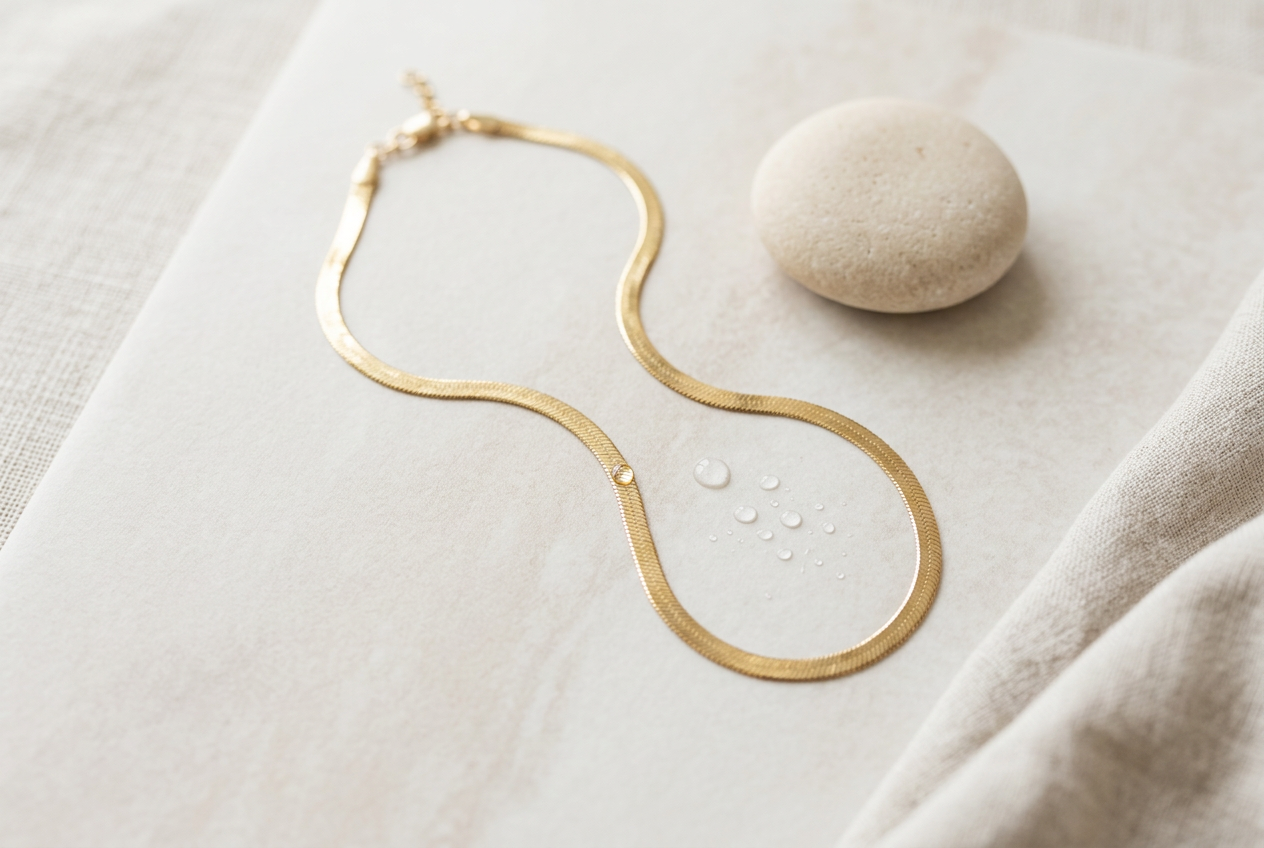
Soft Herringbone Chain Necklace
A delicate 2mm herringbone in 18k gold-plated stainless steel — waterproof and tarnish-free, with a 13.5"+2.5" extender for easy layering.
Shop this necklace →Honest caveats — answering the real objections
- Is it actually waterproof, or will it tarnish like my last "gold-plated" set? Ours is built on 316L stainless steel, which resists corrosion, so the chain won't rust and the gold tone stays put through showers, workouts, and the beach. The honest limit of any plated piece: the gold layer is thin by nature, so harsh chemicals, abrasion, or chlorine over a long time can eventually wear plating anywhere — 316L underneath simply means there's no rusting base reacting beneath it. We don't claim it's indestructible; we claim it's genuinely built for daily wear.
- Will it arrive looking like the photo, or tiny and unrecognizable? "Dainty" is the point — this is a fine 2mm chain, and we publish the width and length (13.5"+2.5" extender) so there's no guessing. It's a delicate, demi-fine piece, not a chunky statement chain. Knowing the real millimeters up front is how you avoid the "it arrived smaller than expected" surprise.
- Am I being signed up for a hidden monthly subscription? No. The price you see is a one-time price — no membership, no auto-enrollment, no recurring charge slipped in at checkout. You buy the necklace once.
If you're building a stack, browse the full minimal jewelry collection for dainty chains and matching pieces. Shop all stainless-steel necklaces to compare lengths and styles.
Frequently asked questions
What does "dainty" mean for a gold necklace?
Dainty refers to a fine, delicate chain — typically about 1–2mm wide — that lies flat against the skin and layers easily. It describes the scale of the chain, not the gold type. A dainty necklace is the opposite of a chunky statement piece.
Is a gold-plated dainty necklace real gold?
Yes, the surface is real gold, but it's a thin layer (commonly around 0.5–2.5 microns) electroplated over a base metal — not solid gold throughout. That's why a quality gold-plated piece can cost $36–55 instead of the hundreds a solid-gold chain commands. Meideya's chains are 18k gold-plated over a 316L stainless-steel core.
Will a dainty gold-plated necklace tarnish or turn my skin green?
It depends on the base metal under the plating. Plating over a corrosion-resistant 316L stainless-steel base (like Meideya's) resists tarnishing and won't rust, so it holds up to water and daily wear. Plating over plain brass is more prone to reacting and discoloring where the gold layer thins over time.
Is stainless-steel gold jewelry safe for sensitive skin?
For most people, yes. 316L stainless steel contains nickel (around 10–14%), but the nickel is locked into a stable crystal structure and releases at extremely low levels — well within the EU Nickel Directive limit measured by the EN 1811 test. That very low release is what makes 316L suitable for the vast majority of people with sensitive skin. Anyone with a severe, diagnosed nickel allergy should consult a dermatologist before wearing any nickel-containing metal.
What length should I choose for a dainty necklace?
A choker sits around 13–16 inches; a classic everyday length is 16–18 inches. If you like to layer, choose a piece with an extender chain so one necklace works at several lengths — for example, a 13.5-inch chain with a 2.5-inch extender gives you flexibility from choker to standard.
The rule for buying a dainty gold necklace: check the width in millimeters, confirm the gold type, and always check the base metal — that last spec is what separates a chain that survives the shower from one that fades in a few months. See also our guide to the gold dainty necklace collection.
%20in%20a%20warm%20gold%20tone%20%E2%80%94%20and%20for%20everyday%20wear,%20an%2018k%20gold-plated%20stainless-ste...)
Laat een reactie achter
Deze site wordt beschermd door hCaptcha en het privacybeleid en de servicevoorwaarden van hCaptcha zijn van toepassing.