


How to Tell if Jewelry is Real Stainless Steel
A few years ago, before I founded Meideya, I bought a stunning, chunky chain necklace from a trendy online boutique. The product description proudly labeled it as "Premium Stainless Steel." I was thrilled. I thought I had found a durable piece I could wear to the gym and the beach without a second thought.
Two weeks later, I took that necklace on a beach vacation. By the third day, the golden shine had completely flaked off, revealing a dull, pinkish-brown metal underneath. Even worse, it left a stubborn, dark green ring around my neck that took days to scrub off. I felt completely betrayed. The necklace was not steel at all; it was cheap, flash-plated brass masquerading under a false label.
This frustrating experience is one of the main reasons I built Meideya. I wanted to create a brand where you could blindly trust the materials. Our entire collection is built on genuine, high-quality stainless steel jewelry. But as this waterproof jewelry trend has exploded, so has the amount of "greenwashing" and false advertising in the market. Many brands use terms like "stainless" or "tarnish-free" while secretly selling you cheap copper alloys that will inevitably ruin your clothes and irritate your skin.

If you have a piece in your jewelry box that you are suspicious of, you don't need a chemistry lab to find the truth. Today, I am going to show you exactly how to test stainless steel jewelry using a few simple methods you can do right in your kitchen.
Test 1: The Magnet Mystery
This is the most common question I get in my DMs: "Mia, is magnetic jewelry real stainless steel?"
The answer is fascinating because it involves a bit of metallurgy. Generally speaking, high-quality jewelry-grade stainless steel should have very little to no magnetic pull.
At Meideya, we strictly use 316L stainless steel jewelry standards. The "L" stands for low carbon. This specific grade of steel is known as an "austenitic" alloy. Because of its unique crystal structure and high levels of chromium and nickel, it is virtually non-magnetic.


How to do the test: Take a standard refrigerator magnet and hold it close to your jewelry. If the necklace or ring vigorously snaps onto the magnet and holds tight, you have a problem. That strong magnetic pull means the piece is likely made of a cheap iron alloy, carbon steel, or nickel—materials that will absolutely rust and corrode when exposed to water. If the magnet does not react at all, or only has a very faint, almost unnoticeable pull, that is a fantastic sign that you are holding real 316L steel.

Test 2: The Ultimate Skin Reaction Check
When comparing fake vs real stainless steel, your body is actually the ultimate lie detector. Customers who have been burned in the past always ask me, "does real stainless steel turn green?"
Let me say this as clearly as possible: No. Real stainless steel will never, ever turn your skin green.
The dreaded "green finger" happens because of a chemical reaction. When the acids in your sweat mix with copper or cheap brass, it creates copper salts, which are green. Real stainless steel possesses an invisible, self-healing layer of chromium oxide. This microscopic shield completely prevents the base metal from reacting with your sweat, your lotions, or the oxygen in the air.


If you wear a ring for a few hot, sweaty days and you see a green or black shadow forming on your skin, throw the ring away. It is fake. If you want to dive deeper into the science behind this annoying phenomenon, I highly recommend reading my previous deep-dive article, Will My Stainless Steel Jewelry Turn My Skin Green?.
Test 3: The Scratch and Reveal
Real 316L stainless steel is an incredibly hard, durable metal. It is the exact same material used to make surgical scalpels and luxury diving watches. It does not scratch easily, and it certainly does not dent if you drop it on the floor.
Fake stainless steel is usually just a thin plating over a very soft core of brass, copper, or zinc alloy. As you wear the fake piece, the friction from your clothes or other jewelry will quickly wear away the top layer.
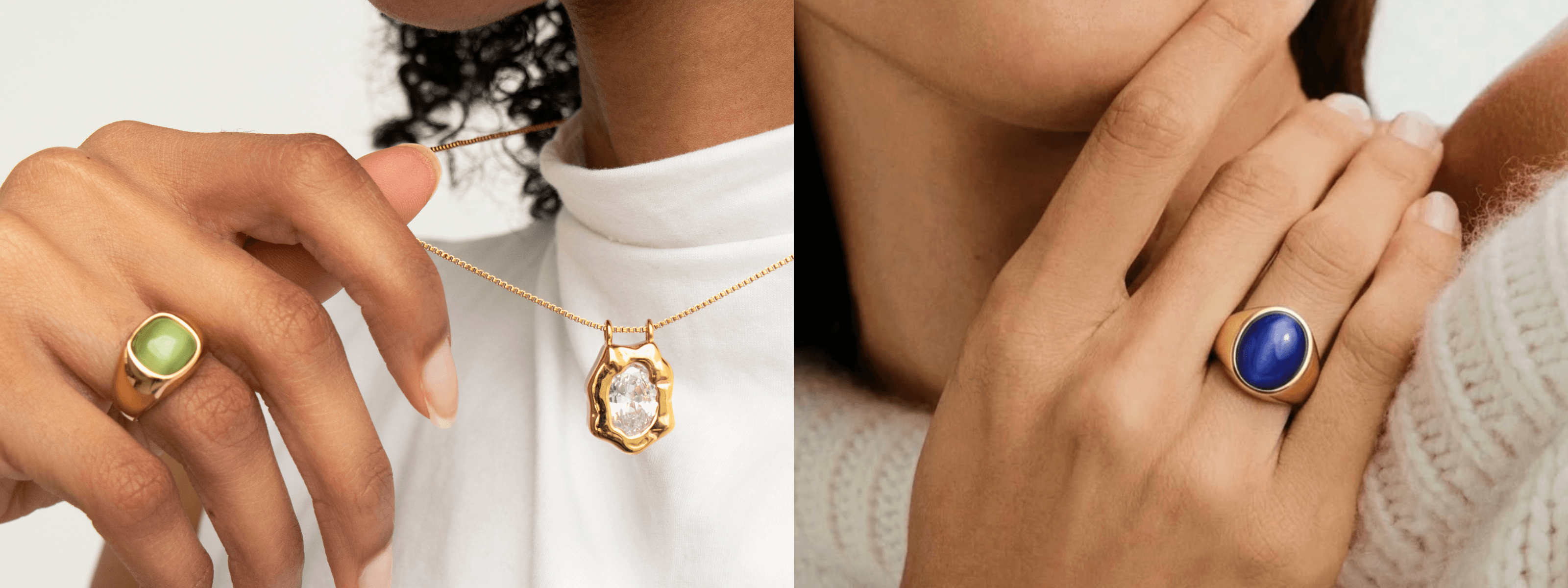
[hotspot_banner id="Puffy Coil Ring + Moonface Signet Ring"]
How to check: Inspect the high-friction areas of your jewelry, like the bottom of a ring band or the clasp of a necklace. Is the gold or silver color rubbing off to reveal a dull bronze, pink, or dark copper color underneath? If so, you have been duped. Real stainless steel is silver all the way through its core. Even if you manage to scratch our PVD gold-coated steel (which is very hard to do), you will only see silver steel underneath, never copper. For a full breakdown on why this specific color change happens.
Test 4: The Weight and Sound Profile
As I have mentioned before, true luxury has a specific weight to it. If you order a thick, chunky Cuban link chain and it arrives feeling as light as a plastic toy, be immediately suspicious.
Fake jewelry is often manufactured using hollow aluminum or zinc alloys to save on shipping costs and material expenses. These metals are incredibly light. Furthermore, they sound different. If you drop a real steel chain on a wooden table, it produces a solid, heavy, grounding "clink." If you drop an aluminum or zinc alloy chain, it produces a hollow, tinny, almost plastic-sounding rattle. Trust your senses. If it feels too light to be metal, it probably isn't quality steel.


Test 5: The Price Tag Reality Check
I am a huge advocate for affordable luxury. You should not have to spend $500 to get a good ring. However, there is a floor to how cheap quality materials can be.
Sourcing genuine 316L stainless steel, utilizing modern PVD gold-coating technology, and paying skilled workers to properly polish the hard metal costs money. If you are browsing a fast-fashion website and you see a "stainless steel" necklace selling for $2.50, your alarm bells should be ringing. At that price point, the manufacturer is absolutely cutting corners. They are likely using toxic lead alloys, cheap nickel, or flash-plated brass. If a deal seems too good to be true, it almost always is.
FAQ: Becoming a Jewelry Detective
Can a jeweler test my stainless steel?
Yes, most professional jewelers have acid testing kits. However, since stainless steel is highly resistant to standard testing acids (unlike silver or gold, which react predictably), the easiest way for them to confirm it is steel is simply by observing its hardness and lack of reaction to nitric acid.
Does real stainless steel ever tarnish or rust?
316L stainless steel is highly resistant to rust and tarnish. The only extreme scenario where it might show slight corrosion is if it is submerged in highly concentrated chlorine or harsh industrial chemicals for extended periods. For everyday wear, showering, and normal ocean swimming, it is entirely rust-proof.
Are there different grades of stainless steel?
Yes. 304 and 316L are the most common. 304 is often used for kitchen appliances, while 316L is used for jewelry and medical implants because it contains molybdenum, which dramatically increases its resistance to saltwater and sweat. Always look for brands (like Meideya) that specify 316L.
The Bottom Line
Your jewelry should empower you, not give you anxiety about washing your hands or going for a swim. You deserve complete transparency about what you are putting on your body every day.
By understanding these simple tests, you can clear out the fake, low-quality pieces from your jewelry box and start investing in accessories that are actually built to survive your real life. Stop settling for the illusion of quality, and demand the real thing.
[Shop with absolute confidence: Explore our guaranteed 100% 316L Stainless Steel Collection]
Published: [February 20, 2026]


Laat een reactie achter
Deze site wordt beschermd door hCaptcha en het privacybeleid en de servicevoorwaarden van hCaptcha zijn van toepassing.