

Statement ring: A Style Guide
A statement ring earns its name by being the one piece you actually see across a room — a dome, a sculptural curve, or an oversized stone worn as the focal point, not an accent. The decision that matters most is scale versus wearability: the boldest look is useless if the ring spins, snags, or sits too tight to wear daily. This guide covers what separates a good statement ring from a costume one, how to choose by occasion and finger, how the materials actually behave, and the honest trade-offs (real stones, plated metal, true scale) before you buy.
Key takeaways
- A statement ring is meant to be the focal point — dome, sculptural form, or a single oversized stone. Wear it largely on its own and keep the rest of your jewelry quiet.
- The criterion that decides comfort is band width and profile: a wide or domed band sits tighter, so size up about half a size and check the finished width in millimeters before you commit.
- Don't overpay for "diamond" sparkle on a fashion ring. Cubic zirconia (Mohs ~8–8.5) is honest sparkle, not a mined diamond (Mohs 10) — and a genuine gemstone is real stone set in plated metal, never solid gold.
- For an everyday bold ring that survives the shower and gym, a waterproof 18k-gold-plated 316L stainless steel dome ring is the most low-maintenance pick.
What to look for — the buyer's decision criteria
Statement and cocktail rings overlap: all cocktail rings are statement rings, but not every statement ring is a cocktail ring. The label matters less than how the ring is built. Here is what actually separates a piece you'll wear from one that lives in a drawer.
- Band width and profile. Most rings fall between roughly 1.6 mm and 6 mm; statement and dome bands run wider for presence. A wider band — especially anything past about 8 mm — sits tighter on the finger and is harder to push over the knuckle, so it should be sized up. A comfort-fit (domed interior) band slides on more easily and is the friendliest profile for an everyday wide ring.
- Scale that suits your hand. A statement ring should command attention without overwhelming the finger. If you have slimmer fingers, a tall dome or oversized stone can look top-heavy; a flowing sculptural form spreads the visual weight more evenly.
- The stone (if any) and how it's set. A single prominent gemstone reads as a classic cocktail ring; a sculpted metal motif reads as modern. Either way, a low, secure setting wears better day to day than a high prong that catches on clothing.
- The metal, stated honestly. For daily wear you want a base that resists tarnish and water. 18k-gold-plated 316L stainless steel gives you a warm gold tone with real corrosion resistance; plated brass can also look great but tarnishes faster once the plating wears. Know which one you're buying.
- The finish. A high-shine, "liquid metal" finish maximizes drama and hides fine surface marks better than a flat matte; matte and brushed finishes read quieter and more contemporary.
Best for X — pick by occasion and finger
Different moments call for different rings. Match the piece to where it lives on your hand and when you'll wear it.
- Best for everyday bold: a waterproof 18k-gold-plated 316L stainless steel dome or flowing-form ring. Low maintenance, no upkeep, and it won't turn your finger green.
- Best for evening and events: a true cocktail ring with a single oversized stone — historically worn on the right hand (ring or middle finger) to set it apart from wedding and engagement rings on the left.
- Best for a focal point on the index finger: a sculptural metal statement ring. The index reads confident and modern, and a metal form holds up to the bumps that finger takes.
- Best for sensitive skin: a 316L stainless steel base. It's hypoallergenic for most wearers because nickel is locked into the alloy and releases only a very small amount — far less than costume metals.
- Best for a gift: a flowing, sculptural gold-tone ring at a fashion price. It feels luxe, suits most outfits, and avoids the sizing gamble of a tall narrow band.
How the materials actually compare
The most common buying mistake is paying diamond expectations onto a fashion ring, or assuming a "gold" ring is solid gold. Here is what each material really is, with verified values.
| Material | What it really is | Hardness / key spec | Honest note |
|---|---|---|---|
| 18k-gold-plated 316L stainless steel | Corrosion-resistant steel core with a micro-thin 18k gold layer (75% gold) | FTC "gold plated" = ≥10k gold, ≥0.175 micron layer (electrolytic) | Waterproof, tarnish-resistant, won't turn skin green; the gold is a surface layer, not solid gold |
| 18k-gold-plated brass | Brass (copper alloy) core under a gold plating | Same FTC plating threshold | Looks identical when new, but tarnishes faster once plating wears; copper is what turns skin green |
| Cubic zirconia (CZ) | A real, lab-made stone — honest sparkle, not a diamond | Mohs ~8–8.5 (diamond is 10); higher dispersion than diamond | More colorful "fire," softer than diamond, costs a fraction; we never call it a diamond |
| Genuine gemstone (e.g. jade, onyx, tiger's-eye, moonstone) | A real mined stone, set in plated metal | Hardness varies by stone (see FAQ) | The stone is genuine; the band is plated, never solid gold |
For a daily statement ring, 18k-gold-plated 316L stainless steel wins on durability and upkeep. For maximum sparkle at a fashion price, CZ is the honest choice — bright and bold, just not a diamond. For a one-of-a-kind natural look, a genuine gemstone delivers, as long as you accept it's real stone in a plated setting.

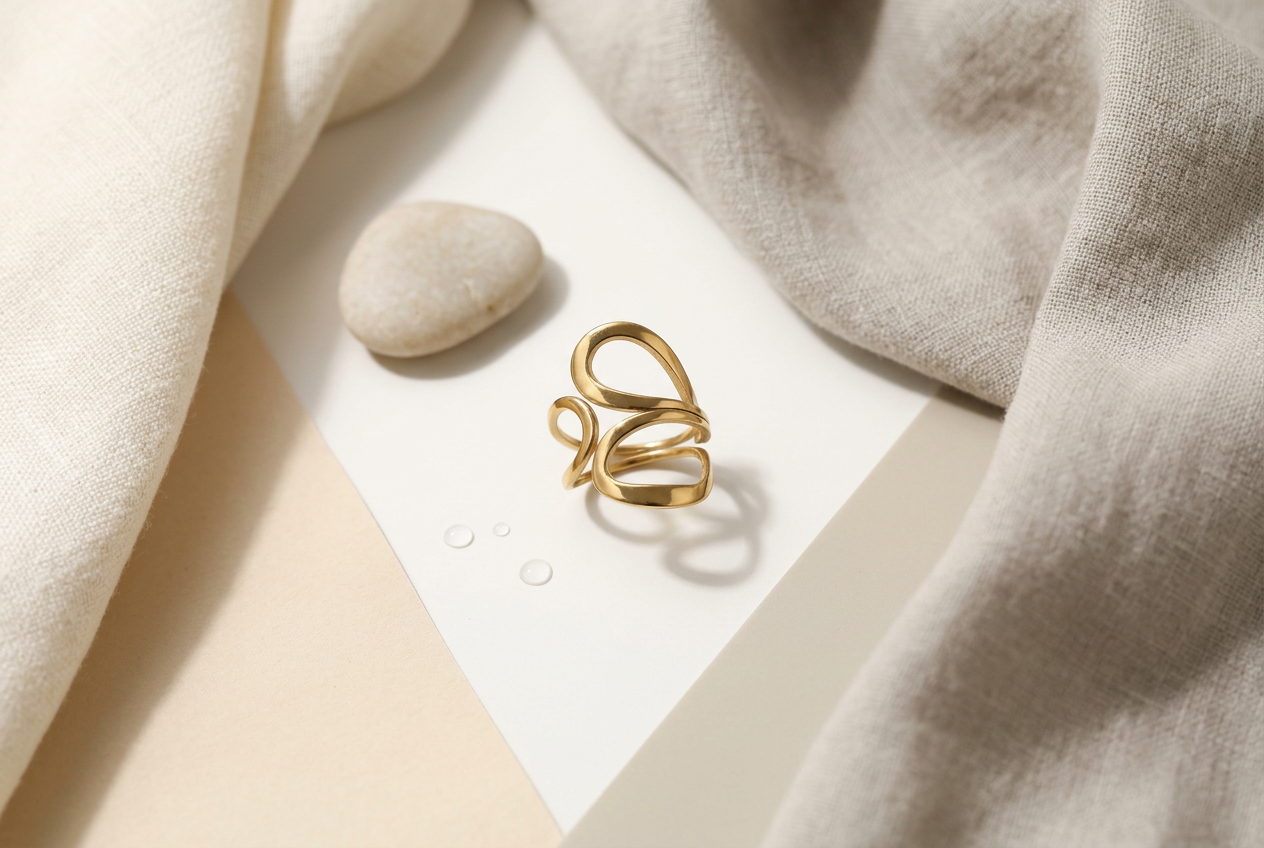
Statement Flow Ring
A sculptural piece inspired by the effortless movement of liquid gold, with open, flowing curves and a high-shine finish.
Shop this ring →Honest caveats — the real objections
- Will it actually hold up? A 316L stainless steel base is genuinely waterproof and corrosion-resistant — it can survive the shower, the gym, and the beach without rusting or tarnishing. The 18k gold is a plated surface layer, so it resists tarnish for years rather than forever; gentle wear (avoid abrasives and harsh chemicals) keeps the shine longer. A plated-brass piece is the same idea but wears faster underneath.
- Will it arrive looking like the photo — and fit? Statement rings photograph large, so check the actual band width and dome height before you order. Because a wide or domed band sits tighter, plan to size up about half a size from your usual ring size, and never size down on a band wider than roughly 8 mm. If you're between sizes, go up.
- Is the stone real, or "fake gold"? Be precise about both. A genuine gemstone is a real mined stone — but the band it sits in is 18k-gold-plated metal, not solid gold, and CZ is honest lab-made sparkle, never a mined diamond. We don't blur those lines. With jade specifically, ask whether it's natural or dyed: dyeing is a real concern in the market, and an honest listing will tell you.
- Any hidden costs? No. The price you see is a one-time price — no membership, no auto-enrollment, no subscription to keep your ring. You buy it once.
Ready to find your focal point? Browse the full Statement Rings collection for dome, sculptural, and stone-set styles.
Frequently asked questions
What is the difference between a statement ring and a cocktail ring?
A statement ring is any ring designed to be the focal point of your hand — a dome, a sculptural form, a wide band, or an oversized stone. A cocktail ring is a specific kind of statement ring, usually built around a single prominent gemstone and worn for evening or events. All cocktail rings are statement rings, but statement rings also include bold metal designs you can wear casually.
What size should I order for a wide or dome statement ring?
Size up. A wide or domed band sits tighter and is harder to slide over the knuckle than a thin band, so most people go about half a size larger than their usual ring size. For bands wider than roughly 8 mm, do not size down — they already fit snug. If you're between sizes, choose the larger one.
Is the gold on a Meideya statement ring real?
It's real 18k gold, applied as a plating over a 316L stainless steel base — not solid gold. Under U.S. FTC rules, "gold plated" means a layer of at least 10-karat gold at least 0.175 micron thick; 18k is 75% gold. The plating gives a true gold tone and resists tarnish for years, while the steel core keeps the ring waterproof and durable.
Will a stainless steel statement ring turn my finger green or irritate my skin?
No. 316L stainless steel is corrosion-resistant and won't turn skin green — that discoloration comes from copper in brass alloys. 316L is also considered hypoallergenic for most wearers: it contains nickel, but the nickel is locked into the alloy and releases only a very small amount, well within the EU Nickel Directive limits. A small number of highly sensitive people can still react, so test against your own skin if you have a known nickel allergy.
Are the gemstones in statement rings genuine, and how durable are they?
The gemstones are genuine natural stones, set in plated metal. Durability varies by stone: black onyx and tiger's-eye are quartz-family stones at about Mohs 7, jade is roughly Mohs 6–7, and moonstone is about 6–6.5 — all reasonably hard for everyday wear. Mother-of-pearl and freshwater pearl are much softer (about Mohs 2.5–4.5) and need gentle care, away from chemicals and abrasion. Cubic zirconia, at Mohs ~8–8.5, is harder than all of them but is a lab-made diamond alternative, not a diamond.
The rule is simple: choose the boldest ring you'll actually wear. Get the width and size right, know whether you're buying steel or brass, and accept that genuine stones are real but the band is plated — then a statement ring becomes the easiest way to make an outfit yours. See also our guides on chunky ring jewellery and the stainless steel ring jewelry guide.

Laat een reactie achter
Deze site wordt beschermd door hCaptcha en het privacybeleid en de servicevoorwaarden van hCaptcha zijn van toepassing.