


Signet ring: A Style Guide
A signet ring for women is a flat-faced statement ring — once a wax-seal stamp, now a wear-everyday piece you choose by face shape, finger, and how much daily abuse it has to survive. If you want the heirloom look without the heirloom upkeep, the decision usually comes down to one trade-off: a real-gold band you baby, or a gold-plated 316L stainless band you can shower, sweat, and swim in. This guide covers what actually matters when you buy one — the styles, the finger and sizing rules, an honest material comparison, and the questions buyers always ask before they trust the photo.
Key takeaways
- A signet ring is defined by its flat or domed face — historically engraved with a seal; today usually plain, paved, or stone-set as a style piece rather than a working stamp.
- The decision that matters most is everyday durability: if you won't take it off for the shower or gym, choose a waterproof 316L stainless base, not a delicate plated-brass or vermeil band.
- Don't overpay for "gold" you'll never see — a quality 18k-gold-plated 316L ring gives the same warm tone as solid gold at a fraction of the price, and won't turn your finger green (that green comes from copper in brass, not from stainless).
- Quick pick for most people: a polished or pavé signet on a pinky or index finger, sized up about half a size if the band is wide.
What a signet ring actually is — and how to choose one
Signet rings are one of the oldest forms of jewelry: Mesopotamians pressed them into wet clay to "sign" tablets around 3500 BC, and European nobility later used engraved seals to close letters. Worn on the middle or index finger when they were large working tools, they shrank and migrated to the pinky by Victorian times. Princess Diana wearing a gold signet on her left pinky in the 1980s is widely credited with normalizing the style for women. Today the seal is optional — most are bought as fashion pieces — so you're really choosing on these criteria:
- Face shape and size. Round and oval faces read soft and vintage; square or cushion faces look more architectural. A larger face makes a bolder statement; a dainty face stacks more easily.
- Surface treatment. A plain polished face is the classic (and the only kind you can engrave); a pavé face sets tiny stones across the top for sparkle without going full cocktail ring.
- Finger and hand. The pinky is the traditional home and the most flattering for a smaller face; the index finger suits a bolder face and reads modern. Wear it where it sits comfortably and clears your knuckle.
- Band material. The real durability decision (see the comparison below) — it determines whether the ring is an everyday piece or one you store in a box.
- Band width and fit. Signet bands are often wider than a plain ring, and wide bands feel tighter because they cover more skin. Most jewelers suggest sizing up about half a size for bands 5 mm or wider.
Best signet for X — pick by how you'll wear it
Different buyers want different things from the same flat-faced silhouette. Match the ring to your day:
- Best for everyday / shower-and-gym wear: a polished or pavé signet on an 18k-gold-plated 316L stainless band — waterproof, tarnish-resistant, and low-maintenance.
- Best for a subtle, layered look: a dainty pinky signet with a small face that stacks against thin bands without competing.
- Best for sensitive skin: a 316L stainless band — surgical-grade steel releases very little nickel, so it's a safe bet for most people who react to cheaper alloys.
- Best for a gift on a budget: a gold-plated 316L signet gives the heirloom look at an accessible, one-time price — no auto-renewing membership attached.
- Best for engraving / heirloom intent: a plain polished face in solid gold, since you'll want to engrave it and keep it for decades (and you'll accept the higher price and the careful storage).
The honest material comparison
"Gold signet ring" can mean five very different things. Here's how the common options actually compare — what the term means, who it's for, and the part most listings gloss over.
| Band material | Best for | What it really is (verified) | Typical price |
|---|---|---|---|
| 18k-gold-plated 316L stainless | Everyday wear, sensitive skin, value | A 316L surgical-steel core with a microscopic gold layer (FTC "gold plated" = ≥0.175 micron of ≥10k gold). 316L is waterproof, corrosion-resistant, and low nickel-release. | ~$30–$70 |
| Gold vermeil | Gold purists on a mid budget | Sterling silver with thicker gold plating (FTC vermeil = ≥2.5 micron of ≥10k gold over silver). Richer layer, but the silver base can still tarnish underneath if the plating wears. | ~$60–$150 |
| Gold-filled | Long-life plating without solid-gold cost | A bonded gold layer that is ≥1/20 (5%) of the item's weight — much thicker than plating, so it lasts longer, but not solid gold. | ~$80–$200 |
| Gold-plated brass | Cheapest "gold" look (short-term) | Brass core with thin plating. Brass contains copper, so as the plating wears it can react with skin and oxidize — this is the metal that turns fingers green. | ~$15–$40 |
| Solid gold (10k–18k) | Engraving, heirloom, lifelong wear | Real karat gold throughout (14k = 58.3% gold, 18k = 75% gold). No plating to wear off — but soft, scratchable, and a large jump in price. | $300+ |
The takeaway: if your priority is wearing it daily and never thinking about it, gold-plated 316L stainless wins on durability-per-dollar. If your priority is engraving an heirloom, only solid gold makes sense. Vermeil and gold-filled sit in between — better plating, but still a coating over a different metal.

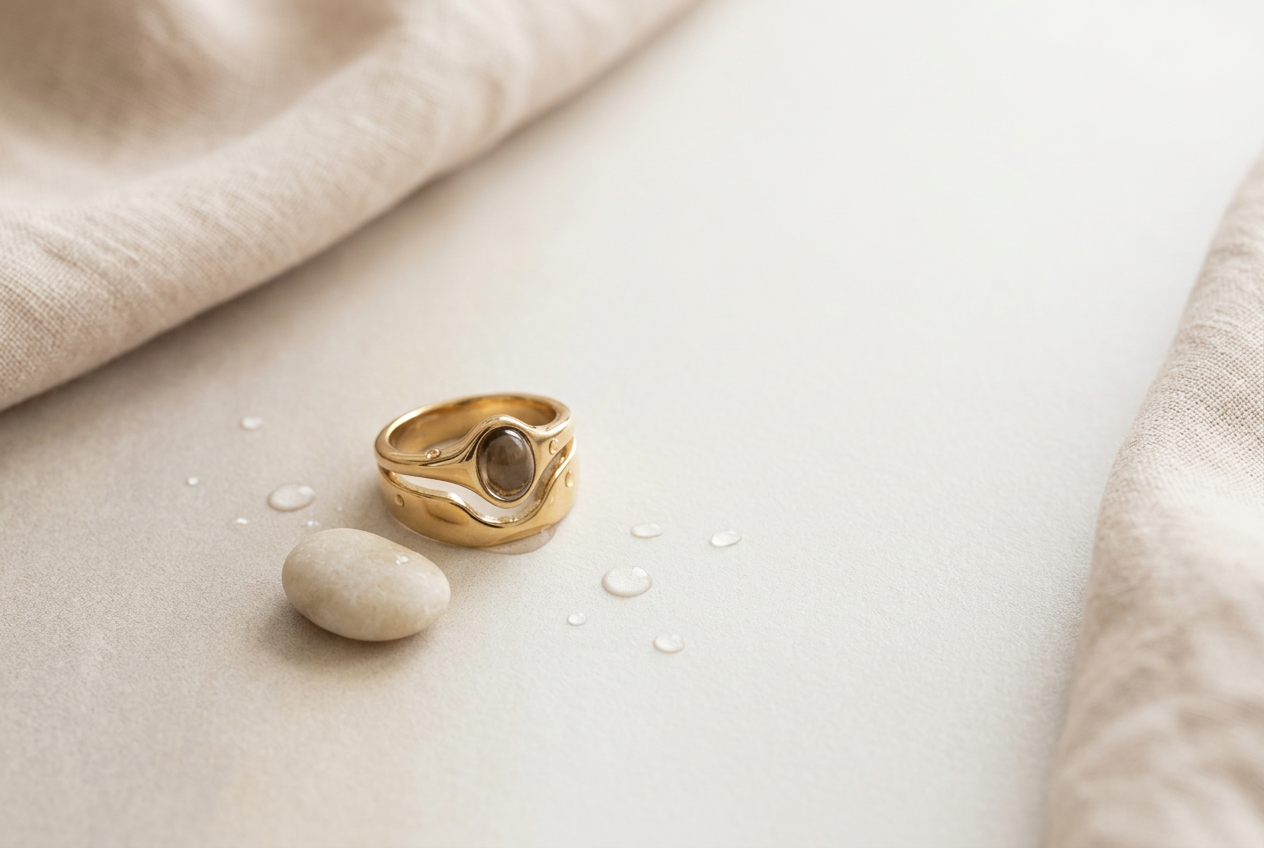
Circle Pave Signet Ring
A pinky signet ring with sparkling circle pavé — a dainty halo of crystals against a polished gold finish, on a waterproof, tarnish-free 18k-gold-plated 316L stainless band.
Shop this ring →Honest caveats — the questions buyers actually ask
- Will it actually hold up? A gold-plated 316L stainless signet is built for daily wear — the steel core is waterproof and corrosion-resistant, and PVD/gold plating resists tarnish for years. One honest caveat: plating is a surface layer, so with heavy daily friction it can eventually thin — it resists tarnish for years, not forever. The steel underneath never rusts or turns your skin green.
- Are the stones real diamonds? No — the sparkle on an affordable pavé signet like this one is a crystal or stone-set accent, never a mined diamond, and we'll never call it one. If a pavé piece is set with cubic zirconia (CZ), that's still honest sparkle, not a diamond: CZ rates about 8–8.5 on the Mohs hardness scale (diamond is 10) and actually throws more rainbow fire because its dispersion (≈0.058–0.066) is higher than a diamond's (≈0.044). Check each product's own listing for its exact stone — the rule across all of them is the same: brilliant everyday sparkle, never a diamond.
- Will it turn my finger green or irritate my skin? That green tint comes from copper in brass alloys, not from stainless steel. 316L surgical steel contains roughly 10–14% nickel by composition but releases very little — it's the release that triggers reactions, which is why 316L is considered safe for most sensitive skin and is used in surgical tools and piercing posts. If you have a severe nickel allergy, patch-test as you would with any metal.
- Will it arrive looking like the photo? Signet faces are small — typically a single-digit millimeter face, not the oversized rings some photos imply. Check the listed dimensions, and remember the wide-band rule: if the band is 5 mm or more, size up about half a size so it clears your knuckle.
- Any hidden costs? No. Our prices are one-time — there's no membership, no auto-enrollment, and no recurring charge to wear what you bought.
Ready to find your face shape and finger? Browse the full Signet Rings collection.
Frequently asked questions
What finger should a woman wear a signet ring on?
Traditionally the pinky finger of the non-dominant hand, a custom that became popular in the Victorian era and was later normalized for women when figures like Princess Diana wore a signet on the left pinky. There's no firm rule today — the index finger suits a bolder face and reads modern — so wear it where it sits comfortably and clears your knuckle.
Are the stones on a pavé signet ring real diamonds?
No. The sparkle on an affordable pavé signet is a crystal or stone-set accent, not a mined diamond. Where a piece uses cubic zirconia (CZ), it's a diamond simulant: CZ rates about 8–8.5 on the Mohs scale versus diamond's 10, and gives off more rainbow fire because its dispersion is higher. It's honest, durable everyday sparkle — check each listing for its exact stone, and we never market any of them as a diamond.
Is a gold-plated signet ring real gold?
A gold-plated ring has a microscopic layer of real karat gold over a different base metal. To be called "gold plated" under FTC guides, the plating must be at least 0.175 micron of 10-karat-or-finer gold. The visible surface is genuine gold tone; the core (ideally 316L stainless) is what gives the ring its strength and waterproof durability. It is not solid gold.
Will a stainless steel signet ring turn my finger green?
No. Green discoloration comes from copper in brass alloys reacting with skin, not from stainless steel. A 316L stainless core won't rust, tarnish from water, or turn your skin green, which is why it's a popular everyday and sensitive-skin choice.
Should I size up for a wide signet band?
Usually yes. Wide bands feel tighter because they cover more of the finger and create more friction, so most jewelers recommend sizing up about half a size for bands 5 mm or wider, so the ring slides comfortably over your knuckle.
The buying rule for a signet ring is simple: pick the face and finger you love, then match the band material to your real life — waterproof gold-plated 316L stainless if you'll wear it everywhere, solid gold if you'll engrave and keep it. See also our guides on chunky ring style and stainless steel rings.

Laat een reactie achter
Deze site wordt beschermd door hCaptcha en het privacybeleid en de servicevoorwaarden van hCaptcha zijn van toepassing.