

14k Gold Hoop Earrings: An Honest Buyer's Guide
Solid 14k gold hoops are a buy-them-once heirloom — usually $200 to $800+ a pair — while the gold hoops most people actually wear every day are 18k gold-plated stainless steel: the same warm gold look, waterproof, and well under $100. The trick to buying hoops is matching three things to your life: the metal, the size, and the weight. This guide walks through all three, explains what “14k gold” really means versus the gold-look finishes, and helps you pick a pair you will actually reach for.
Key takeaways
- “14k gold” means solid 14-karat gold (58.3% pure) throughout — the heirloom option, priced accordingly.
- For daily and in-the-water wear, 18k gold-plated 316L stainless steel is the value pick: the look, hypoallergenic, water- and tarnish-resistant, usually $30–$90.
- Size changes everything. Huggies hug the lobe (~8–13mm); small hoops (~15–25mm) are the everyday default; large hoops (40mm+) make a statement and need to be lightweight.
- Lightweight matters more than people expect — a hollow or thin-tube hoop is far more comfortable for all-day wear than a solid heavy one.
First decide the metal
Almost every hoop sold as “gold” is one of four things, and the U.S. Federal Trade Commission’s jewelry guides define them:
- Solid 14k gold. Gold alloy throughout, 58.3% pure. Never wears to another metal, holds value — and costs the most.
- 18k gold-plated stainless steel. A layer of 18k gold bonded to a 316L stainless-steel core. The FTC requires “gold-plated” to be at least 0.175 microns of 10k-or-better gold; the steel base is what makes it rust-proof and hypoallergenic.
- Gold-filled. A thicker bonded layer — by FTC rule the gold is at least 1/20 (5%) of the item’s weight, usually over brass.
- Vermeil. Gold (at least 2.5 microns, 10k+) over sterling silver.
For hoops specifically, the base metal matters more than usual, because hoops swing and rub against the neck and hair all day. A 316L stainless-steel base resists that wear and will not turn your neck green the way a cheap brass hoop can.
Then decide the size
Hoop size is measured by diameter, and it changes the whole look:
| Size (approx. diameter) | Look | Best for |
|---|---|---|
| Huggie (~8–13mm) | Sits tight on the lobe | Everyday, stacking, sleeping in |
| Small (~15–25mm) | Classic, versatile | The all-day default |
| Medium (~30–40mm) | Noticeable, still wearable | Dressing up an outfit |
| Large / statement (50mm+) | Bold, eye-catching | Going out — choose lightweight |
A practical tip: if you are buying your first “real” gold-look hoops, a small-to-medium size in a lightweight design is the most-worn choice. Many people end up reaching for a small everyday pair far more than a dramatic large one.
Best for your situation
- Best for everyday and the gym: small 18k gold-plated 316L hoops — the look, hypoallergenic, water-resistant, and inexpensive enough not to fuss over.
- Best as an heirloom: solid 14k gold — buy once, keep for decades.
- Best for versatility: a hoop set in graduated sizes, so you can match the hoop to the day.
- Best for sensitive ears: a stainless-steel or solid-gold base — both release very little nickel, the most common contact allergen per the American Academy of Dermatology and Mayo Clinic.

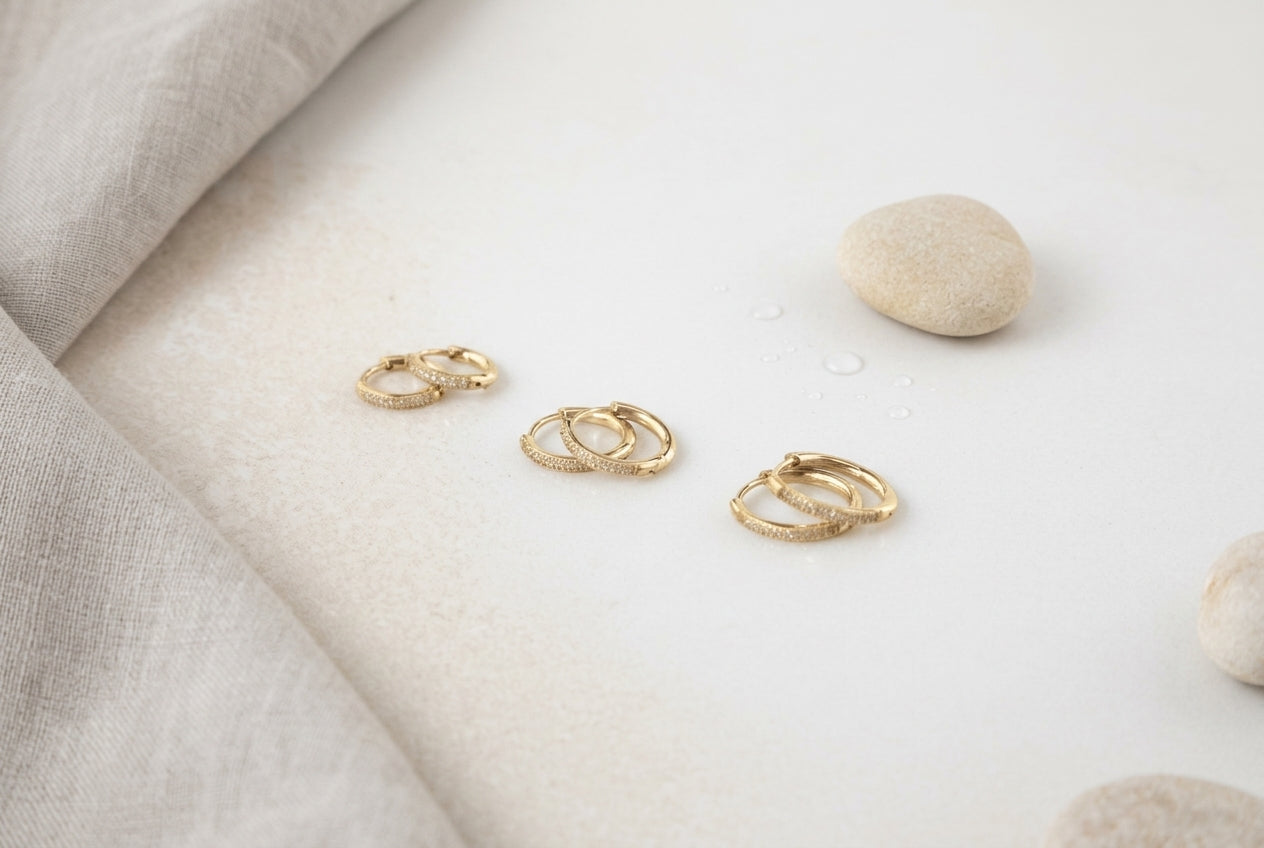
Gold Hoop Earrings Set
Three pairs in 12mm, 14mm, and 16mm with cubic-zirconia accents — an everyday set in 18k gold-plated stainless steel.
Shop this set →Honest answers to the questions buyers actually ask
- Will gold-plated hoops turn my ears or neck green? The green reaction comes from copper in brass bases, not stainless steel. A 316L base does not do it, and a quality gold layer resists tarnish — but it is a surface layer, so the honest answer is “resists wear for years,” not “never wears.”
- How heavy should a hoop be? Lighter is usually better for comfort. Larger hoops should be hollow or thin-tube so they do not drag on the piercing; a heavy solid large hoop gets uncomfortable fast.
- Any hidden costs? Meideya’s pieces are one-time purchases — the price you see is the price you pay, with no membership auto-enrolled at checkout.
Bottom line: pick the metal for how you live, then the size for the look. For everyday gold hoops that handle water and sensitive skin without the solid-gold price, browse Meideya’s hoop & huggie earrings in 18k gold-plated stainless steel. If you prefer the close-to-the-lobe look, see our guide to 14k gold huggie earrings, or for sparkle, diamond (and CZ) huggie earrings.
Frequently asked questions
Are 14k gold hoop earrings worth it?
If you want hoops that never tarnish, hold resale value, and last for decades, solid 14k gold is worth the higher price. For everyday wear where you would rather not worry about an expensive earring at the gym or in the shower, 18k gold-plated stainless steel gives the same gold look for far less.
What size gold hoops should I buy?
Small hoops of about 15 to 25mm are the most versatile everyday choice. Huggies of roughly 8 to 13mm sit tight on the lobe and are great for stacking, while large hoops of 40mm and up make a statement but are most comfortable in a lightweight design.
Is 18k gold-plated stainless steel good for hoops?
Yes. The 316L stainless-steel core is rust-proof and hypoallergenic, and the 18k gold layer gives a warm gold finish. Because the gold is a surface layer it is not the same as solid gold, but on a stainless base it resists tarnish and water far better than cheap plating over brass.
Can I shower or work out in gold-plated hoops?
Occasional water and sweat are fine, and a stainless-steel base will not rust. To keep the gold finish looking its best, rinse off chlorine and sweat, avoid harsh chemicals, and dry the hoops before storing them.
Why do cheap gold hoops turn my ears green?
That reaction is caused by copper in brass alloys reacting with moisture and skin, not by gold or stainless steel. Choosing a hoop with a 316L stainless-steel or solid-gold base avoids it.

Laat een reactie achter
Deze site wordt beschermd door hCaptcha en het privacybeleid en de servicevoorwaarden van hCaptcha zijn van toepassing.