

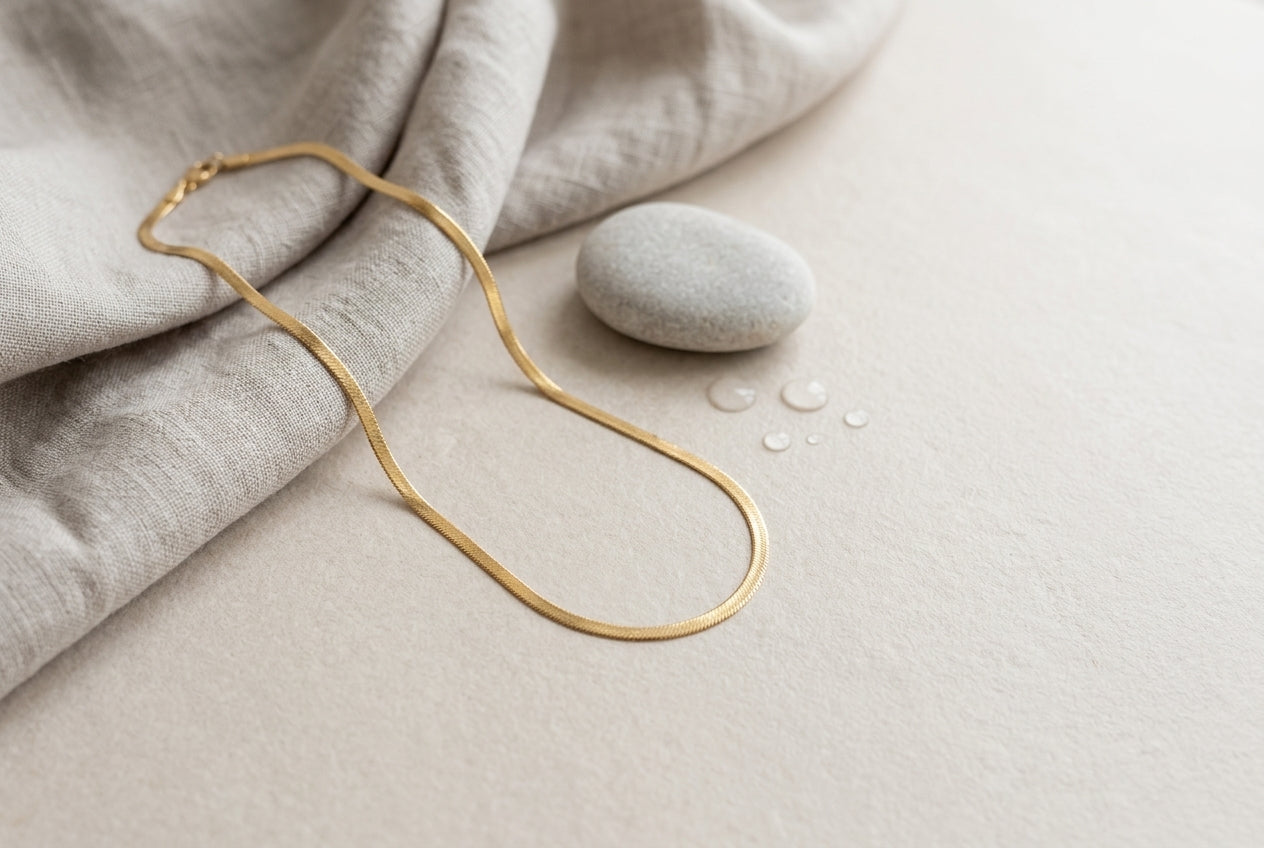
Herringbone necklace: A Buyer's Guide
A herringbone necklace is a flat, tightly woven chain whose mirror-smooth surface lies flush against the skin — and the single thing that decides whether you love it long-term is how well it resists kinking. This guide is for anyone shopping their first herringbone (or replacing one that kinked): we cover what actually separates a good one from a flimsy one, which width suits which neckline, how to read material claims honestly, and how to keep that liquid-gold shine flat for years. Meideya makes waterproof, 18k-gold-plated 316L stainless-steel versions, and we'll be straight about what plating can and can't do.
Key takeaways
- The herringbone's signature look is also its weakness: the flat weave lies beautifully flush but kinks permanently if it's twisted, slept in, or loaded with a heavy pendant. Buy one built to be worn alone.
- Width is the real decision: ~2mm reads delicate and layers well; 3–5mm makes a bolder solo statement. Heavier doesn't mean more durable — construction does.
- Don't overpay for "gold." A quality 18k-gold-plated 316L stainless-steel herringbone gives you the warm gold tone and waterproof wear without solid-gold pricing — just know plating is a surface layer, not solid metal.
- Quick pick: for most people, a 2mm gold-tone herringbone in a choker-to-collarbone length is the everyday workhorse.
What to look for: the buyer's decision criteria
Herringbone chains look nearly identical in photos, so judge them on the things that actually predict daily satisfaction:
- Kink resistance. Herringbone links are flat parallel bars woven side by side, which is why the chain lies flush and reflects light like a ribbon. That same flatness means a sharp bend creates a crease that never fully recovers — and that crease becomes a permanent weak spot prone to bending and breaking again. The fix is partly design (don't hang heavy charms on it) and partly care, covered below.
- Width and feel. A ~2mm herringbone is light, soft, and layers easily; wider 3–5mm versions sit bolder and worn solo. Pick width by the statement you want, not by a "thicker = tougher" assumption.
- Base metal, stated honestly. Herringbones come in solid gold, gold-filled, sterling silver, and gold-plated stainless steel. For everyday wear at a fair price, gold-plated 316L stainless steel is the sweet spot — it's corrosion-resistant, holds a bright gold tone, and won't turn your skin green (that greening comes from copper in brass, not from steel).
- Plating method. If a piece is gold-plated, ask how. PVD (physical vapor deposition) bonds the gold to the steel at a molecular level and is dramatically harder and more wear-resistant than the old dip-style electroplating — a meaningful durability gap for a chain that flexes all day.
- Clasp and length. A secure lobster clasp and a length that suits your neckline matter more than people expect; many gold-tone chains include a short extender so one piece works as a choker or a collarbone necklace.
Best for X: pick by how you'll actually wear it
Different buyers want different things from the same chain. Match the herringbone to the job:
- Best for everyday + layering: a slim ~2mm gold-tone herringbone. It's the one you reach for daily and the one that stacks cleanly under a pendant or a second chain.
- Best for sensitive skin: a 316L stainless-steel base. 316L is widely regarded as hypoallergenic because it releases very little nickel onto skin — far less than the metals that typically trigger reactions.
- Best for shower, gym, and pool: a waterproof gold-plated 316L piece. Stainless steel is corrosion-resistant, so sweat and water won't tarnish it the way plated brass eventually does.
- Best as a gift: a collarbone-length gold-tone herringbone. It's the most versatile, photographs beautifully, and suits almost any neckline — a safe choice when you don't know the wearer's exact preference.
- Best on a budget: gold-plated stainless over solid gold or gold-filled. You get the look and the waterproof wear for a fraction of the price.
The comparison: herringbone material options
Here's how the common ways to buy a gold-tone herringbone stack up on the facts that matter. Prices are typical market ranges, not exact quotes.
| Option | Best for | Key facts — verified | Typical price |
|---|---|---|---|
| Gold-plated 316L stainless steel | Everyday, waterproof wear at a fair price | 18k gold layer over corrosion-resistant 316L; PVD plating is far harder (~800–2000+ HV) than standard electroplating (~100–200 HV); won't turn skin green | ~$30–$70 |
| Gold-filled | A long-lasting gold layer below solid-gold cost | FTC requires the gold layer to be ≥1/20 of the item's weight — a far thicker bonded layer than plating | ~$60–$200+ |
| Sterling silver (gold-plated) | A precious-metal core with gold tone | 925 silver base; the gold is still a surface plating that can wear over time | ~$50–$150 |
| Solid gold (10k–18k) | Heirloom, no plating to wear | 10k = 41.7% gold, 14k = 58.3%, 18k = 75% gold; price tracks karat and weight | $300–$1,000+ |
The takeaway: solid gold wins on permanence, but for a chain you'll wear in the shower and at the gym, a well-made gold-plated 316L herringbone delivers the look and the toughness for everyday life — which is why it's the column most buyers land on.

Soft Herringbone Chain Necklace
Crafted with a delicate 2mm width and an incredibly soft feel — perfect for easy layering or wearing solo.
Shop this necklace →Honest caveats: the real objections
- Will it actually hold up? A 316L stainless-steel base is corrosion-resistant and waterproof, and PVD-style gold plating bonds at the molecular level for genuine scratch and wear resistance. But be clear-eyed about two things: plating is a surface layer that resists tarnish for years, not literally forever; and every herringbone — regardless of metal — can crease if it's twisted hard. Treat it as a wear-alone chain and it will reward you.
- Will it arrive looking like the photo? Yes, but know the scale before you buy. Our Soft Herringbone Chain Necklace is a delicate 2mm width and sits at roughly 13.5" plus a 2.5" extender — a true choker-to-high-collarbone length, not a long matinee chain. It's intentionally fine and lightweight; if you want a bolder drop, choose a longer or wider style. (For reference: chokers sit at 14–16", princess length at 17–19" with 18" the most popular, and matinee at 20–24".)
- Any hidden costs? No. The price you see is a one-time price — no subscription, no auto-enrollment, no membership to keep your jewelry working. You buy the necklace and you're done.
Ready to find your shade and length? Browse the full Chain Necklace collection.
Frequently asked questions
Do herringbone necklaces kink easily?
They can, because the flat woven links lie flush and don't tolerate sharp bending. A twist or a heavy pendant can create a crease that becomes a permanent weak spot. Worn alone, stored flat, and kept off the pillow at night, a quality herringbone holds its shape for years.
Is a gold-plated stainless steel herringbone good quality?
Yes, for everyday wear. An 18k-gold-plated 316L stainless-steel chain is corrosion-resistant, waterproof, and won't turn your skin green. Just understand that the gold is a durable surface layer, not solid gold — which is exactly what makes the price accessible.
Will a herringbone necklace tarnish in the shower or at the gym?
A stainless-steel-based, PVD-gold-plated herringbone is built for water and sweat — it's waterproof and tarnish-resistant for daily wear. Plated brass is the type that eventually discolors with moisture; a 316L base is far more forgiving. Rinse off lotions and salt water and dry it to keep the shine its best.
What width and length herringbone should I choose?
Width sets the vibe: ~2mm reads delicate and layers easily, while 3–5mm makes a bolder solo statement. For length, a choker (14–16") sits high on the neck, princess (17–19", with 18" most popular) rests just below the collarbone, and matinee (20–24") falls toward the bust. Many gold-tone chains include an extender so one piece spans two looks.
Is stainless steel safe for sensitive skin?
Generally, yes. 316L stainless steel is widely considered hypoallergenic because it releases very little nickel onto the skin, which is what reduces irritation for most wearers. Nickel is one of the most common contact allergens, so if you have a severe nickel allergy, patch-test first or look to nickel-free metals like titanium.
The rule for buying a herringbone is simple: choose it for the flat, liquid-gold look, treat it as a wear-alone chain, and pick a base metal you can actually live in every day. See also our guides on styling a chunky chain necklace and choosing a dainty gold necklace.

Laat een reactie achter
Deze site wordt beschermd door hCaptcha en het privacybeleid en de servicevoorwaarden van hCaptcha zijn van toepassing.