

Solid Gold Earrings: Investment vs Everyday
Solid gold earrings are an investment piece — buy them for the one or two designs you'll wear for decades, not the on-trend looks you change with the season. "Solid gold" means the whole earring is a real gold alloy (at least 10k) rather than plated or hollow-filled, so it never wears down to a base metal — but you pay for every gram, and the karat decides both price and how the gold behaves. This guide covers what "solid" means under FTC rules, where it's worth it versus where a waterproof alternative makes more sense, and how to read the spec sheet so a "gold" earring doesn't disappoint you in a year.
- "Solid gold" is not "pure gold." It only means the piece is made entirely of a gold alloy of at least 10k and is not hollow or filled — 14k is 58.3% gold, 18k is 75% gold; 24k pure gold is too soft for most earrings.
- Solid gold's real advantage is permanence. The gold goes all the way through, so it never wears off to reveal a base metal — but you pay full gold weight up front, which is why it suits keepers, not trend pieces.
- Plating is a surface layer, not a lie. A 0.175-micron minimum is all the FTC requires to call something "gold plated," so quality varies enormously — the base metal underneath is what decides whether it lasts and whether it's skin-safe.
- For everyday, low-maintenance wear, a waterproof 316L stainless-steel pair, or a fun gemstone-accent style, survives daily life without the cost — and without the worry of losing a real-gold earring. Just check each listing for the base metal, since it sets durability and skin safety.
What "solid gold" actually means — and what to look for
The term sounds absolute, but it's a category, not a guarantee of purity. Under the FTC's jewelry guides (16 CFR Part 23), the words on the tag are precise — and reading them is most of the battle.
- Solid gold = made entirely of gold alloy, not hollow or filled. It says nothing about purity. A solid 10k earring is still mostly other metals; the value is that it's gold all the way through, with no base-metal core to corrode.
- Karat tells you the gold content. Karats are parts out of 24: 14k is 58.3% gold, 18k is 75% gold, 24k is 100% pure. Higher karat is richer in color and more hypoallergenic, but softer and pricier.
- Plated and filled are different products. "Gold plated" requires only a 0.175-micron layer of at least 10k gold; "heavy gold electroplate" and "vermeil" require 2.5 microns (vermeil specifically over a sterling-silver base); "gold filled" must be at least 1/20 (5%) of the item's weight in 10k-plus gold, mechanically bonded. None is solid gold.
- Match karat to use. For daily wear, 14k balances durability and price; 18k looks warmer and is gentler on sensitive ears but dents more easily. Above 22k is usually too soft to hold a post or stone setting well.
- Skin safety comes from the alloy, not the word "gold." Solid 14k and 18k gold contain no nickel, the metal behind most jewelry allergies. With plated pieces, once the surface wears, the base metal is what touches your skin — so the base matters more than the plating's shine.
Best for X — when solid gold wins, and when it doesn't
Different buyers want different things from an earring. Here's how to decide which kind of "gold" is the right spend for you.
- Best for a true heirloom or milestone: solid 18k or 14k. For one pair to keep for decades and pass on, real gold is the only material that never wears down.
- Best for sensitive ears on a budget: solid 14k gold posts, or a 316L stainless-steel pair. Both keep nickel exposure very low; stainless does it for far less because the metal is the same all the way through.
- Best for everyday, no-maintenance wear: waterproof 316L stainless steel. You can shower, swim, and work out in it without removing it or worrying about a high-value loss — a trade-off solid gold can't match.
- Best for color or a trend: an affordable pair with a natural stone or CZ accent. Spending full gold weight on a seasonal look rarely makes sense; a low-cost pair lets you experiment.
- Best for a gift when you're unsure of taste: a versatile gold-tone stud in 316L. It reads polished and luxe, survives daily life, and won't strand the recipient with an expensive piece that isn't their style.
Solid gold vs. the alternatives — the honest comparison
Here's how the common "gold" earring options stack up on the specs that actually decide longevity, skin safety, and price. Prices are typical market ranges, not fixed figures.
| Option | Best for | Key spec (verified) | Typical price (a pair) |
|---|---|---|---|
| Solid 18k gold | Heirloom keepers, warm color, sensitive ears | 75% pure gold throughout; never wears off; no nickel; softer than 14k | $$$$ (hundreds to thousands) |
| Solid 14k gold | Daily-wear keepers on a budget | 58.3% pure gold throughout; harder than 18k; no nickel | $$$ (high tens to hundreds) |
| Gold vermeil | Gold look over a precious base | ≥2.5-micron gold (≥10k) over sterling silver; surface layer wears with time | $$ (tens to low hundreds) |
| Gold-plated 316L stainless | Affordable luxury, waterproof everyday wear | 316L is corrosion-resistant; very low nickel release; plating is a surface layer, lasts years not forever | $ (often $20–$60) |
| Gemstone- or CZ-accent pair | Color and trend pieces, low maintenance | Plated setting (check listing for the base metal); agate ~Mohs 6.5–7, CZ Mohs 8.5 (vs diamond 10); affordable, easy to wear | $ (often $30–$60) |
The honest takeaway: solid gold wins on permanence and resale, and there's no substitute if that's your goal. But for the pairs you actually reach for every day — the ones that get rained on, slept in, and worn to the gym — a waterproof 316L design delivers the look and the skin safety without the cost or the anxiety of an expensive loss.

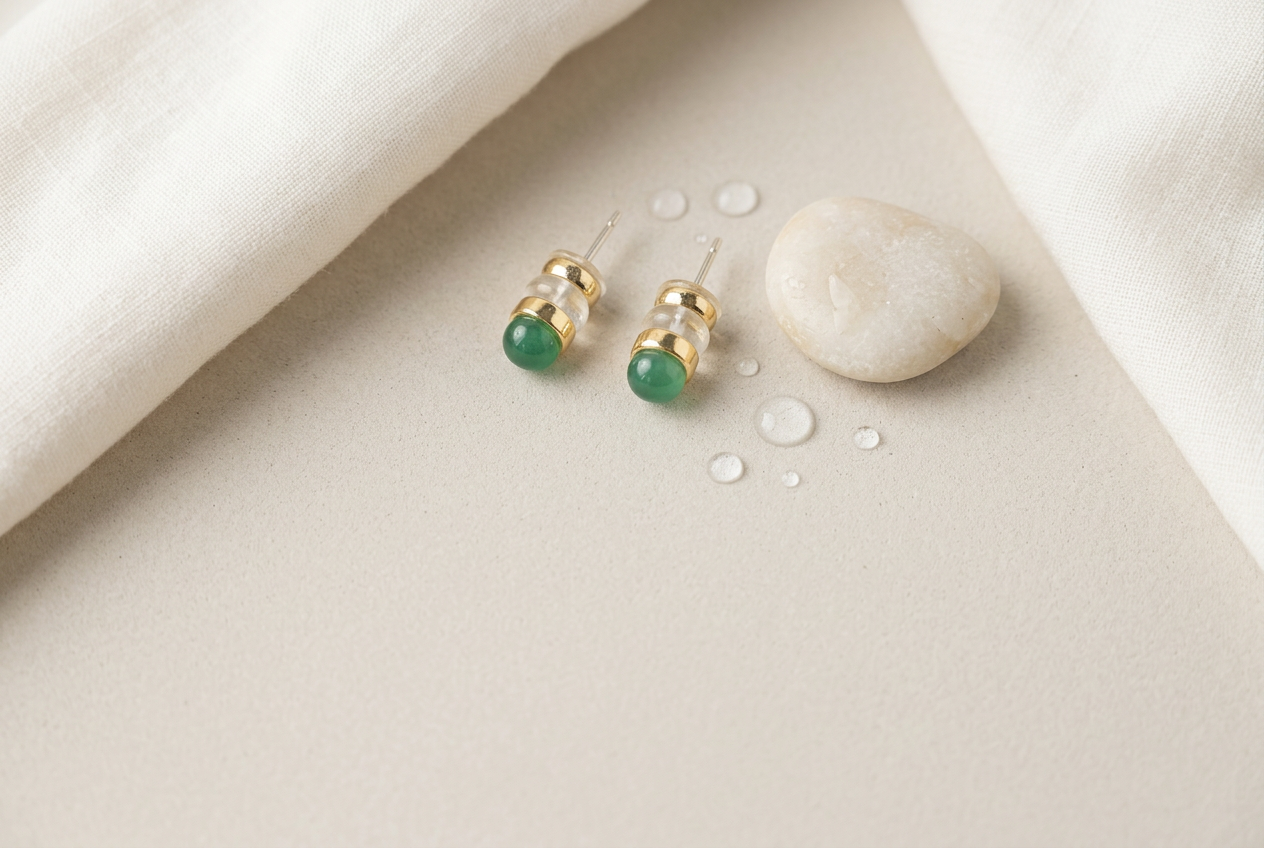
Green Agate Studs
Featuring genuine 4mm green agate stones for a natural pop of rich color — an easy everyday pair that adds character without the cost of solid gold.
Shop these studs →Honest caveats — the questions buyers actually ask
- Will a plated pair tarnish like my last "gold" earrings? Cheap gold-plated jewelry usually fails because of a paper-thin layer over a poor base metal — once it wears, the base corrodes. The fix is twofold: a durable plating and a sound base. Meideya's everyday gold-tone pieces are 18k-gold-plated, and the brand's waterproof line is built on corrosion-resistant 316L stainless steel; gemstone styles like the Green Agate Studs use a plated brass setting to hold the stone. Across the board the gold tone is a surface finish, so check the product page for the exact base metal — and remember any plating resists tarnish for years, not forever, then shows wear on the metal beneath.
- Will it arrive smaller than the photos? We'd rather you know the real scale. Studs like our Green Agate pair use 4mm stones — petite and refined, sitting close to the lobe, not the oversized look a zoomed shot suggests. Want presence? Size up deliberately. Want an everyday pair that layers with anything? Small is the point. Either way, the listed millimeters are the truth.
- Are there hidden costs or a subscription? No. Every Meideya pair is a one-time purchase — no membership, no auto-enrollment, no recurring charge. The price you see is the price you pay, the opposite of solid gold's true ownership cost (insurance, careful storage, the worry of loss) that buyers often forget.
If your goal is a low-maintenance pair that looks luxe and lasts through real life, browse the full stainless steel earrings collection and pick the look you'll actually wear every day.
Frequently asked questions
What does "solid gold" mean — is it the same as pure gold?
No. "Solid gold" only means the piece is made entirely of a gold alloy of at least 10k and is not hollow or filled with another metal. It is not the same as pure (24k) gold. A solid 14k earring is 58.3% gold and a solid 18k earring is 75% gold; the rest is other metals that add strength. The value of "solid" is that the gold runs all the way through, so it can never wear off to reveal a base metal.
Are solid gold earrings a good investment?
For pieces you'll keep and wear for decades, yes — solid gold holds its material value and never tarnishes, fades, or wears off, so the gold you see today is the gold you'll have in twenty years. It makes less sense for trend-driven or seasonal styles, where you pay full gold weight for a look you may not wear long. Remember that true ownership cost includes insurance, careful storage, and the risk of loss, which a durable, affordable everyday pair avoids entirely.
Is solid gold better than gold-plated stainless steel for everyday wear?
It depends on your priorities. Solid gold is unbeatable for permanence and resale, but it's costly and a real worry to lose or damage in daily life. Gold-plated 316L stainless steel is corrosion-resistant, waterproof, and very low in nickel release, so it survives the shower, gym, and beach at a fraction of the price. For the pairs you actually wear every day, a quality stainless design is often the smarter, lower-stress choice; for one keeper, solid gold wins.
Will gold-plated stainless steel turn my skin green or cause a reaction?
Green skin comes from copper in brass, not from stainless steel — 316L does not cause it. 316L is also hypoallergenic, releasing very little nickel, the metal behind most jewelry allergies according to dermatology sources. Solid 14k and 18k gold contain no nickel at all, which is why they're so skin-friendly. With any plated piece, the base metal matters most, because once the surface layer eventually wears, the base is what touches your skin — which is why a 316L base is a meaningful advantage.
How big are Meideya's stud earrings — will they look as large as the photos?
Meideya leans demi-fine and dainty, so we're upfront about scale. Our Green Agate Studs, for example, use genuine 4mm stones — a petite, refined size that sits close to the lobe, not an oversized statement. Product photos are often shot close-up, so check the listed millimeters rather than the image. If you want more presence, choose a larger design on purpose; if you want an everyday pair that pairs with everything, the smaller size is the point.
The buying rule is simple: spend on solid gold for the one or two pairs you'll keep forever, and choose a waterproof, affordable design for the looks you wear every day. See also our guides on 18k gold earrings and 14k gold huggie earrings.

Laat een reactie achter
Deze site wordt beschermd door hCaptcha en het privacybeleid en de servicevoorwaarden van hCaptcha zijn van toepassing.