

Tiger eye ring: A Style Guide
A tiger's eye ring is genuine chatoyant quartz — the warm golden-brown stone with a shifting band of light — set on a metal band, and the smart way to buy one is to focus on the stone's "cat's-eye" shimmer first and the band material second. This guide is for anyone drawn to tiger's eye for its earthy color and its reputation as a stone of confidence, but who wants to know what they're actually paying for. The one trade-off that decides most purchases: a real golden tiger's eye is durable everyday quartz, while a vivid neon-blue or candy-pink "tiger's eye" is usually dyed. Below we cover how to judge the stone, which ring suits which wearer, an honest material comparison, and the questions buyers actually ask.
Key takeaways
- Genuine tiger's eye is a quartz variety with a Mohs hardness of about 7 — hard enough for daily wear, and prized for its chatoyancy (the moving "cat's-eye" stripe of light).
- The decision that matters most is authenticity of color: classic golden-brown is natural; red is an accepted heat treatment; bright/neon blue, green, or pink is usually dyed and can fade.
- Don't overpay expecting a precious gem — tiger's eye is an affordable semi-precious stone. What you're paying for is a good cut, strong chatoyancy, and a well-made band.
- For the most common case — an everyday statement ring you can wear in the shower — a genuine cabochon tiger's eye on 18k gold-plated 316L stainless steel is the practical pick.
What to look for: how to choose a tiger's eye ring
Tiger's eye is a member of the quartz family, which is why it earns its place in everyday jewelry. Here is what separates a piece worth wearing from a forgettable one.
- Strong chatoyancy. The whole appeal of tiger's eye is the silky band of light that rolls across the surface as you move your hand — an effect called chatoyancy, from the French for "cat's eye." Tilt the stone under light: a good cabochon shows a crisp, mobile stripe rather than a flat, muddy brown.
- Cabochon cut. Tiger's eye is almost always cut as a smooth, domed cabochon (not faceted) because the rounded surface is what displays the cat's-eye effect. A polished dome with even color and a clean reflection beats a dull or pitted one.
- Honest color. Natural tiger's eye is golden-brown to honey. Red tiger's eye is produced by heat-treating the golden variety — a stable, widely accepted enhancement that's still a natural stone. Be cautious with intense blue, green, or pink stones sold as "tiger's eye": those are frequently dyed, and dye can fade along the edges with water and time.
- The band material. The stone may be genuine while the band is not solid gold. Most affordable tiger's eye rings — including ours — use a stone set on 18k gold-plated stainless steel. That's an honest, durable combination, not a downgrade, as long as the seller states it plainly.
- Comfortable fit. Many tiger's eye rings are sculptural or wide-band designs. As a rule of thumb, when a band is roughly 5–6mm or wider, size up about half a size from your usual measurement so it slides over the knuckle comfortably.
Best for X: matching the ring to the wearer
Different buyers want different things from a tiger's eye ring. Here's a quick way to narrow it down.
- Best for an everyday statement: a single cabochon on a sculptural gold-tone band — bold enough to notice, comfortable enough to forget you're wearing it.
- Best for meaning: tiger's eye is traditionally seen as a stone of courage, confidence, and grounding, which makes it a thoughtful "you've got this" gift or a personal everyday talisman.
- Best for low maintenance: a genuine stone set on 18k gold-plated 316L stainless steel — waterproof and tarnish-resistant, so it survives the shower, gym, and pool without daily upkeep.
- Best for a budget: because tiger's eye is semi-precious, you can get real, well-cut chatoyant quartz for a fraction of a gemstone ring — spend on a clean cut and a solid band, not on a "rare" color claim.
Tiger's eye vs. other ring stones: an honest comparison
Tiger's eye sits in a sweet spot for everyday wear: hard enough to take daily knocks, but earthy and affordable. Here's how it compares with other stones we set in rings, using verified hardness values.
| Stone | What it is | Mohs hardness | Best for |
|---|---|---|---|
| Tiger's eye | Chatoyant quartz (golden-brown; red is heat-treated) | ~7 | Bold, warm everyday statement rings |
| Black onyx | Chalcedony (a quartz) | ~7 | Sleek, neutral, goes-with-everything looks |
| Jade | Genuine jadeite or nephrite stone | ~6–7 | Heirloom-feel pieces; watch for dyed stones |
| Moonstone | Feldspar with adularescence (a floating glow) | ~6–6.5 | Soft, ethereal, romantic styling |
| Mother-of-pearl | Nacre — soft and porous | ~2.5–4.5 | Delicate looks; needs gentle, careful wear |
The takeaway: at a Mohs hardness around 7, tiger's eye is one of the more wear-friendly colored stones here — noticeably tougher than soft nacre or pearl, and on par with onyx. If you want a warm statement ring you don't have to baby, it's hard to beat.

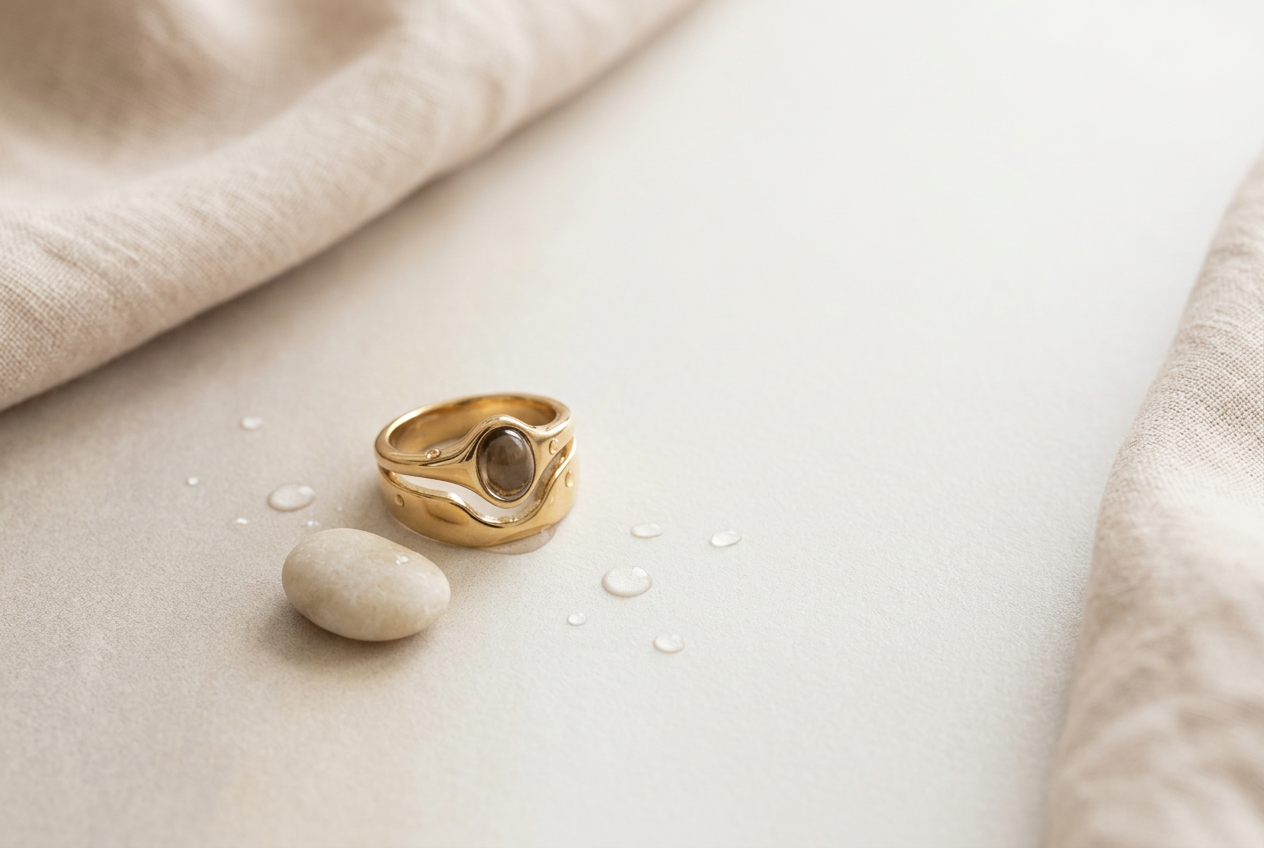
Hugo Ring - Tigers Eye
A sculptural piece with an open-front design that creates a layered look while staying a single, solid band for maximum comfort — anchored by a rich cabochon tiger's eye.
Shop this ring →Honest caveats: the real objections answered
- Is the stone real, or dyed? Our tiger's eye is genuine, naturally golden chatoyant quartz — the classic color, not a dyed neon. As a buyer, your best tell is the cat's-eye shimmer: real tiger's eye displays chatoyancy when rotated, and natural golden-brown color stays consistent for years rather than fading along the edges.
- Is the band solid gold? No, and we won't pretend otherwise. The Hugo Ring is 18k gold-plated 316L stainless steel — a genuine stone on a plated band. Under FTC standards, "gold-plated" means a real gold layer (at least 10k, at least 0.175 microns thick) bonded to the base. Plating is a surface layer that resists tarnish for years with care, but it is not the same as solid gold and won't last literally forever.
- Will it hold up to daily life? Yes. The 316L stainless base is corrosion-resistant and waterproof, so you can wear it in the shower, pool, or ocean. 316L is also a low-nickel-release, hypoallergenic steel — the kind used in body-safe applications — though anyone with a severe nickel allergy should still test their own sensitivity. Tiger's eye at ~7 on the Mohs scale handles everyday wear well; just avoid hard knocks against harder surfaces.
- Will it arrive looking like the photo? Tiger's eye is a natural stone, so the exact pattern and band of light vary slightly piece to piece — that's a feature of real quartz, not a flaw. The Hugo Ring is a wide, sculptural style, so consider sizing up about half a size for a comfortable fit.
- Any hidden costs? None. The price you see is a one-time price — no subscription, no auto-enrollment, no surprise fees.
If you love the warmth of tiger's eye, it's worth seeing what else pairs with it. Browse the full stainless steel rings collection.
Frequently asked questions
What is a tiger's eye ring made of?
The stone is genuine tiger's eye — a chatoyant variety of quartz with a Mohs hardness of about 7, recognizable by the moving "cat's-eye" band of light. The band varies by maker; most affordable tiger's eye rings, including Meideya's Hugo Ring, set the stone on 18k gold-plated 316L stainless steel, which is waterproof and tarnish-resistant.
What does a tiger's eye ring mean?
Tiger's eye is traditionally regarded as a stone of courage, confidence, and grounding — sometimes called a stone of strength. That symbolism makes it a popular everyday talisman or a meaningful gift, alongside its simple appeal as a warm, earthy statement stone.
Is my tiger's eye natural or dyed?
Classic golden-brown tiger's eye is natural. Red tiger's eye is usually heat-treated, a stable and accepted enhancement that's still a natural stone. Intense blue, green, or pink stones sold as "tiger's eye" are frequently dyed, and dyed color can fade along the edges over time. Genuine tiger's eye always shows chatoyancy when rotated under light.
Can I wear a tiger's eye ring in the shower or pool?
Yes, if the band is built for it. Tiger's eye quartz handles water fine, and Meideya sets it on waterproof, tarnish-resistant 316L stainless steel, so you can wear the Hugo Ring in the shower, pool, or ocean. Rinse and dry it occasionally to keep the stone and plating looking their best.
What ring size should I order for a wide tiger's eye band?
For a wide or sculptural band — roughly 5–6mm and up — size up about half a size from your usual measurement so it slides comfortably over the knuckle. If you're between sizes on a very wide style, the larger size is usually the safer choice.
Buy the shimmer first and the band second: a real golden tiger's eye with strong chatoyancy on an honest, durable band beats a flashy dyed stone every time. See also our guides on chunky ring jewellery and stainless steel rings.

Laat een reactie achter
Deze site wordt beschermd door hCaptcha en het privacybeleid en de servicevoorwaarden van hCaptcha zijn van toepassing.