

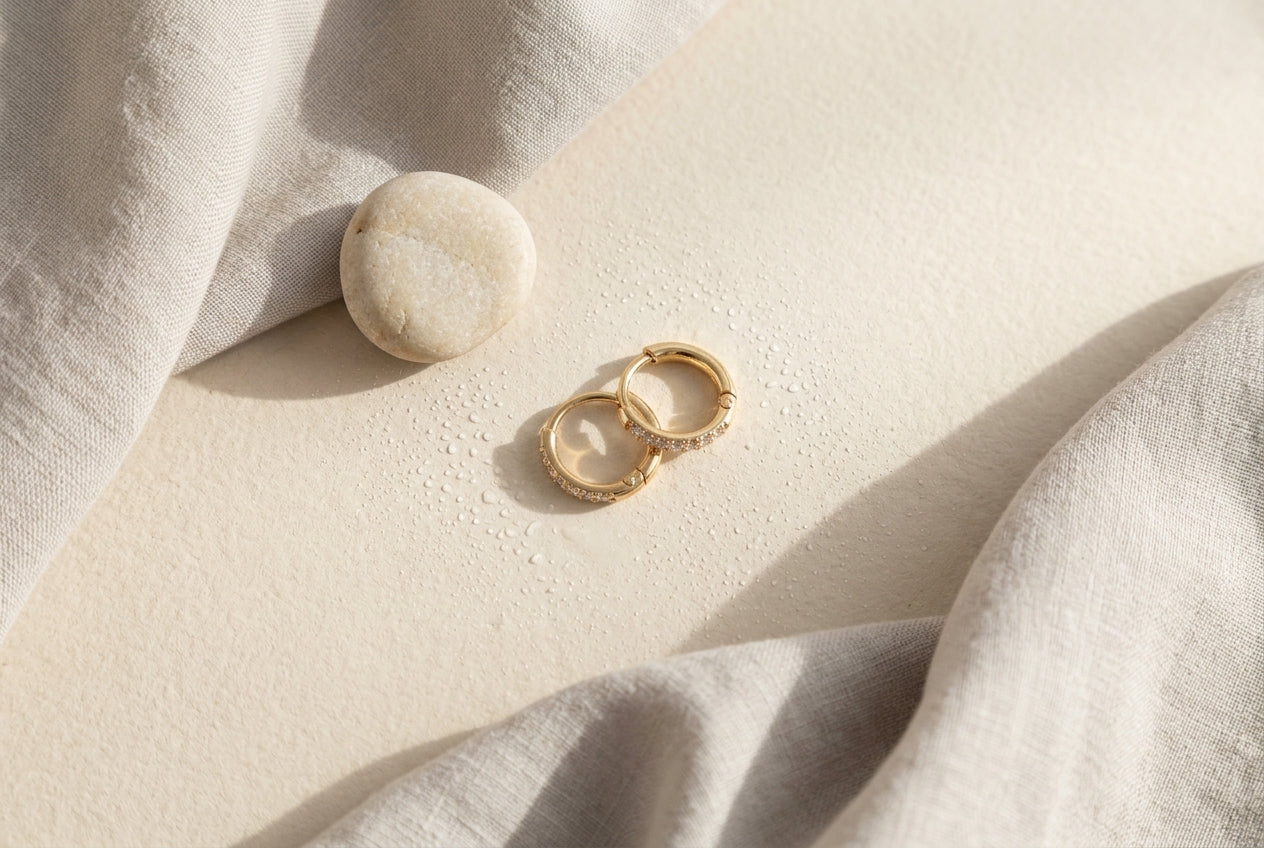
14k Gold Huggie Earrings: An Honest Buyer's Guide
If you want a real 14k gold huggie, expect to spend roughly $150 to $600 a pair — but most people shopping for everyday gold huggies are better served by 18k gold-plated stainless steel, which gives the same warm gold look, shrugs off water and sweat, and costs under $50. “14k gold” is a specific, expensive thing, and a lot of listings blur the line between solid gold and gold-look finishes. This guide explains the four kinds of “gold” huggies you will actually see, what each one really is, what it costs, and how to pick a pair that will not turn your ears green.
Key takeaways
- “14k gold” means solid 14-karat gold — 58.3% pure gold all the way through. It is the heirloom option, and priced like one.
- For daily, in-the-water wear, 18k gold-plated 316L stainless steel is the value pick: the gold look, hypoallergenic, water- and tarnish-resistant, usually under $50.
- Plating is a surface layer, not solid gold. On a quality stainless-steel base it resists tarnish for years, but it is honest to say it can eventually wear — solid gold cannot.
- Match the type to the job: solid 14k for an heirloom, gold-plated steel for everyday and the gym, vermeil if you specifically want a sterling-silver core.
The four kinds of “gold” huggies
Almost every huggie sold as “gold” falls into one of four categories. The differences are defined by the U.S. Federal Trade Commission’s jewelry guides, so they are not just marketing words.
- Solid 14k gold. Gold alloy throughout, 14 parts gold out of 24 (58.3% pure). It never tarnishes, never wears down to another metal, and holds resale value — which is why it costs the most.
- 18k gold-plated stainless steel. A thin layer of 18k gold bonded over a 316L stainless-steel core. The FTC requires “gold-plated” to be at least 0.175 microns of 10k-or-better gold; better pieces use a thicker, more durable coat. The steel base is what makes it hypoallergenic and rust-proof.
- Gold-filled. A thicker bonded gold layer — by FTC rule, the gold must be at least 1/20 (5%) of the item’s total weight, in 10k or higher. More gold than plating, less than solid; usually over a brass core.
- Vermeil. Gold (at least 2.5 microns, 10k or higher) over a sterling silver base. A good middle ground if you want a precious-metal core without solid-gold pricing.
How to choose: the four questions that decide it
- Budget. Solid 14k is a $150–$600+ commitment per pair; gold-plated steel is usually $15–$60; gold-filled and vermeil sit in between.
- Will they get wet? If you shower, sweat, or swim in your earrings, a 316L stainless-steel base is the safest core — it does not rust or turn green. Solid gold is also water-safe; gold-filled over brass tolerates water but is less forgiving long-term.
- Sensitive ears? Look for a nickel-safe base. Stainless steel and solid gold release very little nickel; the American Academy of Dermatology and Mayo Clinic both flag nickel as the most common contact allergen, so the base metal matters more than the gold on top.
- How long do you need them to last? Solid gold is forever. Quality gold-plated steel holds its finish for years with care. Cheap flash plating over brass is what fails in weeks — that is the “turned green” story most people remember.
Best for your situation
- Best for everyday and the gym: 18k gold-plated 316L stainless steel. The gold look, hypoallergenic, water-resistant, and inexpensive enough to wear and not worry about.
- Best as an heirloom or investment: solid 14k gold. Buy once, keep for decades, pass it down.
- Best if you want a precious-metal core on a budget: vermeil (gold over sterling silver).
- Best for a bolder statement: a wider huggie like Meideya’s Bold Huggie Hoops (18mm) in 18k gold-plated steel.
Gold huggie types compared
| Type | What it is | Best for | Typical price (pair) |
|---|---|---|---|
| Solid 14k gold | 58.3% gold throughout | Heirloom, resale value | $150–$600+ |
| 18k gold-plated 316L steel | 18k gold layer over stainless steel | Everyday, water, sensitive skin | $15–$60 |
| Gold-filled | ≥5% gold by weight, bonded (often over brass) | More gold than plating, mid-budget | $40–$120 |
| Vermeil | ≥2.5µm gold over sterling silver | Precious-metal core, mid-budget | $50–$150 |
The takeaway: there is no single “best” — there is the right type for how you will wear them. For most people asking about 14k gold huggies for daily wear, gold-plated stainless steel delivers the look and durability they actually want at a fraction of the price.

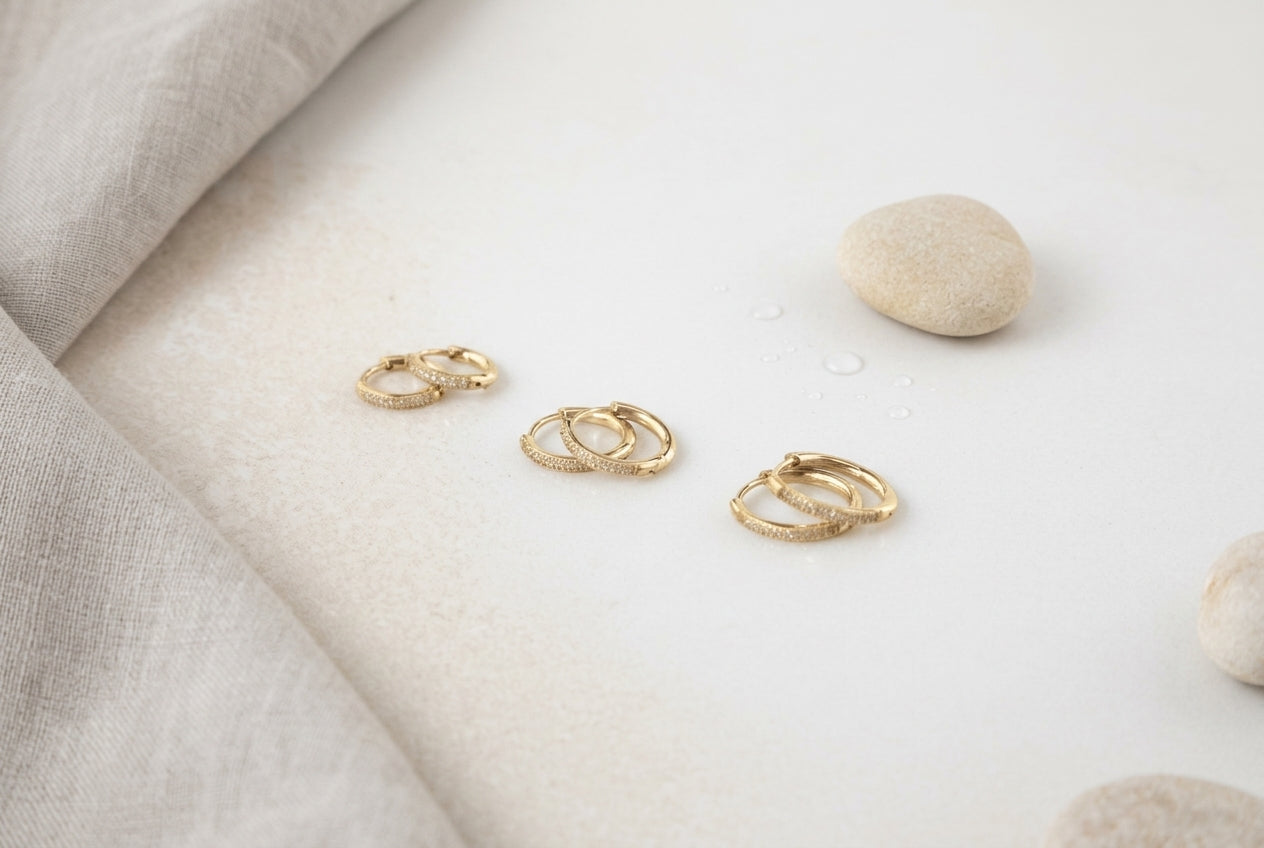
Mini Pave Huggie Hoops
Crafted in 18k gold-plated stainless steel with a row of cubic zirconia — hypoallergenic and made for daily wear.
Shop this huggie →Honest answers to the questions buyers actually ask
- Will gold-plated huggies turn my ears green? The “green” reaction comes from copper in cheap brass bases reacting with moisture. A 316L stainless-steel base does not do this, and a quality gold layer resists tarnish — but it is still a surface layer, so the honest answer is that it resists wear for years rather than “never wears.”
- Will they arrive tiny? Huggies are meant to be small — they hug the lobe, with an inner diameter around 10–13mm. That is by design, not a defect. If you want more presence, size up to a wider huggie (Meideya’s Bold Huggie Hoops come in 12mm and 18mm).
- Any hidden costs? Meideya’s pieces are one-time purchases — the price you see is the price you pay, with no membership auto-enrolled at checkout.
Bottom line: decide by how you will wear them, not by the word “gold” alone. If you want everyday huggies that handle water and sensitive skin without the solid-gold price, browse Meideya’s hoop & huggie earrings in 18k gold-plated stainless steel.
Frequently asked questions
Are 14k gold huggie earrings worth it?
If you want a piece that never tarnishes, holds resale value, and lasts for decades, solid 14k gold is worth the higher price. For everyday wear where you would rather not worry about an expensive earring in the shower or at the gym, 18k gold-plated stainless steel gives the same look for far less.
Is 18k gold-plated stainless steel good quality?
Yes, for everyday jewelry. The 316L stainless-steel core is hypoallergenic and rust-proof, and the 18k gold layer gives a warm gold finish. It is not the same as solid gold — the gold is a surface layer — but on a stainless base it resists tarnish and water far better than cheap plating over brass.
Will gold-plated huggies tarnish or turn my ears green?
Green discoloration comes from copper in brass bases, not from stainless steel. A 316L stainless-steel base does not turn skin green, and a quality gold layer resists tarnish for years. Because plating is a surface layer, it can eventually show wear with heavy use, which is normal for any plated jewelry.
Can I shower or swim in gold-plated stainless steel huggies?
Occasional water exposure is fine, and a stainless-steel base will not rust. To keep the gold finish looking its best for as long as possible, rinse off chlorine and avoid harsh soaps and chemicals, then dry the earrings before storing them.
What size huggie should I get?
Most huggies have an inner diameter of about 10 to 13mm and sit close to the lobe. If you want a bolder look that stands away from the ear, choose a wider huggie, such as an 18mm style. There is no piercing-gauge guesswork — huggies use a hinged closure that fits a standard lobe piercing.

Laat een reactie achter
Deze site wordt beschermd door hCaptcha en het privacybeleid en de servicevoorwaarden van hCaptcha zijn van toepassing.