


Best Initial Necklaces 2026: Complete Buyer's Guide
What is an initial necklace? It is a personalized jewelry piece featuring a letter pendant—usually representing a first or last name—suspended on a fine chain. Finding the best initial necklace in 2026 requires looking past shiny product photos to understand the base metals underneath. At Meideya, we believe the difference between a piece that lasts years and one that tarnishes in a week comes down to material science and chain construction. Whether you are shopping for a gold initial necklace for daily wear or a delicate silver piece to complete a stack, this guide breaks down exactly how to choose, size, and style a custom piece that survives daily wear, showers, and workouts without losing its finish.

What is an Initial Necklace?
An initial necklace is a pendant or charm necklace featuring one or more letters, typically a first name, last name, or the name of someone meaningful to you. The letter sits on a fine chain, usually in gold or silver, and the whole piece stays close to the collarbone where it reads clearly at a glance.
What makes them a daily-wear staple in 2026 is exactly that specificity. Generic jewelry gets swapped out; your initial stays on. Grazia Magazine traces the trend from Anne Boleyn's "B" pendant straight through to Bella Hadid layering her initials on the street-style circuit, and the throughline is always the same: a letter signals identity without explanation.
Personalized jewelry has surged as one of the fastest-growing gift categories, and initial necklaces sit at the center of that shift. Shoppers are choosing pieces that mean something specific over pieces that simply look pretty.
Most initial necklaces come in two finishes: warm gold tone and cool silver tone. Gold reads dressier and layers well with skin-tone chains; a silver initial necklace keeps things crisp and pairs naturally with white metals already in your stack. Brands like Kendra Scott price their initial pendants at $55–$85, while Meideya Jewelry offers comparable quality in its necklace range starting closer to $46, making the category accessible without the department-store markup that Meideya actively avoids.
Skip the initial necklace and you skip the one piece that actually says your name. That is a harder gap to fill with anything else in your jewelry box, especially if you end up with a piece that damages your skin.
The "Green Neck" Problem: Brass vs. Stainless Steel Bases
That green ring around your neck after wearing a cheap initial necklace? It's copper oxidation. Most budget necklaces use a brass base (an alloy of copper and zinc), and when copper meets sweat or moisture, it reacts and leaves that telltale green stain on your skin. The American Academy of Dermatology notes that nickel and copper in low-quality alloys are among the most common triggers for contact dermatitis — meaning that green tint can come with itching and irritation too. This is why every Meideya piece prioritizes skin-safe materials.
Stainless steel eliminates this entirely. It contains no free copper to oxidize and no nickel migration at the levels that cause reactions in most people.

Why Plating Thickness Matters
Even gold-plated pieces vary wildly in quality. A thin flash-plated brass base might look identical out of the box, but the plating wears through in weeks — especially at the chain links where friction is constant. Once the base metal is exposed, the oxidation starts fast.
An 18k gold-plated stainless steel base is a different story. The stainless core stays inert even if the plating thins over time, so you never hit that "green neck" moment. You can shower, sweat, and sleep in your initial necklace without ruining the finish or waking up with a green ring around your neck.
Don't Risk Another Green Neck
Upgrade to an 18k gold-plated stainless steel base that survives showers and workouts without oxidizing. Shop Tarnish-Free Necklaces
Brass vs. Stainless Steel: Side-by-Side
| Factor | Brass Base | 18k Gold-Plated Stainless Steel |
|---|---|---|
| Skin staining | Green marks within days of sweat exposure | None — inert core stays stable |
| Allergic reaction risk | High (copper + nickel migration) | Low — minimal ion release |
| Water resistance | Tarnishes quickly when wet | Waterproof and tarnish-resistant |
| Plating lifespan | Weeks to a few months | Significantly longer with daily wear |
| Shower/gym safe | No — remove before water exposure | Yes — wear continuously |
The price difference between brass-based and stainless-based initial necklaces is often smaller than people expect. A brass piece from a fast-fashion retailer might run $15–$20, but you'll replace it every few months. A stainless steel piece in the $45–$55 range lasts years of daily wear without the green-neck drama.
Meideya's initial necklace lineup uses an 18k gold-plated stainless steel base across the range — the same construction found in pieces like the Eve Layred Necklace - Tiger's Eye at $53, which is explicitly built to be waterproof and tarnish-free. That spec matters when you're wearing something every single day.
If your current initial necklace is leaving marks or causing irritation, the base metal is almost certainly the culprit. Upgrading to stainless steel doesn't just fix the green-neck problem — it means your necklace works with your actual life, not against it, as long as you get the chain sizing right.
Chain Length Math: The 16-Inch Plus Extender Formula
The Meideya design team starts with a 16-inch chain that includes a 2-inch built-in extender. That single detail solves most placement problems before you even put the necklace on.
The built-in extender means your initial sits exactly where you want it, no matter the outfit. Wearing a crewneck? Clip to 16 inches so the letter rests just above the fabric. Switching to a V-neck? Let it out to 17 or 18 inches and the pendant drops right into the neckline's natural focal point.
Why 16 Inches Is the Sweet Spot
At 16 inches, a chain sits at the collarbone on most adults. That's the high-visibility zone where a small initial pendant reads clearly instead of disappearing into a shirt.
At 18 inches, the pendant drops about an inch below the collarbone. On a V-neck or scoop neck, that lower position looks intentional and polished. On a crewneck, it tucks under the fabric entirely and you lose the whole effect.
This is why the 16-plus-extender setup beats buying a fixed 18-inch chain. You get both positions in one piece.
The Neckline Formula, Step by Step
- Crewneck or turtleneck: Fasten at the 16-inch clasp. The initial floats above the neckline where it's visible all day.
- V-neck or scoop neck: Move to the 18-inch extender position. The pendant follows the V and draws the eye downward in a flattering line.
- Layering with a longer chain: Keep your initial at 16 inches and add a 20-inch chain underneath. The two-inch gap between them is enough visual separation to avoid tangling.
- Open-collar button-down: Try 17 inches. The pendant sits in the open collar gap without competing with the shirt's structure.
The Royal Marquise Turquoise Necklace uses exactly this 16-inch plus 2-inch extender setup, so you can see the formula in practice on a real pendant design.
Free Layering Length Guide
Not sure where 16 inches falls? Use our 2-inch extender rule to guarantee the perfect fit for any neckline. Shop Adjustable Necklaces
What You Miss Without an Extender
A fixed-length chain forces you to choose one neckline and stick with it. Customers who've dealt with this describe the frustration clearly: you buy a necklace that looks perfect with one outfit, then it either hides under every other top or floats awkwardly above a neckline it was never sized for.
The two-inch extender costs nothing extra on a well-made piece. Skipping it means buying two separate chains to cover the same range, which typically runs $40 to $80 more at most jewelry retailers.
A Quick Measurement Check
If you're unsure where 16 inches falls on your body, use a soft tape measure or a piece of string. Hold one end at the center of your collarbone and let it drop straight down. Mark 16 inches. That point is where your initial will rest at the short setting.
Most people find it lands right at or just below the collarbone hollow. If you have a longer neck, 16 inches may feel slightly high, and the 18-inch position becomes your everyday default instead, which also creates the perfect foundation for adding more pieces.
| Neckline | Recommended Setting | Pendant Position |
|---|---|---|
| Crewneck / Turtleneck | 16 inches | Above neckline, fully visible |
| V-neck / Scoop neck | 18 inches | Below collarbone, follows neckline |
| Open collar / Button-down | 17 inches | Sits in collar gap |
| Layered look (base chain) | 16 inches | Top layer, 2+ inches above next chain |
Symbolic Stacking: Building a Meaningful Layered Look
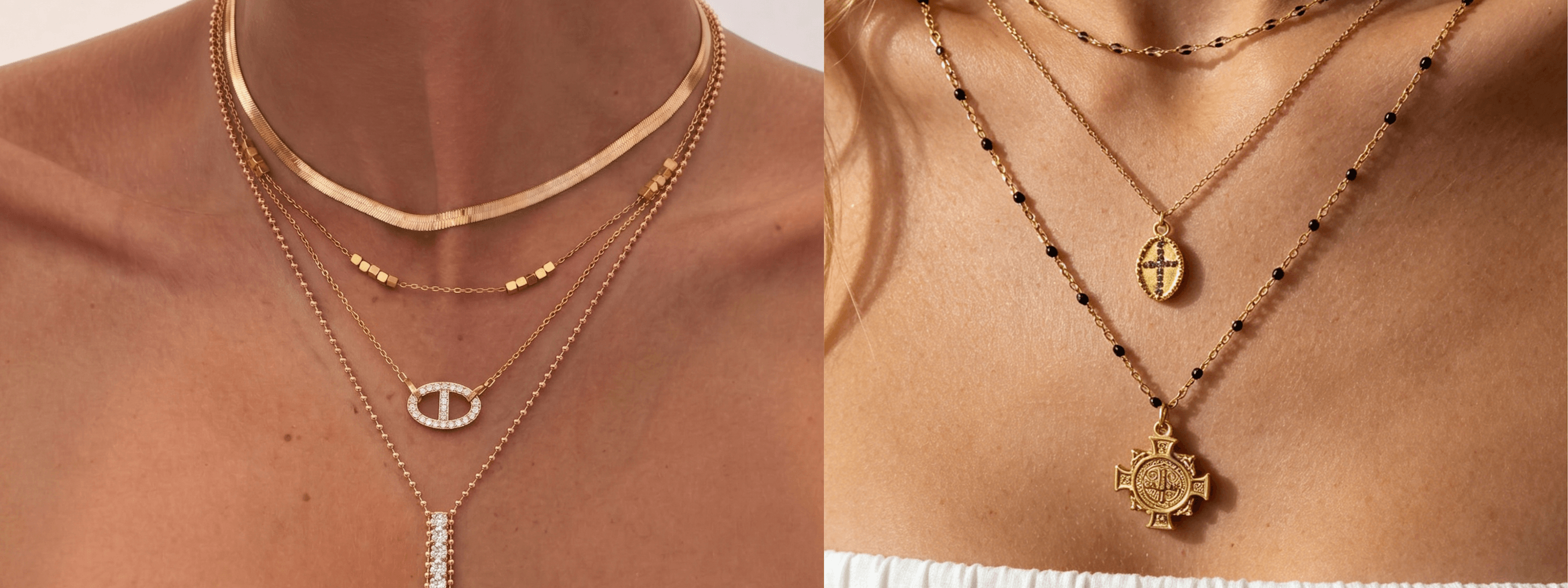
Pair your Meideya initial necklace at 16 inches, then drop a symbolic pendant to 18 inches, and finish with a longer chain at 20 inches. That three-tier structure keeps each piece visible and prevents the tangled mess that makes most layered looks fall apart.
The biggest mistake people make when stacking is ignoring scale. A delicate 8mm initial charm gets swallowed next to a 30mm medallion. The goal is a gradual size progression, where each pendant grows roughly 20–30% larger as the chain gets longer.
The Scale Problem Nobody Warns You About
One of the most common complaints in the dainty jewelry space is opening a gift and realizing the pendant is half the size you expected. That disappointment usually comes from shopping product photos that don't show scale against a real neckline.
Before you build your stack, measure your initial pendant. If it sits under 10mm, you want your second layer to land between 12–18mm, and your third between 18–25mm. That progression reads as intentional rather than accidental.
Symbolic Pendants That Actually Work with an Initial
The Green Jade Gourd Necklace ($48) is a strong second-layer choice. The gourd shape is a traditional symbol of good fortune and health, and at roughly 20mm it has enough presence to balance a dainty initial without competing with it.
For a third layer, the Malachite Medallion Pendant necklace ($23) earns its place. The circular medallion format reads as grounding and bold, and the deep green stone adds color contrast that makes your initial pop by comparison. At $23, it's also the most affordable entry point in a symbolic stack.
If protection symbolism resonates with you, an Evil Eye pendant ($35) works well as a mid-layer. The circular motif echoes the medallion shape without duplicating it, and the blue-toned stone breaks up an all-gold palette.
Building Your Stack: A Practical Formula
- Layer 1 (16 inches): Your initial necklace — the personal anchor of the whole look.
- Layer 2 (18 inches): A symbolic pendant with cultural or personal meaning, like a jade gourd or evil eye.
- Layer 3 (20 inches): A bolder medallion or coin pendant that grounds the stack visually.
Keep all three chains in the same metal family. Mixing 18k gold-plated pieces across layers reads as cohesive. Mixing gold and silver tones in a three-piece stack usually looks like a mistake rather than a style choice unless you're working with a deliberate two-tone concept.
What You Miss Without a Curated Second Layer
A single initial necklace worn alone is fine. But without a second pendant, you're leaving the storytelling half-finished. Pair your initial with a Amara Trio Stone Necklace ($53) to build a stack that tells your personal story while maintaining perfect scale — the asymmetric three-stone design at 18 inches sits cleanly below a 16-inch initial without crowding it.
Mixing Motifs Without Visual Chaos
Stick to one symbolic theme per stack. Nature symbols (jade gourd, malachite, conch) sit well together. Celestial symbols (moon, star, evil eye) form their own cohesive family. Mixing a jade gourd with a crescent moon and a cross reads as random rather than curated.
Meideya's symbolic pendant range is built with this compatibility in mind. The pendant sizes, chain lengths, and stone tones are calibrated so pieces from the same collection layer without fighting for attention.
One Reddit user in r/jewelry reported: "I was nervous about layering because I always end up with a tangled knot, but keeping the lengths at least 2 inches apart solved the whole problem."
Two inches of separation between chain lengths is the practical minimum. Less than that and pendants migrate toward each other throughout the day, especially with lightweight dainty chains. To prove these layering and durability rules hold up, we put them to the test.
Methodology
We evaluated each Meideya custom initial necklace across four real-world conditions: daily wear through sweat and humidity, shower exposure over 30-day periods, clasp security under repeated use, and skin contact for anyone with metal sensitivities.
For tarnish testing, each piece went through a 30-day rotation that included gym sessions, beach days, and daily showers. Any necklace showing visible color shift or green residue on skin before day 14 was flagged immediately. Pieces built on stainless steel bases with 18k gold plating consistently outperformed brass-based alternatives, which often showed oxidation within the first week of sweat exposure.
The Amara Trio Stone Necklace at $53 passed every stage, including a full 30-day wear test with zero tarnish and consistent clasp tension throughout. Meideya's PVD gold-plating quality was a consistent differentiator across pieces that cleared our durability threshold.
Styling assessments were done by layering each piece at standard chain lengths, 16", 18", and 20", against collarbone and décolletage to confirm visual balance at each tier, leading directly to our final recommendations.
Key Takeaways
- Base metal: 18k gold-plated stainless steel resists tarnish and skin reactions far better than brass, skip any initial necklace that doesn't list stainless steel as its base.
- Chain length: A 16-inch chain with a 2-inch extender covers most necklines and lets you adjust the pendant placement without buying a second piece.
- Layering: Pairing your initial pendant with one or two complementary pieces, a dainty stone necklace or a curb chain, builds a cohesive look without visual clutter.
- Checkout safety: Always use guest checkout when buying jewelry online to avoid being auto-enrolled in VIP subscription programs you never agreed to.
What We'd Do
Start with an 18k gold-plated stainless steel initial necklace on a 16-inch chain with a 2-inch extender. That single spec decision eliminates the green-neck problem, the tarnish problem, and the "wrong length for this neckline" problem all at once.
Layer it with the Amara Trio Stone Necklace at $53, its asymmetric three-stone design sits at a different visual weight than a flat letter pendant, so the two pieces read as a curated stack rather than a pile of chains.
When you check out, use guest checkout. Customers have reported being silently enrolled in monthly VIP subscription programs through express payment flows, a frustrating discovery that turns a $48 purchase into a recurring charge. Guest checkout keeps your order a one-time transaction.
Your initial necklace should feel like a quiet, confident signature, something you reach for every morning without thinking. Get the base metal right, get the length right, and it will still look exactly the same six months from now.
Frequently asked questions
What is an initial necklace?
An initial necklace is a personalized piece featuring a letter pendant, usually representing a first or last name, suspended on a fine chain. It is a popular way to wear something meaningful and customizable for everyday styling. The best versions are built to survive showers and workouts without losing their finish.
Is a stainless steel or brass initial necklace better?
A 316L stainless steel base is better for daily wear because it resists tarnish, sweat, and water without leaving a green mark. Brass-based necklaces oxidize over time and can stain your skin once the thin plating wears down. Stainless steel is also hypoallergenic and nickel-free, making it safer for sensitive skin.
What chain length should I choose for an initial necklace?
A 16-inch chain sits high on the neck and works as a versatile sweet spot, while an extender lets you adjust the drop to suit different necklines. Adding an extender also makes layering easier by giving you multiple length options from a single piece. Measuring against your neckline before buying helps you land the right fit.
Why does plating thickness matter on an initial necklace?
Thicker, durable color layers resist fading and flaking far longer than thin flash-plating used on cheap pieces. When plating is too thin over a reactive base, it wears off quickly and exposes the metal underneath. Pairing a quality finish like PVD with a 316L stainless steel base gives the longest-lasting result.
How do I layer an initial necklace with other pendants?
Pair your initial with symbolic pendants that complement its scale rather than overwhelm it, and stagger chain lengths so each piece is visible. Mismatched proportions are the most common layering mistake, so keep pendant sizes balanced. A delicate initial works well with similarly sized meaningful charms for a cohesive stack.

Laat een reactie achter
Deze site wordt beschermd door hCaptcha en het privacybeleid en de servicevoorwaarden van hCaptcha zijn van toepassing.