

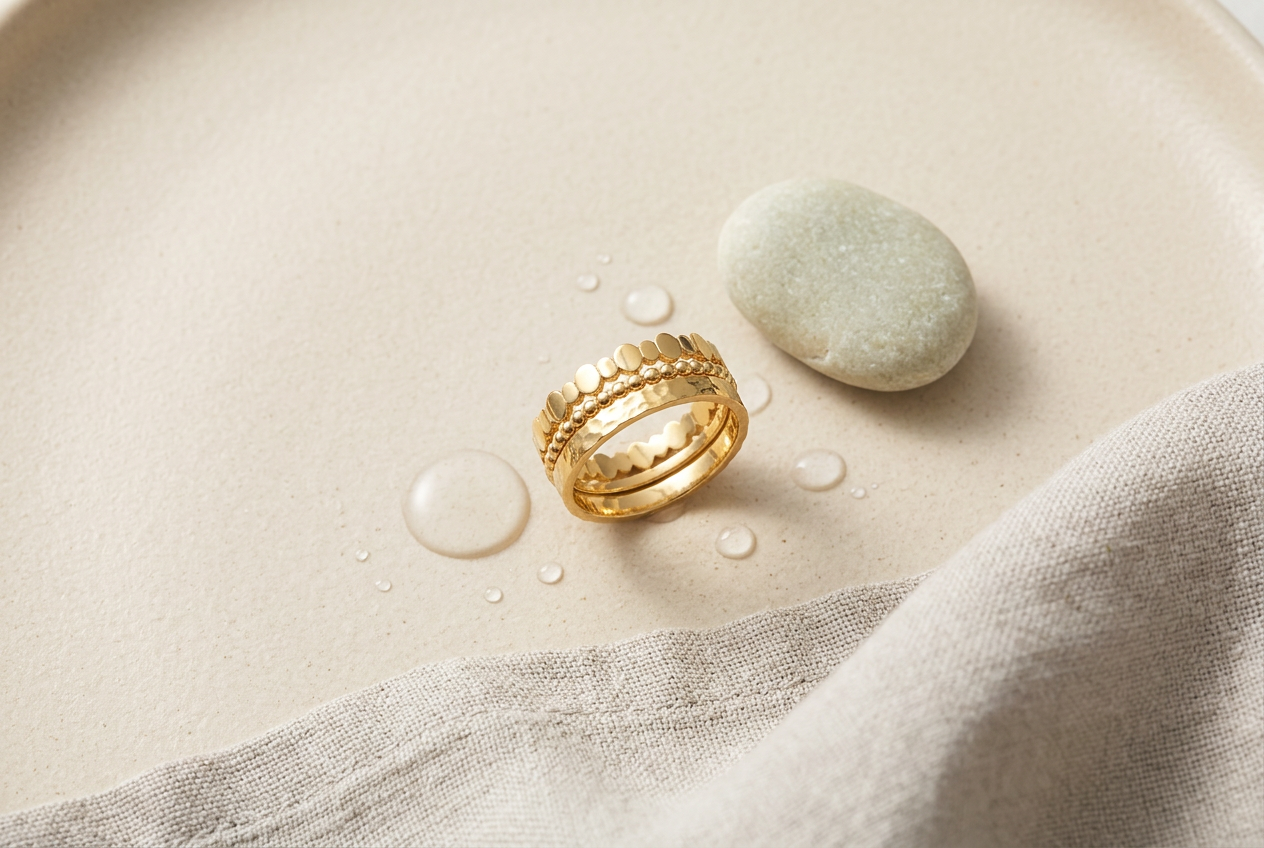
Stackable rings: A Style Guide
The easiest way to stack rings is to anchor your stack with one wider band, layer thinner rings around it, and vary the texture so each ring reads as its own piece. This guide is for anyone who wants the curated, lived-in look without the fuss — and without rings that turn your finger green or arrive thinner than the photo. We'll cover how to choose rings that stack well, the picks for everyday wear versus a statement, an honest comparison of stacking widths, and the real answers on sizing, durability, and price.
Key takeaways
- A good stack needs one wider anchor band plus two or three thinner rings — mixing widths and textures is what makes it look intentional rather than crowded.
- Sizing is the decision that makes or breaks a stack: stacking rings should be within about half a size of each other, and you should size up roughly a half size when you wear several thin bands together for comfort and circulation.
- Don't overpay for "solid gold" claims you can't verify. Meideya's stackers are 18k gold-plated 316L stainless steel — waterproof and tarnish-resistant for years of wear, at a fraction of fine-gold prices.
- For most people, a coordinated three-ring set like the Trio Stacking Ring Set is the simplest way to get a balanced stack on day one.
How to choose rings that stack well
A stack that looks effortless is usually built on a few simple rules. Before you add a ring to your collection, run it through this checklist.
- Pick one anchor, then layer thinner. Wear your widest band lowest on the finger and stack thinner rings above it. A single wider ring gives the stack a visual base; three or four matching thin bands look busy with nothing to ground them.
- Vary the texture, not just the count. Combine a plain polished band with something engraved, ribbed, twisted, or stone-set. Contrast is what makes each ring read as a separate piece instead of one thick blur.
- Keep the metal tone consistent. Meideya is a gold-tone brand, so its stackers stay in the same warm 18k-gold-plated family — that consistency is what lets you mix shapes freely without the stack looking accidental.
- Mind the width math. Wide bands fit more snugly than thin ones because more metal sits against the finger. The general jeweler guidance is to size up about a half size for bands roughly 2mm or thicker, and to keep all the rings in a stack within about half a size of each other so they sit level.
- Choose a finish that survives daily wear. If you'll shower, wash dishes, and work out in your rings, the finish matters more than the karat number. PVD-applied 18k gold plating over 316L stainless steel is built for exactly that.
Best stack for each kind of wearer
Different hands want different stacks. Here's where to start based on how you actually live in your jewelry.
- Best for a beginner or a gift: a pre-coordinated three-ring set. The widths and textures are already balanced, so you skip the trial-and-error of buying singles that don't quite work together.
- Best for everyday, hands-on wear: two or three slim 18k-gold-plated 316L bands. Thin profiles are comfortable under gloves and keyboards, and stainless steel shrugs off water, sweat, and soap.
- Best for sensitive skin: all-stainless-steel stackers. 316L is widely regarded as one of the better hypoallergenic options because its chromium content forms a stable oxide layer that keeps nickel release very low — and stainless won't turn skin green the way copper-bearing brass can.
- Best for a touch of color: add one stone-set stacker — a CZ band for sparkle, or a genuine-gemstone ring (tiger's-eye, onyx, freshwater pearl) for warmth. Let it be the focal point and keep the rest plain.
- Best on a budget: build slowly with individual thin bands from the same collection so every new ring you add still coordinates with what you own.
Comparing stacking widths and finishes
The two variables that decide how a stack feels are band width and finish. This table uses verified ranges, not invented exacts.
| Option | Best for | Key spec — verified | Typical price |
|---|---|---|---|
| Slim band (under ~2mm) | High-count stacks, comfort, everyday | Sits true to size; stack several within ~half a size of each other | ~$25–$40 |
| Wider anchor band (~2mm+) | Grounding a stack, statement base | Fits snugger — size up ~half a size for bands 2mm or thicker | ~$35–$54 |
| Stone-set stacker (CZ or genuine gem) | One focal point of sparkle or color | CZ ~8–8.5 Mohs (durable, scratch-resistant synthetic); genuine gems vary | ~$30–$54 |
| Coordinated three-ring set | An instant balanced stack | 18k-gold-plated 316L stainless; waterproof, tarnish-free | ~$68 |
If you only buy one thing, the coordinated set wins for convenience: the width contrast and spacing are already solved. If you'd rather curate over time, start with one wider anchor and add slim bands around it.

Trio Stacking Ring Set
18k gold plated, stainless steel based, waterproof and tarnish free.
Shop this set →Honest caveats — the real objections
- Will it actually hold up? The base is 316L stainless steel — corrosion-resistant and built for water — and the gold tone comes from PVD-applied 18k plating, which Meideya describes as up to ten times thicker than ordinary plating. Plating is still a surface layer: it resists tarnish for years of normal wear, not literally forever. The honest expectation is "looks great for a long time with basic care," not "indestructible." A soft wipe after wearing keeps it looking new.
- Is the gold real, or is it solid gold? It's plated, not solid, and we say so plainly. Under FTC guidance, a piece marked "gold plated" carries an electroplated layer of at least 10k gold at a minimum thickness of 0.175 microns — that's a real gold finish, just over a stainless core rather than solid karat gold. CZ is honest sparkle (a synthetic zirconium-dioxide stone around 8–8.5 on the Mohs scale), not a mined diamond, and any genuine gemstone stacker uses a real stone — the band is what's plated.
- Will it arrive looking like the photo? These are dainty, demi-fine stacking rings — slim by design, meant to layer. They're not chunky statement bands, so expect a delicate profile in person. Meideya stackers run in standard US whole sizes (the Trio set is offered in US 6, 7, and 8), so measure before you order and remember to size up about a half size if you plan to stack several rings on one finger.
- Any hidden costs? No. You pay a one-time price — there's no membership, no auto-enrollment, and no subscription to keep your rings looking good.
Ready to build your stack? Browse the full Stackable Rings collection to mix anchors, slim bands, and stone-set accents in one consistent gold tone.
Frequently asked questions
How many rings should I stack on one finger?
Two to four rings per finger is the sweet spot for most hands — enough to look intentional without feeling crowded. Anchor the stack with one wider band worn lowest, then layer thinner rings above it and vary the texture so each one stands out.
Do I need to size up for a stack of rings?
Often, yes. Wide bands fit snugger than thin ones, so size up about a half size for any band roughly 2mm or thicker. If you're stacking several rings on the same finger, sizing up about a half size also leaves room for comfort and circulation. Keep all the rings in a stack within about half a size of each other so they sit level.
Will Meideya stacking rings tarnish or turn my finger green?
They're built to resist both. The rings are 18k gold-plated over a 316L stainless-steel base, applied with PVD for durability, and stainless steel is waterproof and tarnish-resistant. Skin turns green from copper in brass alloys, not from stainless steel, so a stainless-based stacker won't cause that. Plating is a surface layer, so the gold tone lasts for years of normal wear with a simple wipe-down — not literally forever.
Are stacking rings safe for sensitive skin?
Stainless-steel stackers are a strong choice. 316L stainless steel contains nickel but releases very little because its chromium forms a protective oxide layer, which is why it's widely considered one of the better hypoallergenic jewelry materials. People with severe nickel allergies can still react to almost any metal, so if you're highly sensitive, start with one ring and see how your skin responds.
Is the cubic zirconia in a stacker the same as a diamond?
No — and we won't pretend otherwise. Cubic zirconia is a synthetic stone (zirconium dioxide) that rates about 8 to 8.5 on the Mohs hardness scale, compared with a diamond's 10. It's durable enough for everyday wear and gives bright, honest sparkle at an affordable price, but it isn't a mined diamond. Genuine-gemstone stackers, by contrast, use a real stone set in a plated band.
Stack with intention: anchor with one wider band, layer thinner textures around it, size up a touch when you pile several on, and choose a 316L stainless base so the whole stack survives daily life. See also our guides on chunky ring jewellery and stainless steel rings.

Laat een reactie achter
Deze site wordt beschermd door hCaptcha en het privacybeleid en de servicevoorwaarden van hCaptcha zijn van toepassing.