

Initial Necklace With Birthstone: An Honest Buyer's Guide
An initial necklace with a birthstone pairs the letter of someone you love with the gem for their birth month — and on an affordable-luxury piece, the smartest buy is a gold-plated 316L stainless-steel chain with a synthetic (cubic-zirconia or glass) birthstone accent, because it survives daily wear without tarnishing and costs a fraction of a mined-gem version. This guide is for anyone shopping a personalized gift who wants the sentiment of a real birthstone without overpaying for a stone you can't tell apart at necklace scale. We'll cover the birthstone-by-month chart, what kind of stone you're actually getting at this price, how to judge the chain and clasp, and the honest trade-offs nobody on a product page tells you.
Key takeaways
- The pairing is the point: the initial says who, the birthstone says when — a double-personalized gift in one pendant.
- On a $30–60 piece the birthstone is almost always a synthetic stone (cubic zirconia or glass), not a mined gem. That's fine and honest — just know what you're paying for.
- Don't overpay for "real gold." A 18k gold-plated 316L stainless-steel chain is the everyday-wear sweet spot; solid gold is a different (much pricier) decision.
- Quick pick for most people: a personalized nameplate or initial chain you can engrave with a name or letter, then layer with a birthstone charm.
What an "initial necklace with birthstone" actually is
It's two personalizations on one chain. The initial is usually a letter pendant or an engraved nameplate; the birthstone is a small colored stone tied to the recipient's birth month. The combination is why this style is such a reliable gift — it's specific to one person twice over, which is exactly what generic jewelry isn't.
Birth-month gems follow the modern birthstone list standardized in the United States in 1912 (and updated since). Use this as your reference when you choose the stone:
| Month | Modern birthstone | Typical color |
|---|---|---|
| January | Garnet | Deep red |
| February | Amethyst | Purple |
| March | Aquamarine | Pale blue |
| April | Diamond (clear) | Colorless |
| May | Emerald | Green |
| June | Alexandrite / pearl | Color-shift / white |
| July | Ruby | Red |
| August | Peridot | Light green |
| September | Sapphire | Blue |
| October | Tourmaline / opal | Pink / iridescent |
| November | Topaz / citrine | Yellow-amber |
| December | Turquoise / blue topaz / tanzanite | Blue |
December and a few other months have more than one accepted stone, so pick the color the recipient will actually love rather than agonizing over the "correct" one.
How to choose — the buyer's decision criteria
Four things decide whether this necklace gets worn for years or lives in a drawer:
- What the birthstone is made of. At an affordable price the colored stone is a simulated or synthetic gem — most often cubic zirconia (CZ) cut and tinted to the birth-month color, or colored glass. CZ is zirconium dioxide, an entirely lab-made simulant, not a crystalline gemstone, and it rates about 8 on the 10-point Mohs hardness scale versus a diamond's 10 (per the USGS Mohs scale). It looks the part at pendant scale; it just won't have the geological pedigree — or the price — of a mined stone.
- The chain and pendant metal. This is what touches your skin all day, so it matters more than the tiny stone. 18k gold-plated 316L stainless steel gives you the gold look with a corrosion-resistant base that handles showers and sweat. "Solid gold" and "gold-filled" are different, pricier categories — covered below.
- Sizing and scale. A 16–18 inch chain sits at or just below the collarbone, the most flattering everyday length. Check the listed pendant and stone dimensions in millimeters before you buy — daintier than you pictured is the most common letdown.
- Personalization method. A pre-cast letter charm ships fast; an engraved or custom nameplate is more personal but adds production time. Decide which matters more for your deadline.
Plated vs. solid vs. gold-filled — the honest version
"Gold" on a product page can mean three very different things, and the gap shows up in both price and longevity:
- Gold-plated (what affordable pieces are): a thin layer of gold bonded over a base metal — at Meideya, 18k gold over a 316L stainless-steel core. With everyday care the plating wears slowly; the steel underneath is what makes it corrosion- and water-resistant.
- Gold-filled: a thicker, mechanically bonded gold layer — more durable than plating, more expensive, still not solid.
- Solid gold (10k–18k): gold all the way through, the most durable and the most expensive by a wide margin. If you specifically want an heirloom, this is the lane — but you'll pay 5–10x a plated piece for the same look at necklace scale.
We make plated pieces and we say so plainly: a gold-plated 316L necklace is not solid gold, and you shouldn't pay solid-gold money for one. For a piece worn daily, plated-over-steel is the value sweet spot.
Best for X — scenario-based picks
Different buyers want different things from this style:
- Best for a sentimental gift: pair the recipient's initial with their actual birth-month stone — the double meaning lands harder than either alone.
- Best for everyday wear: a 16–18 inch gold-plated 316L chain you can shower and sweat in without babying it.
- Best for sensitive skin: a piece on a genuine 316L stainless-steel base, which releases very little nickel (more on that below).
- Best on a budget: an initial chain with a CZ or glass birthstone accent — the look of a birthstone necklace without mined-gem pricing.
- Best for an heirloom: step up to solid 14k–18k gold with a genuine or lab-grown gemstone. That's a different budget, and worth naming honestly.
Stone options compared — what you're really buying
Here's how the common birthstone-necklace stone choices stack up at this price level:
| Stone type | Best for | Hardness & reality (verified) | Typical price impact |
|---|---|---|---|
| Cubic zirconia (CZ) | Affordable everyday sparkle | Mohs ~8; lab-made zirconium-dioxide simulant, not a true gem; scratch-resistant against most household contact but softer than sapphire/diamond | Lowest — keeps the necklace in the $30–60 range |
| Colored glass / crystal | Matching an exact birth-month color | Softer than CZ; fashion-grade; fine for a charm, not a forever stone | Lowest |
| Lab-grown gemstone | Real-gem quality on a budget | Chemically identical to mined (a lab ruby is Mohs 9, same as mined); typically 50–80% less than natural | Mid — raises the piece above fashion pricing |
| Natural mined gemstone | Heirloom / investment value | Genuine geological origin; hardness varies by stone; sapphire/ruby Mohs 9 | Highest — usually pairs with solid gold |
For an everyday personalized gift, CZ or glass on a gold-plated steel chain is the honest value pick. If lasting gem value is the goal, jump to a lab-grown or natural stone — and plan for a solid-gold setting to match.

Nameplate Necklace-Preorder
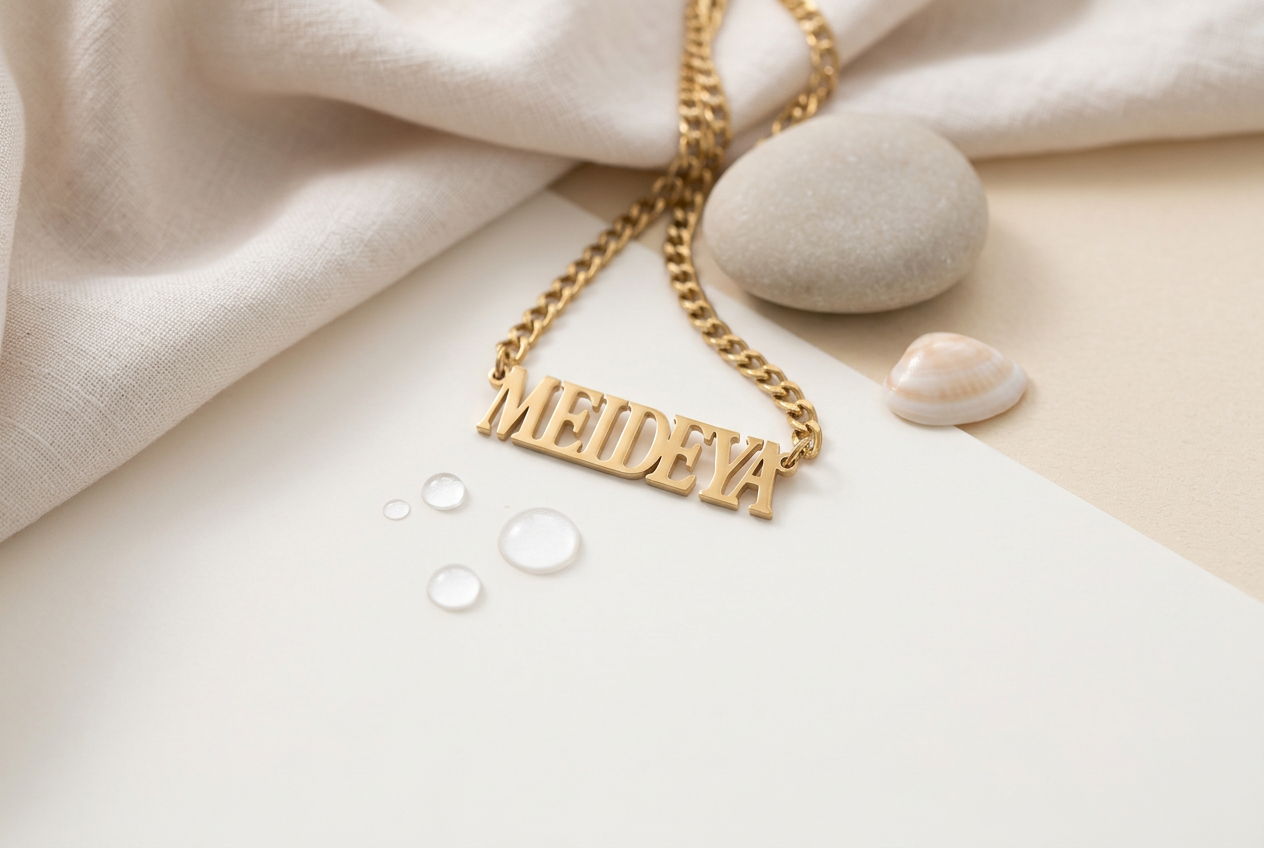
A custom-engraved nameplate in 18k gold-plated (or silver-plated) over stainless steel — durable, waterproof and shower-safe, on an 18" chain with a 2" extender. Leave your font and name in the cart note; allow 7–10 days to make.
Shop this necklace →It's a made-to-order piece, so it ships as a preorder — the personalization anchor you can wear on its own or layer with a birthstone charm for the full initial-plus-stone look.
Honest caveats — answering the real objections
- Is it actually waterproof, or will it tarnish? The 316L stainless-steel base is genuinely corrosion-resistant — our personalized pieces are described as waterproof and shower-safe. "Waterproof" means the steel won't rust or tarnish from water, sweat or showers; it doesn't mean the gold plating is indestructible. Plating is a thin gold layer and wears gradually over years of daily friction. Treat the necklace well (off before harsh chemicals and chlorine) and it holds its finish far longer than a typical fashion chain.
- Will it arrive looking like the photo, or be tiny? Affordable-luxury jewelry is intentionally dainty — that's the demi-fine aesthetic, not a defect. The fix for "catfishing" is simple: read the millimeter dimensions and the chain length (ours run 16–18 inches) before you buy, so the scale is exactly what you expected. We list real measurements rather than only styled macro shots.
- Will the birthstone be a real gem? No — and we won't pretend otherwise. At this price the stone is a synthetic simulant (CZ or glass) chosen to match the birth-month color. It's the right call for an everyday gift; if you need a genuine or lab-grown gemstone, that's a solid-gold-tier purchase.
- Am I being signed up for a hidden subscription? No. Meideya charges a single one-time price — there's no membership, no auto-enrollment, and nothing recurring slipped into checkout. You pay once for the piece, full stop.
- Is it safe for sensitive skin? Pieces on a true 316L stainless-steel base are a strong choice. 316L does contain nickel, but it releases very little because molybdenum and chromium lock the nickel into the alloy — which is why it's widely called hypoallergenic and comfortably meets the EU Nickel Directive's release limit (0.5 µg/cm²/week for items in prolonged skin contact). It's worth remembering that "hypoallergenic" means less likely to cause a reaction, not zero risk, so people with severe nickel allergies should still test-wear.
Ready to personalize one? Browse the full Personalization collection for nameplate and initial pieces you can make your own.
Frequently asked questions
Is the birthstone on an affordable initial necklace a real gemstone?
Usually not. On a piece in the $30–60 range the birthstone is almost always a synthetic simulant — most often cubic zirconia (a lab-made zirconium-dioxide stone, about 8 on the Mohs scale) or colored glass — cut and tinted to the birth-month color. It looks like a birthstone at pendant scale and keeps the price down. If you want a genuine mined or lab-grown gem, expect to pay considerably more, usually with a solid-gold setting.
What's the difference between gold-plated and solid gold for these necklaces?
Gold-plated means a thin layer of gold over a base metal — at Meideya, 18k gold over 316L stainless steel — which gives the gold look with a corrosion-resistant, waterproof core at an affordable price. Solid gold is gold throughout, the most durable and most expensive option, often 5–10 times the cost at necklace scale. Gold-filled sits in between. For everyday wear, plated-over-steel is the value sweet spot; for an heirloom, choose solid gold.
Will a gold-plated stainless-steel necklace tarnish in the shower?
The 316L stainless-steel base won't rust or tarnish from water, sweat, or showers — it's genuinely corrosion-resistant, which is what "waterproof" refers to. The gold plating is a thin layer that wears down gradually over years of daily friction, not something that tarnishes overnight. Keep it away from harsh chemicals, perfume, and chlorine and it holds its finish far longer than ordinary fashion jewelry.
What chain length should I choose for an initial birthstone necklace?
For everyday wear, 16–18 inches is the most flattering range — it sits at or just below the collarbone and layers well with other chains. Many personalized pieces include a short extender so you can adjust the fit; our nameplate style, for example, is an 18-inch chain with a 2-inch extender. Always check the listed length before buying so the scale matches what you pictured.
Is stainless-steel jewelry safe for sensitive skin and nickel allergies?
316L stainless steel is widely considered hypoallergenic because it releases very little nickel — the molybdenum and chromium in the alloy lock the nickel in place, and quality 316L stays well under the EU Nickel Directive's release limit (0.5 µg/cm²/week). Remember that "hypoallergenic" means less likely to cause a reaction, not zero risk. Most people with mild nickel sensitivity wear 316L comfortably; those with severe allergies should test-wear first.
The buying rule is simple: pay for the part that touches your skin every day — a gold-plated 316L chain and a clean personalization — and treat the birthstone as the meaningful, affordable accent it is. See also our guides on diamond initial necklaces and solid gold initial necklaces.

Leave a comment
This site is protected by hCaptcha and the hCaptcha Privacy Policy and Terms of Service apply.