

Stainless Steel Rings: A Jewelry Buyer's Guide
A good stainless steel ring is one made from 316L surgical-grade steel, sized correctly the first time, and chosen for a finish you can live with — not for a karat stamp it doesn't have. Stainless steel has become the smartest everyday-ring metal for anyone who wants a gold or gemstone look without the upkeep, the price, or the skin reactions. This guide covers what separates a ring you'll wear for years from one that turns your finger green in a month: what the grade means, how to pick the right finish and stone, and the one honest trade-off (resizing) before you buy.
Key takeaways
- The grade is the whole story. "Stainless steel" is a category, not a guarantee — look specifically for 316L (surgical/marine grade), whose 2–3% molybdenum content is what resists corrosion, sweat, and water.
- It will not turn your finger green. That reaction comes from copper in brass, not steel. 316L is also low-nickel-release, which makes it a genuinely good option for sensitive skin.
- The real catch is resizing. Steel is so hard that resizing is difficult, limited, and costly — so order your true size rather than counting on an alteration later.
- For most people, a single 316L statement or gemstone ring beats a stack of cheap plated bands — one piece that survives the shower, gym, and pool with no maintenance.
What makes a stainless steel ring worth buying
Most "stainless steel" jewelry online doesn't tell you which stainless steel — and the difference matters more than almost anything else on the listing. Here is what actually decides quality:
- The alloy grade (316L is the one to want). 316L is the surgical- and marine-grade stainless steel. After iron, its main alloying elements are chromium (roughly 16–18%), nickel (about 10–12%), and molybdenum (2–3%). That molybdenum is the part 304 steel lacks, and it's what gives 316L its superior resistance to pitting and chloride corrosion — the reason it shrugs off sweat, chlorinated pools, and salt water.
- The finish, and whether it's plated. A ring can be solid 316L (the steel is the surface you see) or 316L with a gold-tone PVD or gold plating on top. Plating is a thin surface layer — it resists tarnish for years, not forever. A solid steel-tone or PVD finish has the least to wear off; a gold plating gives you the warm gold look but is, by nature, a coating.
- The stone, if it has one. Natural gemstones like tiger's eye sit around 7 on the Mohs hardness scale, which holds up well to daily wear. Cubic zirconia (CZ), the most common diamond-look stone, is harder at about 8.5 — sparkly and durable, though it can micro-scratch or cloud over many years of hard wear. Neither is a mined diamond (Mohs 10), and an honest seller won't pretend otherwise.
- Build and weight. Steel lets makers create bold, chunky shapes that would be costly in solid gold. A ring with some weight and a cleanly polished or brushed surface reads as quality; a tinny, hollow band does not.
Best stainless steel ring for each kind of buyer
Different people are solving for different things. Here's the honest match:
- Best for everyday wear: a solid 316L band or signet in a steel or PVD finish — the least maintenance, nothing to remove before a shower or workout.
- Best for sensitive skin: 316L, full stop. It releases very little nickel, and nickel is the single most common contact allergen, so a surgical-grade steel ring is one of the safest picks short of platinum.
- Best for a gold look on a budget: a gold-PVD or 18k-gold-plated 316L ring. You get the warm tone for a fraction of solid-gold pricing, with steel underneath so it survives daily life.
- Best for a meaningful or unique piece: a gemstone ring — a natural stone like tiger's eye gives you real color and character that a plain band can't, while still being tough enough to wear often.
- Best for a gift: a gemstone or statement ring in a popular middle size (US 6–7), so it's striking out of the box and likely to fit.
Solid gold vs. gold-plated vs. gold-filled vs. stainless steel
If you're cross-shopping a "gold" ring, it helps to know exactly what each label legally means. These FTC definitions (16 CFR Part 23) are the real thresholds — and they show why stainless steel is its own value proposition rather than a cheap gold imitation.
| Type | What it actually is | Gold layer (FTC minimum) | Typical price tier |
|---|---|---|---|
| Solid gold (14k / 18k) | Gold alloy throughout (14k = 58.3% pure, 18k = 75% pure) | N/A — gold all the way through | Highest |
| Gold vermeil | Sterling silver base, plated with gold | ≥ 2.5 microns of ≥ 10k gold | Mid-high |
| Gold-filled | Base metal with a bonded gold layer | ≥ 1/20 (5%) of total weight in ≥ 10k gold | Mid |
| Gold-plated | Base metal with a thin electroplated gold layer | ≥ 0.175 micron of ≥ 10k gold (electroplate) | Low–mid |
| Stainless steel (316L) | Surgical-grade steel; may have PVD/gold tone on top | N/A — value is the steel, not gold content | Low–mid, very durable |
The takeaway: solid gold wins on intrinsic metal value and resizability, but a quality 316L ring wins on durability-per-dollar and skin-friendliness — you're buying a tough, low-maintenance piece, not a gold investment. Just don't pay solid-gold money for something that's actually plated.

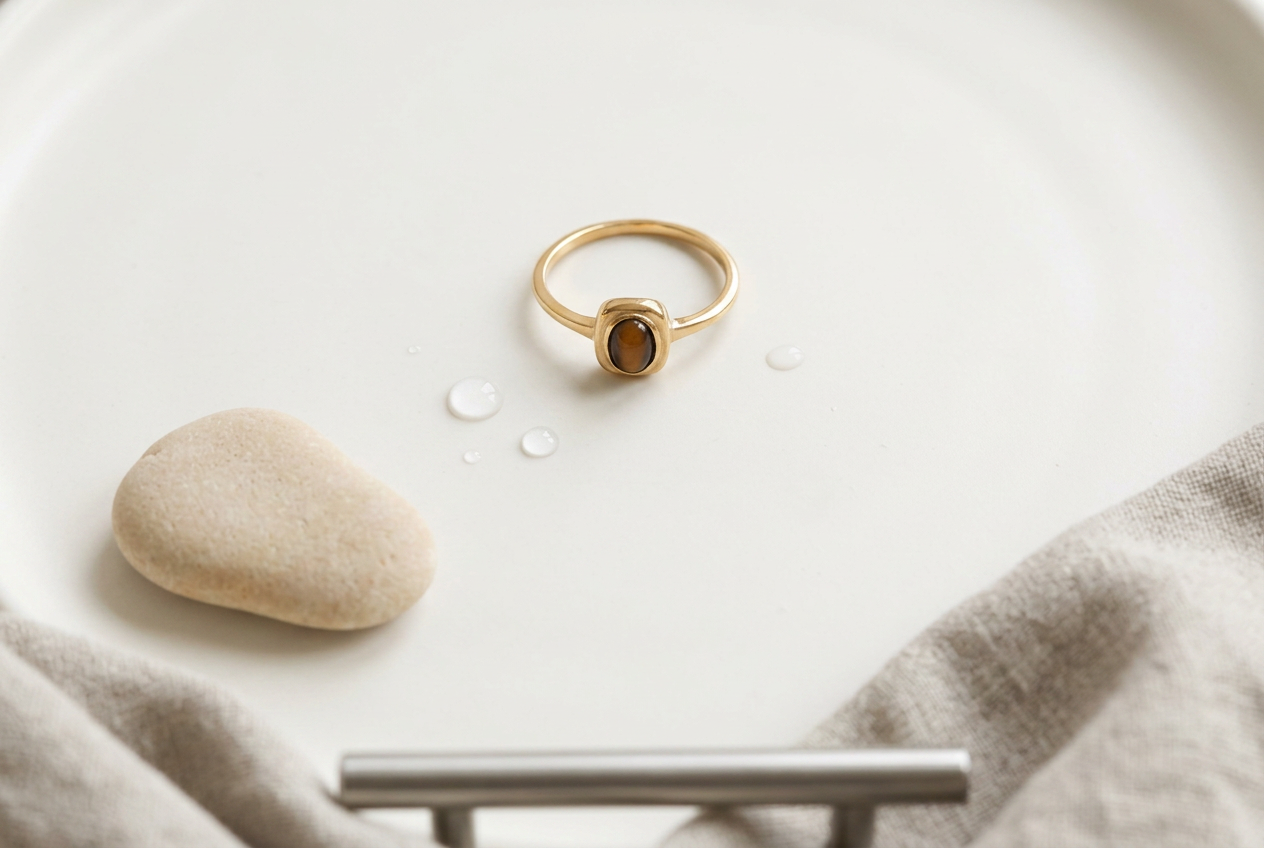
Minimal Tiger's Eye Ring
A small oval-cut tiger's eye stone in golden-brown hues, nestled in a polished gold setting — an everyday statement ring in waterproof 316L stainless steel.
Shop this ring →Honest answers to the questions buyers actually ask
- Will it tarnish or turn my finger green like my last gold-plated set? The green is copper in brass reacting with skin — 316L stainless steel doesn't contain the copper that causes it, so a solid steel ring won't. A gold plating on top is still a surface coating that resists tarnish for years rather than forever; the steel underneath is what stays corrosion-resistant. Meideya's pieces are built to handle the shower, gym, and pool without tarnishing.
- Will it arrive looking like the photo, or tiny? Rings are sized by a number, not eyeballed from a photo, so scale surprises are smaller here than with a necklace or earring. A US size 7 is about 17.3 mm across the inside; whole sizes step by roughly 0.8 mm. Measure your finger (or an existing ring that fits) before ordering, and read the listing's stone and band dimensions — a minimal stone is meant to be delicate, not huge.
- Any hidden costs or subscription? No. A Meideya ring is a one-time purchase — no membership, no auto-enrollment, no recurring fee. You pay once and own it.
Want to see the full range before you decide on a stone or finish? Browse the complete stainless steel rings collection.
Frequently asked questions
Is a stainless steel ring good quality?
Yes, when it's made from 316L surgical-grade stainless steel. 316L is corrosion-resistant thanks to its chromium and molybdenum content, hard enough to resist daily scratches, and hypoallergenic for most people. It's a genuinely durable everyday metal — just confirm the listing specifies 316L rather than an unnamed "stainless steel."
Will a stainless steel ring turn my finger green?
No. The green discoloration people remember from cheap rings comes from copper, which is found in brass, not in stainless steel. A solid 316L ring won't cause it. If a steel ring has a gold plating, that coating can eventually wear, but the steel beneath it still won't react like brass.
Can a stainless steel ring be resized?
It can, but only with difficulty. Stainless steel is much harder than gold or silver and has a high melting point, so jewelers need specialized tools — laser welding or a stretching machine — and even then adjustments are usually limited to about a quarter or half size and can be costly. The practical advice is to order your correct size from the start rather than plan on resizing later.
Is stainless steel jewelry safe for sensitive skin?
For most people, yes. 316L stainless steel releases very little nickel, and nickel is the most common cause of contact-allergy reactions in jewelry. Because the release is so low, 316L is one of the more reliable choices for sensitive skin, short of premium metals like platinum.
What's the difference between a gold-plated stainless steel ring and a solid gold ring?
A gold-plated stainless steel ring is steel with a thin layer of gold on the surface (the FTC minimum for gold electroplate is 0.175 micron of at least 10k gold), giving you the gold look at a low price with steel's durability. A solid gold ring is gold alloy all the way through — 14k is 58.3% pure, 18k is 75% — so it costs far more, can be resized more easily, but needs more care for daily wear.
The buying rule for stainless steel rings is simple: insist on 316L, choose a finish and stone you can live with, and get the size right the first time. Do that and you'll have a ring that looks like more than it cost and outlasts almost anything in your jewelry box. See also our guide on chunky ring jewellery style.

Leave a comment
This site is protected by hCaptcha and the hCaptcha Privacy Policy and Terms of Service apply.