

Gold Stud Earrings: A Buyer's Guide
The best gold stud earrings are the pair you can wear every single day without thinking about them — which means the metal underneath the gold matters far more than the karat number on the label. Studs are the most-worn earring style there is: they go in once and stay in through showers, workouts, and sleep. That daily-driver reality is exactly what should drive your decision. This guide breaks down what "gold" actually means on a stud earring, how to read karat and plating claims honestly, what size to pick, and which pair fits which buyer — so you end up with studs that still look good a year from now, not a green earlobe and a pair you stopped wearing.
Key takeaways
- The base metal decides longevity, not the gold color. For everyday studs, a corrosion-resistant 316L stainless steel core with a real gold layer outlasts cheap brass-based "gold" that turns your skin green.
- "Gold" is a spectrum the FTC actually regulates. Solid gold, gold-filled, vermeil, and gold-plated are legally distinct — knowing which you're buying tells you what you're paying for.
- Don't overpay for a stone you'll only see from arm's length. In a small stud, well-cut cubic zirconia reads as sparkle to everyone but a jeweler with a loupe — saving the diamond budget for a piece people actually inspect.
- The quick pick: for a do-everything everyday stud, a 6–7mm 316L-based design in 18k-gold-plated finish hits the balance of look, comfort, and price most buyers want.
What to look for: the buyer's decision criteria
Before you compare individual pairs, get clear on the four things that actually separate a good everyday stud from one you'll regret. In rough order of how much they matter:
- The base metal under the gold. The single most important factor and the one product photos hide — a gold finish is only as durable as the metal it sits on. Surgical-grade 316L stainless steel is corrosion-resistant and releases very little nickel, so it holds up to daily wear and water. Brass-based costume studs contain copper, and copper is what reacts with sweat and skin to leave a green mark.
- What "gold" legally means. The U.S. FTC's jewelry guides (16 CFR Part 23) define each term. Solid gold is gold all the way through, priced by karat. Gold-filled bonds a layer that's at least 1/20th (5%) of the item's weight in at least 10k gold. Vermeil is sterling silver coated with at least 2.5 microns of gold. Gold-plated means an electroplated layer of at least 0.175 micron of 10k-or-higher gold. More gold up top generally means the color lasts longer.
- Size and proportion. Studs read very differently at 3mm versus 8mm. Pick the size for the role you want the earring to play, not the biggest one in the listing.
- The post and back. Standard ear-piercing posts run 18-gauge (about 1mm) to 20-gauge (about 0.8mm); a smooth, hypoallergenic post and a secure back make a stud comfortable enough to forget you're wearing it.
Best for X: scenario-based picks
Different buyers want different things from a "gold stud." Match the pick to how you'll actually wear it:
- Best for true everyday / shower-and-gym wear: a 316L stainless steel core with an 18k-gold-plated finish. Corrosion-resistant and waterproof-friendly, so you can leave them in without babying them.
- Best for sensitive ears: again, 316L stainless steel — its very low nickel-release rate makes it a safe everyday choice for most people with nickel sensitivity. (Truly severe nickel allergy is the exception; titanium or niobium contain no nickel at all.)
- Best for a gift: a classic 6–7mm CZ or design stud. It looks polished out of the box, suits almost anyone, and the recipient can wear it immediately without sizing.
- Best on a budget: a gold-plated 316L stud with cubic zirconia. You get the everyday-luxury look without solid-gold or mined-diamond pricing.
- Best heirloom / once-in-a-while special piece: if you want something to keep for decades and pass on, that's the case for solid 14k or 18k gold with a real diamond — a different budget and a different purpose than a daily stud.
The comparison: solid vs gold-filled vs vermeil vs gold-plated
"Gold stud" can mean four very different products. Here's how the FTC-defined categories stack up for an everyday buyer. Prices are typical market ranges, not exact quotes.
| Type | What it is (FTC, 16 CFR 23) | Best for | Typical price (a pair) |
|---|---|---|---|
| Solid gold | Gold throughout; 14k = 58.3% pure, 18k = 75% pure | Heirloom pieces; never reacts or wears through | $$$ (hundreds and up) |
| Gold-filled | Bonded layer ≥1/20 (5%) of weight in ≥10k gold | Long-lasting wear at less than solid-gold cost | $$ (mid) |
| Vermeil | Sterling silver + ≥2.5 micron gold layer | A precious-metal base with more gold than plating | $$ (mid) |
| Gold-plated | Electroplated ≥0.175 micron of ≥10k gold over a base metal | The everyday-luxury look; best when the base is 316L steel | $ (affordable) |
The takeaway: there's no single "best" column — there's the right one for the job. For a stud you'll wear daily and replace style with as trends shift, gold-plated over 316L stainless wins on value. For something you'll keep forever, solid gold earns its price. What you want to avoid isn't plating itself — it's plating over a cheap brass base that turns your skin green.
Stones follow the same logic. A diamond (Mohs 10) is the hardest and never clouds; moissanite (Mohs 9.25) is nearly as hard and far cheaper; cubic zirconia (Mohs ~8.5) is the most affordable and, in a small everyday stud, looks like sparkle to everyone around you. CZ's honest caveat is that over years of daily wear it can pick up micro-scratches and gradually cloud — but in a stud you swap with the seasons, that's a fair trade for the price.

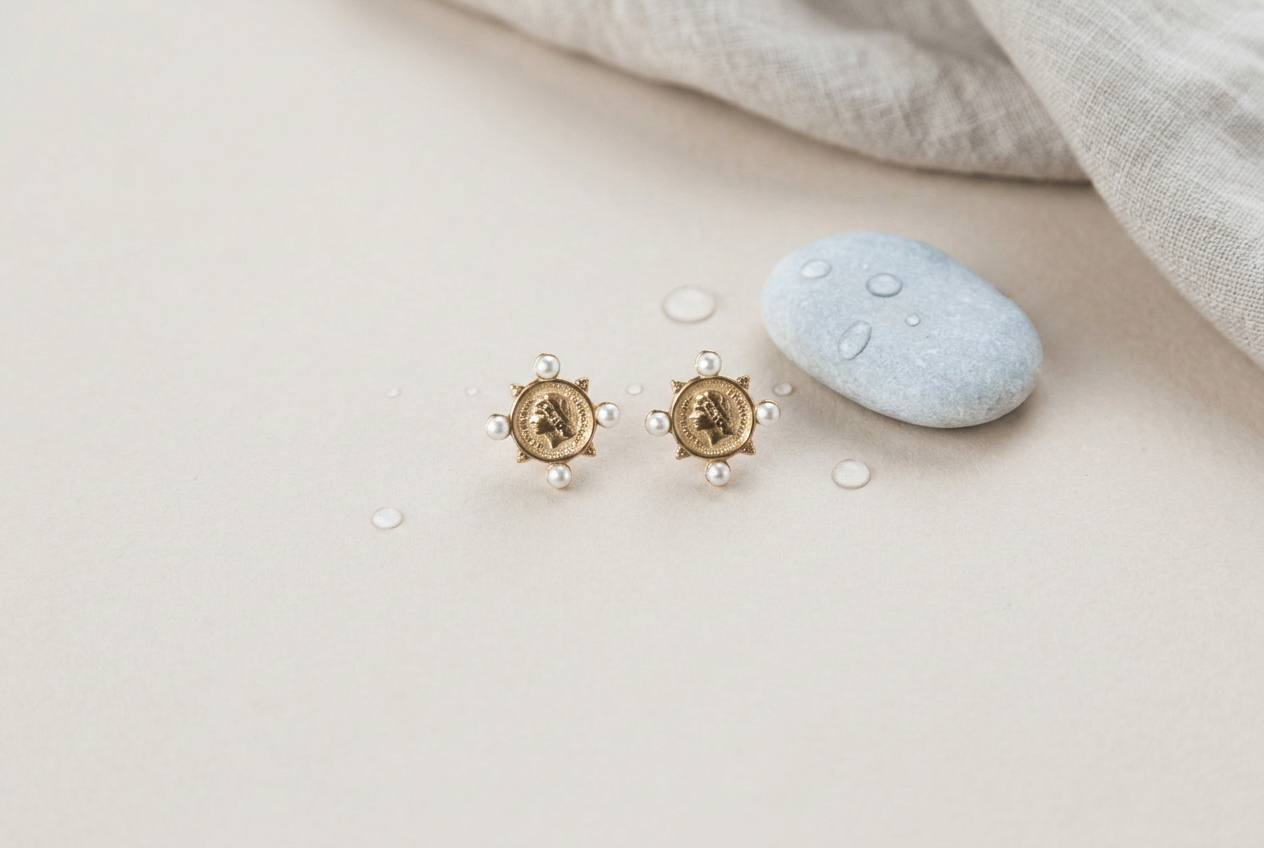
Royal Medallion Stud Earrings
A vintage Victorian-style stud with a detailed medallion portrait at the center and four small pearls placed delicately around it — heritage-inspired everyday studs.
Shop this pair →Honest caveats: answering the real objections
- Will it actually hold up, or tarnish like my last gold-plated set? Plating is a surface layer, so let's be straight: it resists tarnish for years, not forever. The difference between a pair that lasts and one that flakes in a month is the base metal and the finish quality. Meideya's studs are 18k-gold-plated over 316L stainless steel — the steel core is corrosion-resistant and built for shower, gym, and beach wear, which is why it outlasts brass-based costume jewelry. It won't turn your skin green (that's copper in brass, and there's no brass here). With normal care it keeps its look for a long time, but no plated finish is permanently indestructible — that's the honest line.
- Will it arrive tiny compared to the photos? Studs are genuinely small by design — that's the style, not a catfish. To set expectations: 4–5mm is a subtle everyday stud, 6–7mm is the most popular "noticeable but not bold" size, and 8mm+ starts to make a statement. Check the listed millimeter measurement and picture it against a pencil eraser (about 6mm) before you buy, so the scale is no surprise when the box arrives.
- Are there any hidden costs or subscriptions? No. Meideya is a one-time purchase — you pay once for the earrings and that's it. There's no membership, no auto-enrollment, and no recurring charge hiding in the checkout.
Ready to browse? Explore the full stainless steel earrings collection to compare studs side by side.
Frequently asked questions
What does "gold-plated" actually mean on a stud earring?
Under the FTC's jewelry guides (16 CFR Part 23), gold-plated means an item has an electroplated layer of at least 0.175 micron of 10-karat-or-higher gold over a base metal. It's a real gold surface, not solid gold — so longevity depends heavily on the base metal underneath. Gold-plating over corrosion-resistant 316L stainless steel holds up far better for daily wear than plating over cheap brass.
Will gold-plated stud earrings turn my skin green?
Not if the base metal is right. The green mark comes from copper, which is found in brass-based costume jewelry reacting with sweat and skin. Stainless steel does not cause it. Meideya studs are plated over 316L stainless steel, which contains no brass, so they won't leave a green stain.
Are stainless steel stud earrings safe for sensitive ears?
For most people, yes. 316L (surgical-grade) stainless steel releases very little nickel because the nickel is locked into the alloy, and clinical evidence shows it is a non-sensitizer for nearly all nickel-sensitive people. Nickel is the most common cause of jewelry-related contact dermatitis, so a low-release metal matters. If your nickel allergy is severe, choose a nickel-free metal like titanium or niobium instead.
What size stud earring should I get?
Pick the size for the role. 4–5mm studs are small and subtle for everyday wear; 6–7mm is the most popular size and reads as noticeable without being bold; 8–9mm and up start to make more of a statement. Most standard ear piercings take an 18-gauge (about 1mm) or 20-gauge (about 0.8mm) post. For a single do-everything pair, 6–7mm is the safest choice.
Is cubic zirconia good enough for stud earrings, or do I need a diamond?
For an everyday stud, cubic zirconia is more than good enough. CZ scores about 8.5 on the Mohs hardness scale versus 10 for diamond, so a diamond is harder and never clouds — but in a small stud viewed from conversational distance, well-cut CZ reads as sparkle to everyone but a jeweler with a loupe. CZ can micro-scratch and cloud over years of daily wear, so it suits studs you'll restyle over time rather than an heirloom you'll keep for decades.
The buying rule stays simple: judge a gold stud by the metal under the gold and the size for your daily routine, not by the karat number alone. See also our guides on 18k gold earrings and 14k gold hoop earrings.

Laat een reactie achter
Deze site wordt beschermd door hCaptcha en het privacybeleid en de servicevoorwaarden van hCaptcha zijn van toepassing.