

Dainty Jewelry: A Minimalist Style Guide
Dainty jewelry is delicate, lightweight, everyday jewelry — usually thin chains of about 1–2mm with small pendants or subtle sparkle — and the trick to wearing it well is restraint: a few fine pieces that layer cleanly beat one heavy statement. If you want a quiet-luxury look that goes with everything and disappears into your day, this guide covers what makes a piece "dainty," how to choose lengths that layer, the materials worth understanding before you buy, and the honest trade-offs — including where Meideya's waterproof 18k-gold-plated steel fits and where it doesn't.
Key takeaways
- Dainty = thin and light. Most dainty chains are 1–2mm wide; the goal is jewelry that whispers, not shouts. Keep layered necklaces to 2–3 pieces with 2–4 inches of length difference between them.
- Length decides the look. 16" sits at the collarbone, 18" is the universal everyday length, and 20–24" drops lower for layering — pick a stagger, not three of the same.
- Material is where the money goes. 18k-gold-plated 316L stainless steel gives you a real gold look that survives showers and gym sweat without the price of solid gold — but plating is a surface layer that wears over years, not forever. We're transparent about that.
- Quick pick. For one do-everything dainty piece, a fine 16–18" chain in waterproof 316L is the safest first buy; if you want a bit more presence, a slim curb chain reads minimalist while still catching the light.
What makes jewelry "dainty" — the decision criteria
"Dainty" isn't a single style so much as a set of proportions — pieces that add almost no visible weight (the word comes from an Old French root meaning delicately small and pretty). Here's what to look at before you buy:
- Chain width. The defining spec. Truly delicate chains run around 1mm or less; the broader "everyday dainty" range is roughly 1–2mm. At that width the chain nearly disappears and a small pendant looks like it's floating on the collarbone. Much thicker reads as a fashion or statement chain — still beautiful, just not "whisper-quiet."
- Scale of the focal point. Dainty pendants and stones are small by design — a petite solitaire, a tiny initial, a thin bar. If you want more presence, a slim curb or rope chain bridges delicate and statement.
- Length and layering math. Dainty pieces are made to stack: keep 2–4 inches of difference between layers so chains don't tangle, and a 2–3 piece maximum before the look tips from "curated" into "cluttered."
- Material and finish. This is where everyday wearability is won or lost. For jewelry you never take off, you want a corrosion-resistant base and an honest description of the finish (plated, filled, vermeil, or solid — they are not the same thing, and the difference is regulated; more below).
- Comfort and closures. Light pieces should feel like nothing. Look for a secure lobster or spring-ring clasp and, ideally, an extender so one necklace sits at two lengths.
Best for X — dainty picks by scenario
Different wearers want different things from a delicate piece:
- Best for everyday / "never take it off": a fine 16–18" chain in waterproof 316L stainless steel — it survives the shower, the gym, and the beach, so you stop thinking about it.
- Best for sensitive skin: 316L stainless steel. It releases very little nickel, one of the most common causes of allergic contact dermatitis (per the American Academy of Dermatology and Mayo Clinic) — a far safer bet than unmarked or brass costume pieces.
- Best for layering: a set built on a stagger — say 16", 18", and 20" — in matching tone, so the eye reads one cohesive look rather than three competing chains.
- Best for a little more presence (still minimalist): a slim curb chain. The flat, interlocking links catch light and read as quiet-luxury — a good "one good necklace" that dresses up a blazer or a tee.
- Best for a gift on a budget: a plated-steel piece — the look of gold for a fraction of solid-gold cost, with a one-time price.
Materials, honestly compared
The biggest buying mistake in dainty jewelry is treating every "gold" piece as equal. These terms are defined by the U.S. FTC (16 CFR Part 23), and the differences are real:
| Material / finish | What it actually is | Everyday durability | Typical price band |
|---|---|---|---|
| Solid gold (14k / 18k) | Gold throughout the piece. 14k is 58.3% pure gold, 18k is 75% pure. | Highest — the color is the metal, so it can't wear off. | Highest (hundreds to thousands) |
| Gold vermeil | Sterling silver base with at least 2.5 microns of gold plating (a regulated definition). | Good, but the base is softer silver and the gold layer can still wear over time. | Mid |
| Gold-filled | A bonded layer of at least 1/20 (5%) gold by weight, in 10k or higher. | Very good for plated-style jewelry; thicker layer than standard plating. | Mid |
| 18k-gold-plated 316L steel (Meideya) | A surface layer of 18k gold over corrosion-resistant 316L stainless steel. | Strong everyday wear; the steel base resists corrosion and slows tarnish. Plating is a surface layer and wears over years. | Affordable (often $30–$60) |
| Brass / costume "gold" | Often plated brass with no regulated thickness. | Lowest — copper in brass can turn skin green and the finish wears fast. | Lowest |
The takeaway: if you want the gold look for daily wear without a luxury budget, plated 316L wins on value and toughness — just go in knowing it's a finish, not solid metal. If you want an heirloom that never wears, that's solid gold's column. The FTC thresholds also matter: to be called "gold plate" a finish must be at least 0.175 micron of 10k-or-better gold, and "heavy gold electroplate" at least 2.5 microns — so "gold" with no description is a yellow flag.
A quick word on stones: CZ vs diamond
Dainty pieces often use cubic zirconia (CZ) for sparkle. CZ is lab-made zirconium dioxide — a genuinely pretty, affordable diamond alternative — but it isn't a diamond, and the difference shows up over years, not days. On the Mohs hardness scale CZ sits around 8.5, moissanite is 9.25, and diamond is the maximum at 10. Because it's softer, CZ can pick up micro-scratches and gradually cloud after a few years of hard daily wear, while a diamond essentially won't. For an everyday piece at an everyday price, CZ is a sensible choice — just don't expect it to be a forever stone. (If a piece uses real freshwater or cultured pearls, treat those gently — pearls are soft, roughly Mohs 2.5–4.5, and dislike perfume and chemicals.)

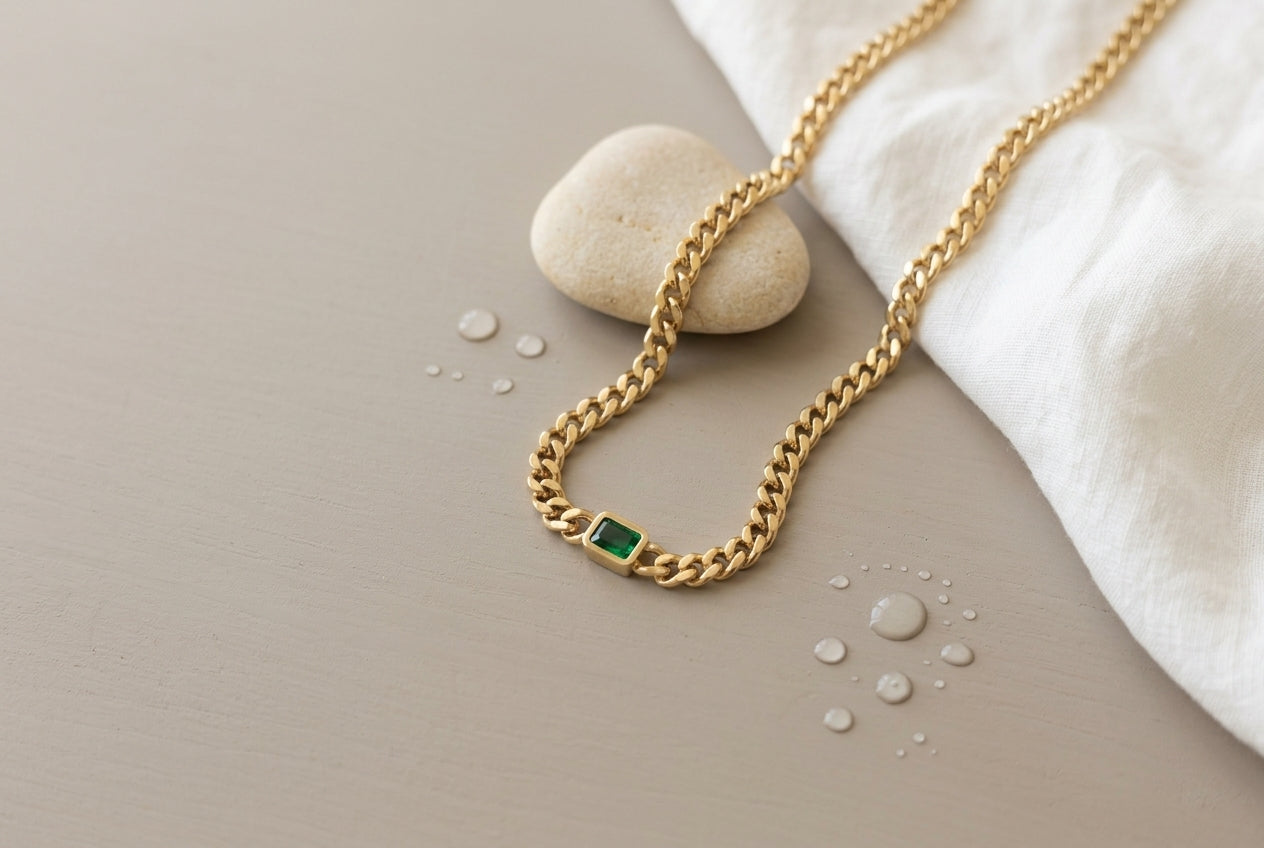
Emerald Gem Curb Chain Necklace
18k gold plated over a 316L stainless steel base, waterproof and tarnish resistant — a 5mm curb chain at 16"+2" extender that reads minimalist while still catching the light, whether you pair it with a blazer or a dress.
Shop this necklace →Honest caveats — the real objections
- Is it actually waterproof, or will it tarnish like my last gold-plated set? Meideya's pieces are built on 316L stainless steel, which is corrosion-resistant and rated waterproof and tarnish-resistant — you can shower, sweat, and swim in them. The honest part: the gold is a plated surface layer. The steel base slows tarnish dramatically and the finish holds up for years of daily wear, but no plating is permanent — over time, on high-contact spots, it can gradually thin. That's true of all plated jewelry. It's still a world apart from cheap brass that turns skin green (that green is copper in brass — stainless steel doesn't cause it).
- Will it arrive tiny compared to the photos? Dainty means small — that's the point — but we list real measurements so there are no surprises: the Emerald Gem necklace, for example, is a 5mm-wide curb chain at 16"+2", a bit more substantial than a 1mm "whisper" chain. Check the width in millimeters and the length in inches on each product page; a 16" chain sits at the collarbone, an 18" just below. If you're between lengths or plan to layer, size up.
- Any hidden subscription or recurring charge? No. Every Meideya piece is a one-time purchase at a one-time price — no auto-enrollment, no membership, no surprise renewal.
Ready to find your everyday piece? Browse the full stainless steel necklace collection to compare lengths and styles side by side.
Frequently asked questions
What counts as dainty jewelry?
Dainty jewelry is delicate, lightweight, everyday jewelry — typically thin chains around 1–2mm wide paired with small pendants or subtle sparkle. The defining feature is that it adds almost no visible weight, so it reads as understated and layers easily rather than making a bold statement.
What necklace length is best for a dainty look?
A 16-inch chain sits right at the collarbone, an 18-inch is the universal everyday length, and 20–24 inches drops lower and works well for layering. For a layered dainty look, stack 2–3 necklaces with at least 2–4 inches of difference between them so they don't tangle.
Is gold-plated dainty jewelry worth it, or should I buy solid gold?
For everyday wear without a luxury budget, 18k-gold-plated 316L stainless steel is excellent value — it gives a real gold look and resists corrosion and tarnish. The trade-off is that plating is a surface layer that can wear over years, whereas solid gold's color is the metal itself and never wears off. Choose plated for an affordable, durable daily piece; choose solid gold for a true heirloom.
Is dainty stainless steel jewelry safe for sensitive skin?
Yes, for most people. 316L stainless steel releases very little nickel — nickel being one of the most common causes of allergic contact dermatitis according to the American Academy of Dermatology and Mayo Clinic — which makes it one of the safer everyday choices. People with a severe, diagnosed nickel allergy should still patch-test or opt for a nickel-free metal.
Will cubic zirconia in a dainty piece last?
Cubic zirconia is a pretty, affordable diamond alternative at about 8.5 on the Mohs hardness scale, compared with 10 for diamond. Because it's softer, CZ can collect micro-scratches and gradually cloud after several years of hard daily wear. It's a great choice for an everyday-priced piece — just don't expect it to stay flawless forever the way a diamond would.
The rule that holds across every dainty buy: choose thin over thick, stagger your lengths, and read the material description before you read the price. See also our guides on dainty gold necklaces and dainty cross necklaces for women.


Laisser un commentaire
Ce site est protégé par hCaptcha, et la Politique de confidentialité et les Conditions de service de hCaptcha s’appliquent.