

Non-Tarnish Rings: The Everyday Wear Guide
A true non-tarnish everyday ring is one made from a corrosion-resistant base metal — 316L stainless steel is the most reliable affordable choice — so it survives showers, hand-washing, and the gym without turning your finger green or going dull. If you want a ring you can put on and forget about, the material matters far more than the look. This guide explains what "non-tarnish" actually means (and what it doesn't), how to pick a ring you'll never have to baby, and the honest trade-offs between stainless steel, plated finishes, and solid gold — so you buy once and wear it for years.
Key takeaways
- 316L stainless steel is the most corrosion-resistant affordable base metal — it resists tarnish, rust, and the green-finger reaction (that green is copper in brass, not stainless).
- "Non-tarnish" describes the base metal, not a magic coating. Gold plating is a thin surface layer that resists tarnish for years, but no plating lasts literally forever.
- Don't overpay for "solid gold" if you just want durable everyday shine — 18k-gold-plated 316L gives the look at a fraction of the price and shrugs off water.
- For most people, a stainless-steel stacking band or CZ set is the quick pick: waterproof, hypoallergenic, and one-time priced with no subscription.
What makes a ring genuinely non-tarnish
Tarnish is a chemical reaction between a metal's surface and air, moisture, sweat, or skincare. A ring is "non-tarnish" only if its base metal resists that reaction in the first place. Here is what actually decides it:
- The base metal is everything. 316L stainless steel is highly corrosion- and tarnish-resistant — its edge over cheaper steel comes from added molybdenum, which inhibits corrosion. That is why it holds up to daily water exposure where brass and cheap alloys fail.
- It should not turn your skin green. Green skin comes from copper, which is common in brass; 316L stainless steel does not cause it. If a past ring left a green mark, it was almost certainly a brass or copper-alloy piece, not stainless.
- Plating is a surface layer, not a force field. 18k gold plating over stainless steel resists tarnish for years and adds the warm gold tone, but it is a thin coating that can eventually wear at high-friction points. The steel underneath keeps it from rusting; the plating keeps the color.
- Hypoallergenic matters for daily wear. 316L is considered hypoallergenic because it releases very little nickel — nickel is one of the most common causes of allergic contact dermatitis per the American Academy of Dermatology and Mayo Clinic, so low release is the property you want against skin all day.
- Stones should be hard enough to live on your hands. Cubic zirconia (CZ) sits at about 8.5 on the Mohs hardness scale — hard enough for everyday wear, though over years of abrasion it can micro-scratch or cloud. Diamond is a 10 and moissanite 9.25, so they resist scratching longer, but at a very different price.
Best ring for your situation
"Non-tarnish" is the baseline; the right pick depends on how you live and what you want it to do.
- Best for true everyday wear: a plain or lightly textured 316L stainless-steel band. Nothing to snag, nothing to clean — wear it in the shower and forget it.
- Best for sensitive skin: 316L stainless steel, for its very low nickel release. Skip mystery alloys and anything that has turned your skin green before.
- Best for a little sparkle without diamond prices: a CZ ring or eternity set in 18k-gold-plated steel — the brilliance reads luxury, and it is waterproof.
- Best for stacking: thin stainless bands you can layer and re-arrange; matching finishes keep the stack cohesive and all of it stays water-safe.
- Best for a heirloom you'll pass down: solid gold with a real diamond — the only category that is genuinely permanent. If that is the goal, plating is the wrong tool. For everything short of an heirloom, plated steel wins on value.
Non-tarnish ring materials compared
The honest trade-off is durability and permanence versus price. Here is how the common everyday-ring options stack up on the specs that actually matter.
| Material | Best for | Key spec (verified) | Typical price |
|---|---|---|---|
| 316L stainless steel | Everyday, sensitive skin, water | Corrosion-resistant (molybdenum); very low nickel release; hypoallergenic | $ (most affordable) |
| 18k-gold-plated 316L steel | Gold look without solid-gold cost | Steel core won't rust; gold plating resists tarnish for years (surface layer, not permanent) | $–$$ |
| Gold-filled | A thicker gold layer than plating | FTC: ≥1/20 (5%) of weight in ≥10k gold | $$ |
| Solid 14k / 18k gold | Heirloom, permanent | 14k = 58.3% pure gold; 18k = 75% pure; will not tarnish | $$$$ |
For an everyday ring you don't want to think about, the first two rows win on value: stainless steel for pure utility, 18k-gold-plated steel when you want the warm tone. Reach for solid gold only when permanence — not just non-tarnish performance — is the actual goal.

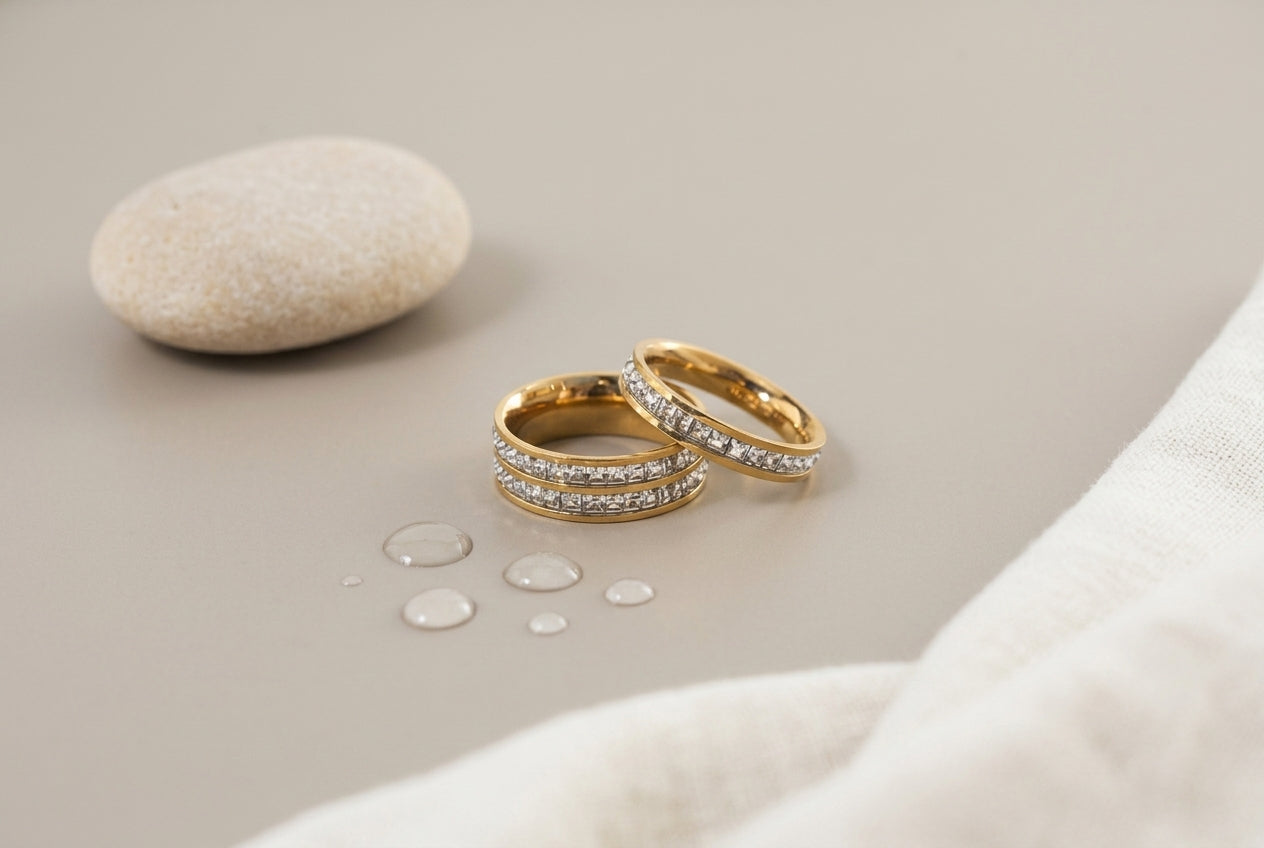
Eden CZ Eternity Ring Set
Two gold bands lined with brilliant cubic zirconia stones — perfect for stacking or wearing separately for a refined, timeless look.
Shop this ring set →Honest caveats — your real objections, answered
- Will it actually stay non-tarnish, or dull out like my last gold-plated ring? The difference is the base metal. Cheap "gold" rings that go dull or turn skin green are usually brass underneath, so once the thin plating wears the base reacts fast. Meideya plates over 316L stainless steel, which is corrosion-resistant on its own — so the steel never rusts, and the 18k plating holds its color for years of normal wear. It is still a surface layer, so high-friction edges can soften over a long time; that is physics, not a defect.
- Will it arrive looking like the photo? Rings are the one piece where scale is predictable — it is set by your ring size, not styling. The honest variable is width: wide bands fit more snugly than thin ones, so it is common to size up about half a size from your usual fit once a band is roughly 5 mm or wider. Measure for the specific style rather than assuming one size fits every ring.
- Any hidden costs or subscription? No. Every Meideya ring is a one-time purchase — no membership, no auto-enrollment, no recurring charge. You pay once and the ring is yours.
Ready to find one you'll never have to baby? Browse the full stainless-steel rings collection.
Frequently asked questions
What is the most non-tarnish metal for an everyday ring?
For an affordable everyday ring, 316L stainless steel is the most reliable non-tarnish choice. It is highly corrosion-resistant thanks to added molybdenum, releases very little nickel so it is hypoallergenic, and does not cause the green-finger reaction. For a gold look that still survives water, 18k gold plating over a 316L steel core gives the color while the steel keeps it from rusting. The only truly permanent option is solid gold, but that costs far more.
Will gold-plated stainless steel tarnish over time?
Gold plating is a thin surface layer that resists tarnish for years, but it is not literally permanent. Over a long period of daily wear, high-friction spots can gradually soften in color. The key advantage of plating over 316L stainless steel is that the base metal underneath is itself corrosion-resistant — so even as the plating ages, the ring will not rust or turn your skin green the way a brass-based ring would.
Why do some rings turn my finger green, and will stainless steel do that?
Green skin is caused by copper, which is common in brass alloys, reacting with moisture and skin acids. 316L stainless steel does not contain the copper that causes this, so it does not turn your finger green. If a past ring left a green mark, it was almost certainly a brass or copper-alloy piece rather than stainless steel.
Is cubic zirconia durable enough for an everyday ring?
Yes, for everyday wear. Cubic zirconia rates about 8.5 on the Mohs hardness scale, which is hard enough to handle daily life. Over several years of abrasion it can develop tiny surface scratches or slight cloudiness, since it is softer than diamond (Mohs 10) and moissanite (Mohs 9.25). For an affordable, sparkly ring you wear often, CZ is a sensible choice; for a once-in-a-lifetime piece, a harder stone lasts longer.
Do I need to size up for a wide non-tarnish band?
Often, yes. Wide bands cover more of your finger and create more friction, so they fit more snugly than thin ones. A common rule is to size up about half a size from your usual fit once a band is roughly 5 mm or wider, and possibly a bit more for very wide bands. Always size for the specific ring style rather than assuming your standard size fits every width.
The buying rule is simple: choose the base metal first. Pick 316L stainless steel — plain or 18k-gold-plated — and you get a ring that stays non-tarnish, hypoallergenic, and waterproof without any upkeep, at a one-time price. For more on bolder styles and getting the fit right, see our chunky ring style and buyer's guide.

Laisser un commentaire
Ce site est protégé par hCaptcha, et la Politique de confidentialité et les Conditions de service de hCaptcha s’appliquent.